RQ-5 Hunter
Israeli-designed short-range tactical unmanned aerial vehicle, introduced in the mid-1990s, used for aerial reconnaissance, surveillance, and light precision strike operations. Key figures: top speed 170 km/h, range 125 km, service ceiling 5,500 m, max takeoff weight 885 kg, built 20.
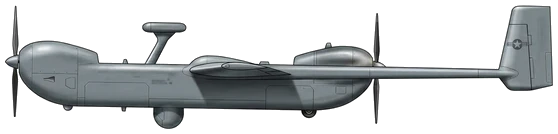
| Length | 7.0 m (23.0 ft) |
| Wingspan | 10.6 m (34.7 ft) |
| Height | 1.9 m (6.2 ft) |
| Max. takeoff weight | 885 kg (1,951 lbs) |
| Powerplant | 2 × Mercedes HFE Diesel 42 kW each |
| Maximum speed | 170 km/h (106 mph) |
| Operational range | 125 km (78 mi) |
| Endurance | 21 hours |
| Service ceiling | 5,500 m (18,045 ft) |
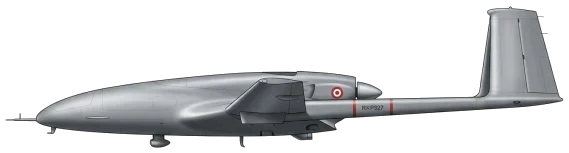
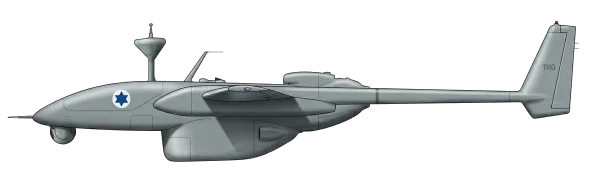
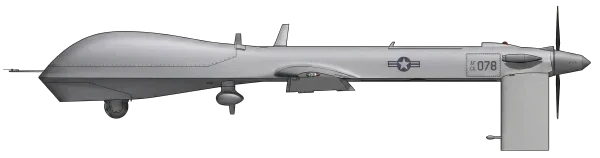
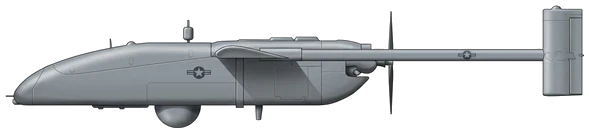
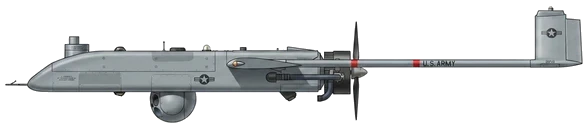
Description
The IAI RQ-5 Hunter is an unmanned aerial vehicle (UAV) developed by Israel Aerospace Industries, originally acquired to serve as the United States Army's Short Range UAV system. System acquisition and training began in 1994, though production was cancelled in 1996 due to program mismanagement concerns. The U.S. Army initially acquired seven low rate initial production (LRIP) systems of eight aircraft each. Following operational use in Kosovo, production resumed with technical improvements.
Design
The RQ-5 features conventional runway takeoff and landing using arresting gear. Power is provided by two twin Mercedes HFE Diesel inline three-cylinder engines, each producing 42 kW (56 hp). The aircraft has a wingspan of 10.57 meters, a maximum takeoff weight of 885 kg, and a payload capacity of 90 kg. For reconnaissance, it utilizes a gimbaled EO/IR sensor that transmits real-time video via a second airborne Hunter over a C-band line-of-sight data link. The platform features a relay mode that allows one aircraft to control another to extend range or overcome terrain obstacles.
Armament
While primarily a reconnaissance platform, the system can be armed with the Northrop Grumman GBU-44/B Viper Strike weapon system.
Operational History
The U.S. Army first equipped A Company, 15th Military Intelligence Battalion with the Hunter in 1995. The system deployed to Macedonia in March 1999 for NATO operations in Kosovo, where seven aircraft were lost, including one shot down by a Yugoslav Mil Mi-8 helicopter. Hunters later deployed to Iraq in 2003 and subsequently to Afghanistan, accumulating over 110,000 flight hours by 2011. In 2004, the U.S. Department of Homeland Security utilized the Hunter for border patrol trials, recording 329 flight hours and 556 detections. The U.S. Army retired the aircraft from active service in December 2015, transferring remaining assets to government-owned, contractor-operated units. Internationally, the Belgian Air Component operated 13 B-Hunter aircraft from 2004 until their withdrawal in August 2020, while the Philippine Air Force is also an operator.
Variants
- MQ-5A/B: An armed variant of the system equipped with the Northrop Grumman GBU-44/B Viper Strike weapon system.
- B-Hunter: A variant purchased and operated by the Belgian Air Component between 1998 and 2020.
Frequently Asked Questions
What type of aircraft is the RQ-5 Hunter?
What is the maximum speed of the RQ-5 Hunter?
What is the range of the RQ-5 Hunter?
How many RQ-5 Hunter have been built?
Which countries operate the RQ-5 Hunter?
What is the service ceiling of the RQ-5 Hunter?
- JUL 232026 Updated Sources and cross-references refreshed
- JUL 12026 Created Page created: RQ-5 Hunter