Su-11 Fishpot
Soviet interceptor aircraft, developed in the early 1960s, used for high-altitude air defense during the Cold War. Key figures: top speed 2,340 km/h, range 1,125 km, service ceiling 18,000 m, max takeoff weight 13,986 kg, built 108.
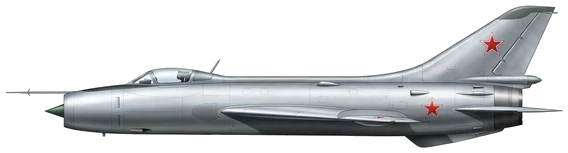
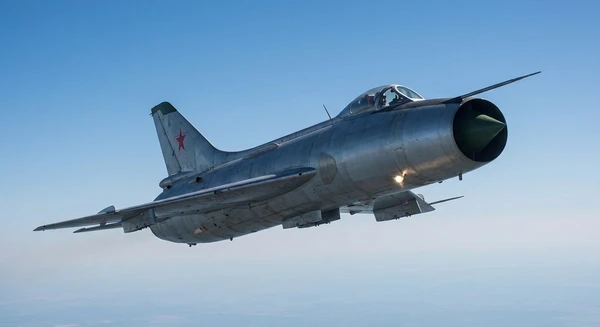
| Crew | 1 |
| Length | 18.2 m (59.8 ft) |
| Wingspan | 8.5 m (28.0 ft) |
| Height | 4.7 m (15.4 ft) |
| Wing area | 34 m² (366.0 sqft) |
| Empty weight | 8,562 kg (18,876 lbs) |
| Max. takeoff weight | 13,986 kg (30,834 lbs) |
| Powerplant | 1 × Lyulka AL-7F-2 99 kN each |
| Maximum speed | 2340 km/h (Mach 2.2) |
| Operational range | 1,125 km (699 mi) |
| Endurance | 1 hours |
| Service ceiling | 18,000 m (59,055 ft) |
| Climb rate | 136.7 m/s (448.5 ft/s) |
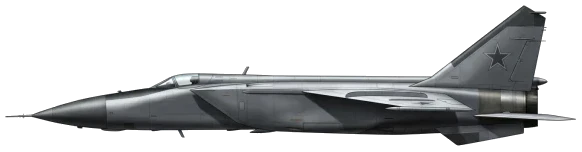
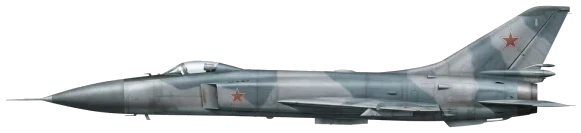
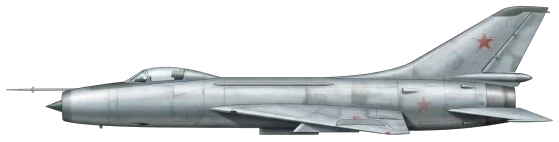
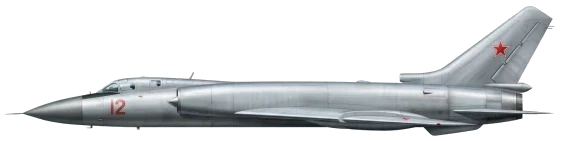
Description
The Sukhoi Su-11 (NATO reporting name: Fishpot-C) was a Soviet interceptor developed as an upgraded version of the Su-9. Designed in parallel with the Su-7 fighter-bomber, the aircraft first flew as the T-47 prototype in December 1958. Production of the definitive Su-11-8M variant took place between 1962 and 1965, with approximately 108 aircraft delivered. Some existing Su-9 airframes were also upgraded to the Su-11 configuration.
Design
The Su-11 utilized a delta wing, swept tailplanes, and a cigar-shaped fuselage with a circular nose intake. It featured a lengthened nose to accommodate the Oryol (NATO reporting name: Skip Spin) radar set. Power was provided by a Lyulka AL-7F-1 turbojet engine, which produced 9.8 kN more afterburning thrust than the engine used in the Su-9. The Su-11 is distinguished from the Su-9 by external fuel pipes located on the upper fuselage aft of the cockpit. Despite its updated radar, the aircraft lacked the capability to engage low-flying targets and remained dependent on ground control interception (GCI) to vector onto targets.
Armament
Armament consisted of two R-98 (AA-3 'Anab') air-to-air missiles. These were typically deployed as a pair featuring one R-98MR semi-active radar homing missile and one R-98MT infrared-guided missile. The Su-11 did not carry an internal cannon.
Operational History
Developmental issues and accidents delayed the introduction of the Su-11 into the Soviet Air Force (VVS) and Soviet Air Defence Forces (PVO) until 1964. The aircraft saw limited production and was eventually superseded by the Su-15. The Su-11 remained in front-line service until approximately 1983, with some examples operational into the early 1980s.
Variants
- Su-11-8M: The definitive production version of the interceptor.
- Su-11U: A conversion trainer variant featuring a second seat, full armament, and radar systems, though it possessed reduced fuel capacity and was not intended for combat.
Frequently Asked Questions
What type of aircraft is the Su-11 Fishpot?
What is the maximum speed of the Su-11 Fishpot?
What is the range of the Su-11 Fishpot?
When did the Su-11 Fishpot first fly?
How many Su-11 Fishpot have been built?
Which countries operate the Su-11 Fishpot?
What is the service ceiling of the Su-11 Fishpot?
- AUG 132026 Updated First-flight date in the body aligned with the specification, the sources giving two different years
- AUG 132026 Updated First flight corrected to the Su-11 maiden flight
- AUG 122026 Updated Range corrected to the ferry range
- MAY 102026 Created Page created: Su-11 Fishpot