Su-15 Flagon
Soviet high-altitude interceptor and the backbone of Soviet air defence from the 1960s to the 1980s, never exported, best known for shooting down Korean Air Lines Flight 007 in 1983. Key figures: top speed 2,230 km/h, range 1,700 km, service ceiling 18,100 m, max takeoff weight 17,900 kg, unit price $4M, built 1,290.
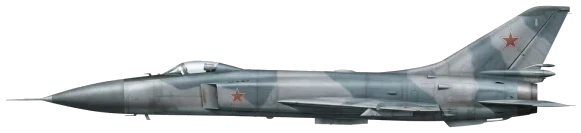
| Crew | 1 |
| Length | 19.6 m (64.2 ft) |
| Wingspan | 9.4 m (30.9 ft) |
| Height | 4.8 m (15.9 ft) |
| Wing area | 36.6 m² (394.0 sqft) |
| Empty weight | 10,760 kg (23,722 lbs) |
| Max. takeoff weight | 17,900 kg (39,463 lbs) |
| Powerplant | 2 × turbojets Tumansky R-13F-300 7,138 kgf each |
| Ejection seat | Severin KS-4 |
| Maximum speed | 2230 km/h (Mach 2.1) |
| Operational range | 1,700 km (1,056 mi) |
| Service ceiling | 18,100 m (59,383 ft) |
| Climb rate | 228.0 m/s (748.0 ft/s) |
- Air-to-Air Medium-Range Bisnovat R-98 (AA-3 Anab)
- Air-to-Air Short-Range Vympel R-60 / K-60 (AA-8 Aphid)
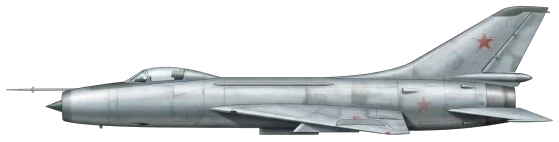
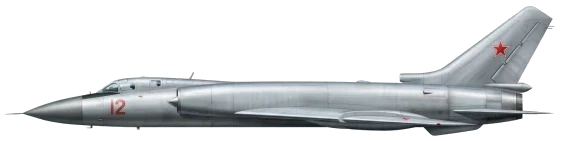
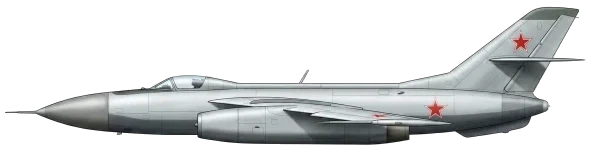
Description
The Sukhoi Su-15 is a Soviet twin-engine supersonic interceptor, known to NATO as Flagon and designated T-58 as a prototype. It was developed to replace the Su-9 and Su-11 in the Soviet Air Defence Forces, first flew on 30 May 1962, and was accepted for service in April 1965. Novosibirsk built 1,290 aircraft between 1965 and 1979. Optimised for high-altitude interception under ground control, the Su-15 formed the backbone of the V-PVO from the late 1960s into the 1980s and was never exported, not even to Warsaw Pact members. Outside the Soviet Union it is known for a series of engagements with foreign aircraft that entered Soviet airspace, including the destruction of Korean Air Lines Flight 007 in 1983.
Development
The Su-9 and Su-11 were reaching their limits against the Boeing B-52, both in radar performance and in the aircraft themselves, and the Sukhoi OKB began work on a more capable successor. Two testbeds led the way. The T-49 kept the Su-9 fuselage and its single engine but moved the air intakes to the fuselage sides, freeing the nose for a large radome housing the RP-22 Oryol-D radar, known to NATO as Skip Spin. A second testbed, a heavily modified Su-11, carried two Tumansky R-11 engines in a widened rear fuselage. The T-58 combined both ideas: twin engines with a version of the T-49 nose, the side inlets moved further aft, behind the cockpit.
Khrushchev had forbidden the development of new aircraft types and allowed only the modernisation of existing ones, so the design was presented as an upgrade of the Su-11 interception complex rather than as a new aircraft. It was approved for production on 5 February 1962 and the prototype flew on 30 May 1962. Service testing began on 5 August 1963. Entry into service was held up by a dispute with the Yakovlev OKB over production capacity at Novosibirsk, which was also building the Yak-28P; the Su-15 proved superior in most respects other than range, a shortfall later corrected by increasing internal fuel. The aircraft was accepted into Air Defence Forces service in April 1965 as part of the Su-15-98 interception complex. Series production began at Novosibirsk in 1966 under the factory index izdeliye 37, the first pre-series machine being flown in March 1966 by factory test pilot I. F. Sorokin, and operational regiments started replacing Su-9s, Su-11s and Yak-25s in 1967. The type was shown publicly at the Domodedovo air parade in July 1967.
Development continued through the production run. The original delta wing gave poor takeoff and landing behaviour, so Sukhoi adopted a wing with extended tips, greater area and boundary layer control; aircraft with the new wing entered production in 1969 and were called Flagon-D by NATO, although the Soviet designation did not change. Testing of the Su-15T with the Volkov Taifun radar, derived from the MiG-25's RP-25 Smerch-A, began the same year, but the radar proved troublesome and only ten aircraft were completed. The Su-15TM followed in December 1971 with the improved Taifun-M, and aerodynamic requirements forced an ogival redesign of the radome that earned the reporting name Flagon-F. A total of 450 Su-15TM were built between 1971 and 1975, and the last aircraft of all, Su-15UM trainers, left the line in 1979. Proposals for further upgrades with better engines and revised aerodynamics, intended to meet a VVS requirement for a long-range tactical fighter, were rejected in favour of the MiG-23.
Design
The Su-15 is an all-metal mid-wing aircraft of conventional layout. The primary structure is aluminium alloy, with alloyed steels at the heavily loaded joints and titanium in the parts of the rear fuselage exposed to engine heat. The fuselage is built in two sections, the rear one detachable so an engine can be repaired or replaced. The nose bay carries the radar under a dielectric cone, behind it the cockpit, with an equipment bay and the nose gear well underneath. The canopy consists of a fixed windscreen with an armoured block and a sliding heat-resistant section.
Many components were carried over from the Su-9 and Su-11, including Sukhoi's rear-fuselage airbrake, but the Su-15 abandoned the shock-cone nose intake in favour of side-mounted intake ramps with splitter plates feeding two turbojets, initially the Tumansky R-11F2S-300 and later the R-13F-300. That change is what freed the nose for a large search radar. Early Flagon-A aircraft had a pure delta wing like their predecessors; from the eleventh production series this gave way to a double-delta of greater span and area, with a small fence above each outer pylon and blown flaps to improve the landing case, accompanied by a tailplane of increased anhedral and a shorter fin.
The aircraft climbs at 228 m/s, the parameter that mattered most in the interception role. Takeoff and landing speeds are high: 395 km/h on the early delta-winged Flagon-A and 370 km/h on the larger-winged Flagon-F. The controls are responsive and precise, but the aircraft is unforgiving of pilot error.
Like most Soviet interceptors before the late 1980s, the Su-15 depended on ground-controlled interception, with aircraft vectored onto their targets by ground radar stations. It was designed against targets flying between 500 and 3,000 km/h at altitudes from 500 to 23,000 m. Early aircraft used the Lazur-S datalink, which passed steering instructions to the pilot. The Su-15TM received the Vozdukh-1M datalink and the SAU-58 automatic control system, which could fly a complete hands-off interception until the closing moments. The Taifun-M radar of the Su-15TM was optimised for resistance to jamming rather than for range, detecting high-flying targets at 70 km and locking them at 45 km; against low-flying targets those figures fell to 15 and 10 km. The Su-15 had no look-down, shoot-down capability at any point in its career, which is the shortcoming that eventually cost it its place.
Armament
The primary weapon was the R-8, later designated R-98, known to NATO as AA-3 Anab. Early aircraft carried two, while Flagon-D and later versions carried four. The missile was produced in infrared and semi-active radar homing versions, and standard practice was to fire them in pairs, one of each type, to maximise the chance of a hit. The infrared round was launched first so that it could not lock onto the radar-homing missile ahead of it.
Later Flagon-F aircraft typically carried two R-98s together with one or two pairs of short-range R-60 (AA-8 Aphid) missiles. The Su-15TM has six hardpoints and an external capacity of 1,500 kg, which could also take UB-16 pods for S-5 rockets or FAB-500 bombs, although ground attack was never its role. The aircraft has no built-in gun; late Flagons instead carried a pair of UPK-23-250 pods on the fuselage pylons, each housing a twin-barrel 23 mm GSh-23L cannon.
Operational History
The Su-15 was assigned the targets the V-PVO considered tractable, the B-52, the U-2 and the British V bombers, while the faster MiG-25P was held for the XB-70 and B-58. In the standard profile the interceptor flew under autopilot on datalinked ground commands and turned on its radar only as it closed, using the set's power to burn through jamming and provide firing parameters for the radar-homing missiles; the infrared rounds and any gun pods were the fallback. Its arrival, roughly coinciding with the widespread deployment of the SA-2, pushed the USAF and the RAF towards low-level penetration, a regime the Su-15 could not cover.
The type was involved in several engagements with aircraft that crossed into Soviet airspace. In April 1978 Korean Air Lines Flight 902, a Boeing 707, strayed over the Kola Peninsula and was hit by a missile fired from a PVO Su-15; the airliner survived, two passengers were killed, and the damaged aircraft made a forced landing on a frozen lake. On 18 July 1981 a Su-15 operating from a base in Georgia collided with a Canadair CL-44 of the Argentinian operator Transporte Aéreo Rioplatense that had crossed the border over Armenia, killing the three Argentinians and the Briton aboard; the CL-44 was reportedly carrying Israeli weapons bound for Iran. Some analysts judged the collision accidental, while the Soviet pilot stated he had rammed the aircraft deliberately.
On 1 September 1983 a Su-15TM based on Sakhalin, flown by Gennadi Osipovich, fired on Korean Air Lines Flight 007 near Moneron Island after the Boeing 747 entered restricted Soviet airspace. A direct hit disabled the airliner's control surfaces and it crashed into the Sea of Japan, killing all 246 passengers and 23 crew. The incident drew condemnation from the United States and remains the engagement the aircraft is most associated with.
The Su-15 was also credited with destroying five reconnaissance balloons launched over Soviet territory by Sweden in 1975. On 3 September 1990 an Su-15TM shot down a CIA blimp with its 23 mm gun pods, the last aerial victory recorded by the Soviet Air Force before the dissolution of the Union.
Despite the number built, the Su-15 was never exported, its systems being considered too sensitive to release even to Warsaw Pact air forces. Aircraft reported in Egypt in 1972 were flown by Soviet crews. A proposal to use the type as a strike fighter was dropped, the design being too specialised for the role. As NATO shifted to low-level penetration the MiG-23P, which did have look-down, shoot-down capability, became the preferred V-PVO asset, though it never wholly displaced the Su-15 before both gave way to newer designs. Many Su-15TM and Su-15UM were withdrawn well before the end of their airframe life under arms limitation reductions. Russia retired the type abruptly in 1994 to comply with the Treaty on Conventional Armed Forces in Europe, scrapping most in favour of the Su-27 and MiG-31 while holding some in reserve storage. Ukraine withdrew its last aircraft, at Kramatorsk and Belbek, in 1996.
Variants
- Su-15 (Flagon-A): First production version, with a pure delta wing, RP-22 Oryol-D radar and Tumansky R-11F2S-300 engines.
- T-58VD (Flagon-B): One-off prototype with three Kolesov lift jets in the centre fuselage for short takeoff and landing trials; not mass-produced.
- Su-15UT (Flagon-C): Two-seat conversion trainer without radar or combat capability, in service from 1970.
- Su-15 (Flagon-D): Production aircraft from 1969 with extended wingtips, increased wing area and blown flaps; the Soviet designation was unchanged.
- Su-15T (Flagon-E): Version with the Volkov Taifun radar, abandoned after ten aircraft when the radar proved unsatisfactory.
- Su-15TM (Flagon-F): Main late-production version with Taifun-M radar, an ogival radome, R-13F-300 engines and provision for R-60 missiles and UPK-23-250 gun pods; 450 built from 1971 to 1975.
- Su-15UM (Flagon-G): Trainer derived from the Su-15TM, without radar but retaining combat capability, built between 1976 and 1979 and the last Su-15 variant in production.
Frequently Asked Questions
What type of aircraft is the Su-15 Flagon?
What is the maximum speed of the Su-15 Flagon?
What is the range of the Su-15 Flagon?
When did the Su-15 Flagon first fly?
How many Su-15 Flagon have been built?
Which countries operate the Su-15 Flagon?
How much does a Su-15 Flagon cost?
What is the service ceiling of the Su-15 Flagon?
- AUG 122026 Updated Range corrected to the ferry range
- AUG 52026 Updated Thrust updated
- JUL 282026 Updated Description, service entry year and 14 more fields updated
- JUL 232026 Updated Sources and cross-references refreshed
- JUN 262026 Updated Missiles updated
- APR 72026 Updated Sources and cross-references refreshed
- APR 52026 Updated Ejection seat added