Su-7 Fitter
Soviet fighter-bomber, renowned for Cold War service, extensively deployed in the Indo-Pakistani and Arab-Israeli conflicts. Key figures: top speed 2,150 km/h, range 1,650 km, service ceiling 17,600 m, max takeoff weight 15,210 kg, unit price $3M, built 1,847. In service with 1 air force as of 2026 — North Korea (18).
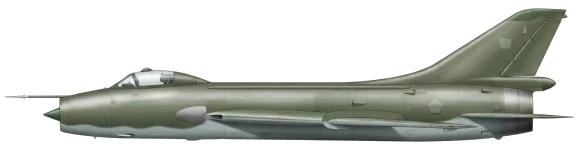
| Crew | 1 |
| Length | 16.6 m (54.5 ft) |
| Wingspan | 9.3 m (30.5 ft) |
| Height | 5.0 m (16.4 ft) |
| Wing area | 34 m² (366.0 sqft) |
| Empty weight | 8,937 kg (19,703 lbs) |
| Max. takeoff weight | 15,210 kg (33,532 lbs) |
| Powerplant | 1 × turbojet Lyulka AL-7F-1 9,596 kgf each |
| Ejection seat | Severin KS-4 |
| Maximum speed | 2150 km/h (Mach 2.0) |
| Operational range | 1,650 km (1,025 mi) |
| Service ceiling | 17,600 m (57,743 ft) |
| Climb rate | 160.0 m/s (524.9 ft/s) |
| Takeoff distance | 950 m (3,117 ft) |

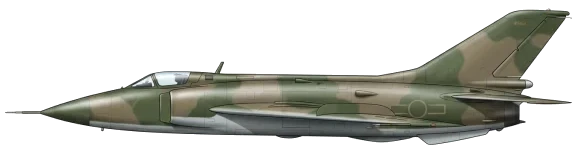
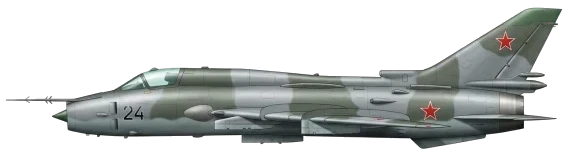
Description
The Sukhoi Su-7 (NATO reporting name: Fitter-A) is a swept-wing supersonic fighter-bomber developed in the Soviet Union by the Sukhoi OKB. Originally conceived as a low-altitude tactical fighter, it failed in that role but gave rise to the Su-7B series, the principal Soviet ground-attack aircraft of the 1960s. Entering service in 1959, it is known for its ruggedness, its ease of maintenance and for the excessive fuel consumption of its Lyulka AL-7 engine, which required drop tanks to be carried on two hardpoints even on short missions.
Development
After Stalin's death, the Sukhoi OKB was reopened and began work on a swept-wing frontline fighter. The first prototype, designated S-1, made its maiden flight on 7 September 1955 with A. G. Kochetkov at the controls. Fitted with an afterburning version of the AL-7 after eleven flights, it set a Soviet speed record of 2,170 km/h (Mach 2.04) in April 1956. The S-1 was destroyed on 23 November 1956, killing its pilot I. N. Sokolov. On 31 July 1958, Soviet tactical aviation tasked Sukhoi with developing a ground-attack variant to replace the abandoned Ilyushin Il-40; the S-22 prototype flew in March 1959 and entered service in 1961 under the designation Su-7B. In 1961-1962, Sukhoi tested blown flaps on the S-25 without follow-up, while the JATO rockets trialled on the S-22-4 were adopted on the Su-7BKL. This work led to the variable-geometry Su-17. In all, 1,847 examples were built, 691 of them exported.
Design
The S-1 was the first Soviet aircraft to combine an all-moving tailplane with a movable intake cone regulating airflow at supersonic speeds. Wing sweep was 60°, with irreversible hydraulic controls and a Sukhoi-designed ejection seat. The Su-7BKL was powered by a Lyulka AL-7F-1 of 66.6 kN dry and 94.1 kN with afterburner, for a speed of 2,150 km/h at altitude and a ceiling of 17,600 m. The landing speed of 340-360 km/h, poor visibility from the cockpit and the absence of an instrument landing system complicated operations.
Armament
Fixed armament comprised two 30 mm Nudelman-Rikhter NR-30 cannon with 70 rounds per gun. Four underwing and two underfuselage hardpoints allowed 2,000 kg of stores to be carried, two of them reserved for 2,300-litre tanks. Stores included UB-16-57U pods for S-5 rockets, FAB-250 and FAB-500 bombs, and the 8U69 nuclear bomb from the Su-7BM onwards.
Operational History
Egypt committed the Su-7 in the 1967 Six-Day War, the War of Attrition and the Yom Kippur War. India acquired 140 aircraft in 1967 for 100 million dollars; six squadrons flew nearly 1,500 offensive sorties during the 1971 Indo-Pakistani War, with a rate reaching six sorties per pilot per day. Fourteen to nineteen Su-7s were lost, mainly to anti-aircraft fire. Indian Su-7BMKs shot down at least two Shenyang F-6s. Syria received 25 aircraft in 1968 and fielded about 80 Fitter-As in 1973, suffering heavy losses before a compensatory delivery of 35 examples. Other users: Czechoslovakia (first foreign customer in 1963), Poland, Iraq, Algeria, Afghanistan and North Korea. Soviet Su-7s were replaced by Su-17s and MiG-27s between 1977 and 1986.
Variants
- Su-7A: first production version, air superiority fighter, 132 examples built between 1957 and 1960 and retired in 1965.
- Su-7B: first ground-attack version, factory designation S-22, 431 examples produced from 1960 to 1962.
- Su-7BM: AL-7F-1 engine, wing tanks, "wet" hardpoints and tactical nuclear delivery capability, 290 built from 1963 to 1965.
- Su-7BKL: rough-field version with skids on the main undercarriage, two SPRD-110 JATO rockets and twin brake parachutes, 267 examples from 1965 to 1972.
- Su-7U (Moujik): two-seat trainer with reduced fuel capacity, first flight on 25 October 1965, exported as the Su-7UMK; 411 two-seaters in total.
Frequently Asked Questions
What type of aircraft is the Su-7 Fitter?
What is the maximum speed of the Su-7 Fitter?
What is the range of the Su-7 Fitter?
When did the Su-7 Fitter first fly?
How many Su-7 Fitter have been built?
Which countries operate the Su-7 Fitter?
How much does a Su-7 Fitter cost?
What is the service ceiling of the Su-7 Fitter?
- AUG 302026 Updated Description updated
- AUG 52026 Updated Powerplant and thrust updated
- JUL 232026 Updated Sources and cross-references refreshed
- APR 72026 Updated Sources and cross-references refreshed
- JAN 122026 Updated Range updated in a site-wide editorial pass