T-25 Universal
Brazilian propeller-driven basic trainer and ground attack aircraft, developed in the 1960s and utilized for primary military pilot training and counter-insurgency operations. Key figures: top speed 300 km/h, range 1,500 km, service ceiling 6,100 m, max takeoff weight 1,700 kg, built 189. In service with 1 air force as of 2026 — Brazil (38).
| Crew | 2–3 |
| Length | 8.6 m (28.2 ft) |
| Wingspan | 11 m (36.1 ft) |
| Height | 3 m (9.8 ft) |
| Wing area | 17.2 m² (185.1 sqft) |
| Empty weight | 1,150 kg (2,535 lbs) |
| Max. takeoff weight | 1,700 kg (3,748 lbs) |
| Powerplant | 1 × Lycoming IO-540-K1D5 220 kW each |
| Maximum speed | 300 km/h (186 mph) |
| Operational range | 1,500 km (932 mi) |
| Service ceiling | 6,100 m (20,013 ft) |
| Climb rate | 6.66 m/s (21.9 ft/s) |

- Gun Pod 7.62 mm machine gun pod
Description
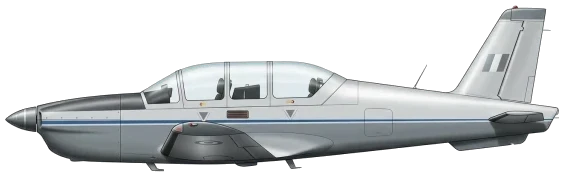
The Neiva T-25 Universal (company designation N621) is a Brazilian single-engine, propeller-driven basic trainer and light ground-attack aircraft built by Indústria Aeronáutica Neiva. Ordered by the Brazilian Air Force as a replacement for the T-6 Texan and Fokker S-11/S-12, it entered service from the late 1960s and remains in use as a primary and basic trainer at the Academia da Força Aérea Brasileira.
Development
Joseph Kovács designed the Universal in 1963 to meet a Brazilian Air Force requirement for a new primary trainer. The prototype, registered PP-ZTW, first flew on 29 April 1966. The Brazilian Air Force ordered 150 aircraft under the designation T-25 Universal and placed a follow-on order for a further 28 in 1978. A developed version, the YT-25B Universal II, first flew on 22 October 1978 but did not reach production.
Design
The Universal is a cantilever low-wing monoplane of all-metal construction with retractable undercarriage and side-by-side seating for a crew of two to three. The wing uses a NACA 632A315 airfoil at the root and NACA 631212 at the tip, with an area of 17.20 m² and an aspect ratio of 7.1:1. Length is 8.60 m, wingspan 11.00 m and height 3.00 m; empty weight is 1,150 kg and maximum take-off weight 1,700 kg. Power comes from a single Lycoming IO-540-K1D5 six-cylinder horizontally opposed air-cooled piston engine of 220 kW (300 hp) driving a two-bladed Hartzell HC-C2YK-4/C8475-A2 constant-speed, non-feathering propeller of 2.13 m diameter. Internal fuel capacity is 332 litres, giving a range of 1,500 km. Maximum speed at sea level is 300 km/h, service ceiling 6,100 m and rate of climb 6.66 m/s; stall speed with flaps down is 104 km/h.
Armament
The aircraft has two underwing hardpoints. These carry 7.62 mm machine gun pods, the configuration used when the type was adopted in the counter-insurgency role.
Operational History
Beyond training duties, the Universal was operated by the Brazilian Air Force as a counter-insurgency aircraft. It was subsequently replaced by the Embraer Tucano in both the advanced training and attack roles, but retained for primary and basic instruction at the Air Force Academy. The Chilean Army ordered ten aircraft, which were later transferred to the Chilean Air Force; five of these were donated to the Paraguayan Air Force in 1983. In 2005 the Brazilian Air Force donated six T-25s to the Fuerza Aérea Paraguaya and six to the Fuerza Aérea Boliviana.
Variants
- N621 Universal: Company designation for the basic production aircraft, first flown as prototype PP-ZTW on 29 April 1966.
- T-25 Universal: Brazilian Air Force production version, 178 ordered in total across two batches.
- YT-25B Universal II: Developed prototype first flown on 22 October 1978, not placed in production.
Frequently Asked Questions
What type of aircraft is the T-25 Universal?
What is the maximum speed of the T-25 Universal?
What is the range of the T-25 Universal?
When did the T-25 Universal first fly?
How many T-25 Universal have been built?
Which countries operate the T-25 Universal?
What is the service ceiling of the T-25 Universal?
- AUG 302026 Updated Description updated
- JUL 232026 Updated Sources and cross-references refreshed
- JUL 12026 Created Page created: T-25 Universal