Tu-160 Blackjack
Soviet strategic bomber, operational during the Cold War era, known for its supersonic speed and nuclear deterrence flights. Key figures: top speed 2,220 km/h, range 12,300 km, service ceiling 16,000 m, max takeoff weight 274,877 kg, unit price $250M, built 37. In service with 1 air force as of 2026 — Russia (17).
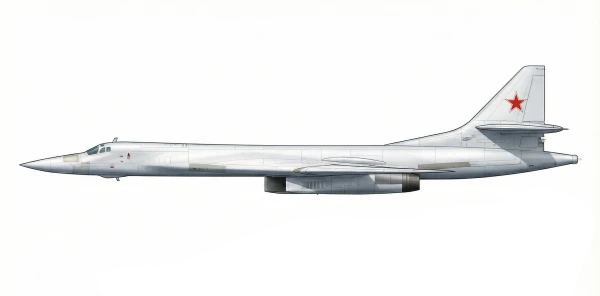
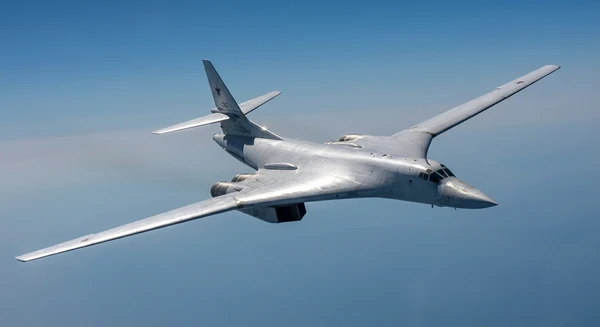
| Crew | 4 |
| Length | 54.1 m (177.5 ft) |
| Wingspan | 55.7 m (182.7 ft) |
| Height | 13.1 m (43.0 ft) |
| Wing area | 232 m² (2497.2 sqft) |
| Empty weight | 109,769 kg (241,999 lbs) |
| Max. takeoff weight | 274,877 kg (605,999 lbs) |
| Powerplant | 4 × turbofans Kuznetsov NK-32 24,983 kgf each |
| Ejection seat | Zvezda K-36DM |
| Maximum speed | 2220 km/h (Mach 2.22) |
| Operational range | 12,300 km (7,643 mi) |
| Endurance | 15 hours |
| Service ceiling | 16,000 m (52,493 ft) |
| Climb rate | 70.0 m/s (229.7 ft/s) |
| Takeoff distance | 2,200 m (7,218 ft) |

- Air-to-Surface Raduga Kh-15 (AS-16 Kickback)
- Cruise Missiles Raduga Kh-55 (AS-15 Kent)
Description
The Tupolev Tu-160 was designed by Tupolev for the 1972 Soviet supersonic, variable-geometry heavy bomber competition. Built by the Kazan Aircraft Production Association (KAPO), the aircraft completed its first flight on 18 December 1981, with production authorized in 1984. A total of 41 aircraft (9 test and 32 serial) were built during the initial production run from 1984 to 1992. Production was halted in 1992 but resumed under modernization programs, with newly built Tu-160M models undergoing test flights starting in January 2022.
Design
The Tu-160 has a length of 54.1 meters and an empty weight of 110,000 kg, with titanium comprising 30 percent of the structure. It utilizes a fly-by-wire control system, a blended wing profile, full-span leading-edge slats, double-slotted trailing-edge flaps, and a cruciform tail. Four Kuznetsov NK-32 afterburning turbofan engines provide propulsion, enabling a maximum speed of Mach 2.05. The four-man crew uses K-36LM ejection seats. Avionics include a TsNPO Leninets Obzor-K radar for ground and air target tracking, a Sopka terrain-following radar, and a probe-and-drogue in-flight refueling system.
Armament
The Tu-160 carries ordnance in two internal weapon bays with a combined capacity of 45,000 kg. Each bay contains a rotary launcher capable of carrying six Raduga Kh-55SM, Kh-101, Kh-102, Kh-555, or Kh-BD cruise missiles, or twelve Raduga Kh-15 short-range nuclear missiles. In 2023, the aircraft was outfitted with the Kh-BD cruise missile, which has a range of 6,500 km. There are no defensive weapons.
Operational History
The aircraft entered service in April 1987 with the 184th Guards Heavy Bomber Regiment in Pryluky. Following the dissolution of the Soviet Union, Ukraine inherited 19 aircraft and Russia inherited 13. In 1999, Russia purchased eight Ukrainian airframes to settle natural gas debts, while the remaining Ukrainian aircraft were scrapped under the Nunn–Lugar Cooperative Threat Reduction agreement. The Russian fleet is based at Engels-2 air base with the 121st Guards Heavy Bomber Regiment. The Tu-160 made its combat debut in November 2015 during the Syrian Civil War, launching Kh-101 cruise missiles. In 2022, the aircraft launched Kh-101 cruise missiles against targets in Ukraine. In 2025, Ukraine targeted the Kazan manufacturing plant and Russian airfields hosting the aircraft with drone strikes. India reportedly held talks to acquire six Tu-160s in 2022.
Variants
- Tu-160: The initial production version of the strategic heavy bomber.
- Tu-160M: An upgraded version featuring new weaponry, improved electronics, and updated avionics.
- Tu-160M2: A highly upgraded version featuring new avionics, a glass cockpit, a new defensive system, and more efficient engines.
- Tu-160SK: A proposed commercial variant designed to launch satellites utilizing the Burlak launch system.
- Tu-160PP: A proposed electronic warfare variant designed to carry stand-off jamming and electronic countermeasures gear.
Frequently Asked Questions
What type of aircraft is the Tu-160 Blackjack?
What is the maximum speed of the Tu-160 Blackjack?
What is the range of the Tu-160 Blackjack?
When did the Tu-160 Blackjack first fly?
How many Tu-160 Blackjack have been built?
Which countries operate the Tu-160 Blackjack?
How much does a Tu-160 Blackjack cost?
What is the service ceiling of the Tu-160 Blackjack?
- AUG 212026 Updated Dropped the bare Blackjack alias, which the RQ-21 Blackjack drone also carries
- AUG 52026 Updated Powerplant and thrust updated
- JUL 232026 Updated Sources and cross-references refreshed
- JUN 122026 Updated Description updated
- APR 72026 Updated Sources and cross-references refreshed
- FEB 72026 Updated Endurance added
- JAN 122026 Updated Range updated in a site-wide editorial pass