Tu-160 Blackjack vs Tu-95 Bear
Tu-160 Blackjack vs Tu-95 Bear at a glance — top speed 2,220 vs 920 km/h, range 12,300 vs 15,000 km, max takeoff weight 274,877 vs 188,000 kg, built 37 vs 500 units.
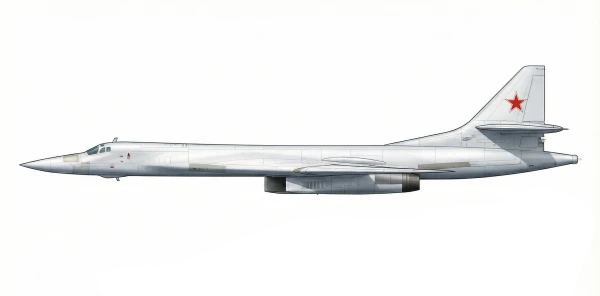
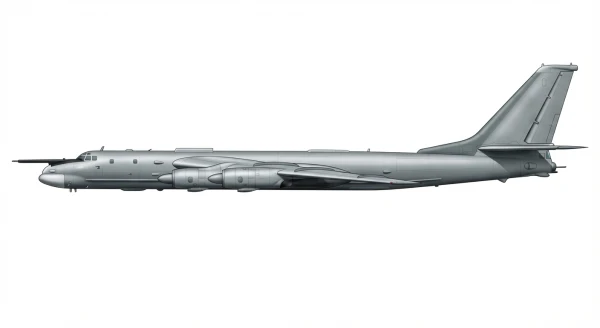
| Tu-160 Blackjack | Tu-95 Bear | |
|---|---|---|
| Origin country | 🇷🇺 Ex-USSR | 🇷🇺 Ex-USSR |
| Category | Bombers | Bombers |
| Manufacturer | Tupolev | Tupolev |
| First flight | 19 December 1981 | 12 November 1952 |
| Year introduced | 1987 | 1956 |
| Number produced | 37 units | 500 units |
| Average unit price | $250 million | $60 million |
| Wing area | 232.0 m² | 310.0 m² |
| Wingspan | 55.7 m | 50.1 m |
| Height | 13.1 m | 12.1 m |
| Length | 54.1 m | 46.2 m |
| Maximum speed | 2220 km/h | 920 km/h |
| Operational range | 12,300 km | 15,000 km |
| Service ceiling | 16,000 m | 13,716 m |
| Max. takeoff weight | 274,877 kg | 188,000 kg |
| Empty weight | 109,769 kg | 90,000 kg |
| Total thrust | 4 x 24,983 kgf | 4 x 8,950 kW |
Detailed Comparison
The Tupolev Tu-95 and Tu-160 form the core of Russia's strategic bomber force, though they originate from different technological eras and execute their missions differently. The Tu-95 is a long-endurance, subsonic bomber defined by its four powerful Kuznetsov NK-12 turboprop engines, a design that has kept it in service since 1956. The Tu-160 is a much later, more complex variable-geometry supersonic bomber, designed as a direct counterpart to the American B-1 Lancer, prioritizing speed and payload.
Development and Design
The Tu-95 'Bear' was born from a 1950s requirement for a strategic bomber with intercontinental range. Its key innovation was its contra-rotating propellers, which allowed it to achieve near-jet speeds (over 800 km/h) with the exceptional endurance inherent to turboprops. Its simple, robust airframe has proven remarkably adaptable, evolving from a free-fall nuclear bomber to its current primary role as a standoff cruise missile carrier. In contrast, the Tu-160 'Blackjack' was developed in the late 1970s with a focus on survivability through performance. Its variable-geometry wings allow it to optimize its flight profile for both low-altitude subsonic penetration and high-altitude supersonic dash. This technological complexity, however, resulted in a significantly higher unit cost and a much smaller production run of only 37 aircraft compared to the Tu-95's 500.
Specifications and Performances
While both aircraft possess intercontinental range (12,500 km for the Tu-95, 14,000 km for the Tu-160), their performance envelopes diverge significantly. The Tu-160's four afterburning turbojets propel it to Mach 2.05 (2,220 km/h), more than double the Tu-95's maximum speed of 920 km/h. This speed advantage is complemented by a superior service ceiling (16,000 m vs. 13,716 m) and a drastically higher climb rate (70 m/s vs. 10 m/s). The Blackjack also boasts a substantially larger payload capacity, carrying up to 40,000 kg of ordnance in internal bays, compared to the 9,000 kg typically cited for the Tu-95M. This allows the Tu-160 to carry a heavier load of cruise missiles like the Kh-55. The crew size also reflects their respective eras, with the Tu-160 requiring a crew of four versus the Tu-95's eight.
Deployment and usage
Historically, the Tu-95 was a cornerstone of the Soviet nuclear triad, tasked with penetrating enemy airspace. Over decades, its role has shifted to that of a standoff weapons platform. Its primary mission today is to carry and launch long-range cruise missiles, such as the Raduga Kh-55 and the newer Kh-101/102, from outside the range of enemy air defenses. Its long endurance also makes it an effective maritime patrol and reconnaissance asset. The Tu-160 was designed for a dual-role mission: deep, high-speed penetration of contested airspace and standoff missile launch. It is used as a strategic power-projection asset, capable of rapidly reaching launch points anywhere on the globe. Both aircraft have been used to launch cruise missiles in recent conflicts.
Conclusion
The Tu-95 Bear stands as a testament to a successful and highly adaptable design, remaining a cost-effective and reliable standoff missile carrier due to its unparalleled endurance. The Tu-160 Blackjack is a premier strategic asset, representing the apex of Soviet-era bomber technology. Its superior speed, payload, and penetration capabilities make it a far more potent platform, though its complexity and cost limit its fleet size. Together, they provide a complementary capability: the Tu-95 serving as the persistent, workhorse missile carrier and the Tu-160 as the high-performance, strategic "silver bullet."