Tu-22M / Tu-26 Backfire
Summary
| Category | Bombers |
| Origin country | 🇨🇳 Ex-USSR |
| Manufacturer | Tupolev |
| First flight | 30 August 1969 |
| Year introduced | 1973 |
| Number produced | 497 units |
| Average unit price | $65 million |
Technical specifications
| Version: Tu-22M3 Backfire-C | |
|---|---|
| Crew | 4 members |
| Operational range | 2,410 km (1,498 mi) |
| Maximum speed | 2327 km/h (1446 mph) |
| Wing area | 183.6 m² (1976.3 sqft) |
| Wingspan | 34.3 m (112.5 ft) |
| Height | 11.1 m (36.3 ft) |
| Length | 42.4 m (139.1 ft) |
| Service ceiling | 13,300 m (43,635 ft) |
| Empty weight | 58,000 kg (127,868 lbs) |
| Max. takeoff weight | 126,000 kg (277,782 lbs) |
| Climb rate | 15.0 m/s (49.2 ft/s) |
| Powerplant | 2 x turbojets Kuznetsov NK-25 delivering 25000 kgf each |
| Ejection seat | Tupolev KT-1 |
Current operating countries
| Country | Units | ||
|---|---|---|---|

|
Russia | 56 | |
4 recent events involving the Tu-22M / Tu-26 Backfire
| Date | Air Force | Aircraft | Active Δ | Ordered Δ |
|---|---|---|---|---|
| 1 Jun 2025 | 🇷🇺 Russian Air Force | Tu-22M | -4 | — |
| Four Tu-22M3 Backfire destroyed on the ground at Belaya, Olenya and Ukrainka air force bases by drone attacks during Ukraine operation "Spiderweb" Details → | ||||
| 19 Apr 2024 | 🇷🇺 Russian Air Force | Tu-22M | -1 | — |
| Crashed near Stavropol due to an engine fire; one of four crew members died after ejection. Details → | ||||
| 19 Aug 2023 | 🇷🇺 Russian Air Force | Tu-22M | -1 | — |
| Destroyed on the ground at Soltsi airbase in Novgorod, after a Ukrainian drone attack. Details → | ||||
| 5 Dec 2022 | 🇷🇺 Russian Air Force | Tu-22M | -1 | — |
| Suffered damage in a long-range drone attack against Dyagilevo air base. Details → | ||||
Armament
Description
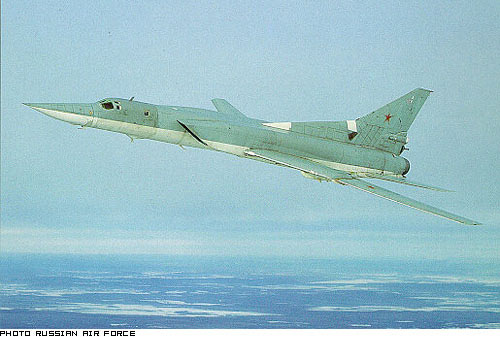
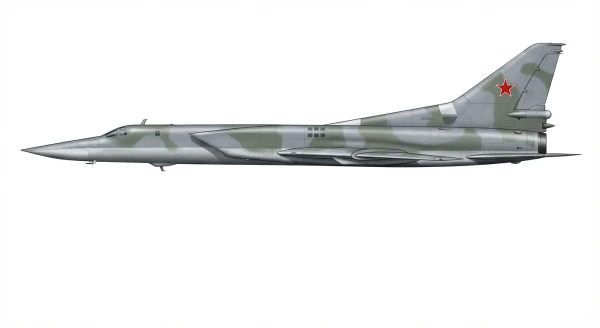
The Tu-22M Backfire, initially designated Tu-26, is a supersonic strategic bomber that combines conventional, nuclear, and anti-ship strike capabilities, as well as reconnaissance missions. The original designation Tu-26 was changed to Tu-22M solely for administrative reasons, aiming to facilitate budget approval. However, the design of the Tu-22M significantly differs from that of the Tu-22 Blinder.
The Backfire features a variable geometry wing, providing it with agility and the ability to penetrate at low altitudes. It is also powered by more powerful engines, mounted inside the fuselage. Its range is twice that of the Blinder, and its maximum speed reaches Mach 2. Furthermore, the Tu-22M's offensive payload has been increased to 24,000 kg. It can carry missiles such as the AS-4 Kitchen and AS-6 Kingfish cruise missiles.
Several improved versions have been introduced. The Tu-22M-2 standard, which constitutes the majority of the fleet and entered service in 1976, has more advanced engines compared to the Tu-22M-0 and Tu-22M-1. The Tu-22M-3, introduced into the Russian Air Force in 1983, features an elongated nose, new air intakes, and a maximum wing sweep of 65°. Capable of reaching speeds of up to 2,300 km/h, it can carry a payload twice that of the Tu-22M-2 (for example, 3 Kh-22 cruise missiles or 10 Kh-15 missiles) over a distance of 6,800 km.
The Tu-22M Backfire was notably used during the 1980s in the war in Afghanistan, for conventional bombing missions. In total, approximately 500 aircraft of all variants were built.