Tu-22M / Tu-26 Backfire
Soviet supersonic long-range strategic bomber, known for its Cold War deployment and various modernization efforts in Russian service. Key figures: top speed 2,327 km/h, range 6,800 km, service ceiling 13,300 m, max takeoff weight 126,000 kg, unit price $65M, built 497. In service with 1 air force as of 2026 — Russia (55).
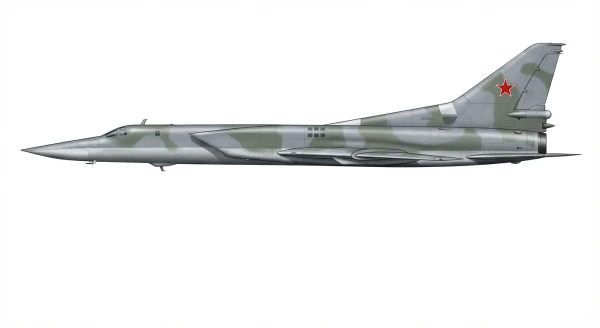
| Crew | 4 |
| Length | 42.4 m (139.1 ft) |
| Wingspan | 34.3 m (112.5 ft) |
| Height | 11.1 m (36.3 ft) |
| Wing area | 183.6 m² (1976.3 sqft) |
| Empty weight | 58,000 kg (127,868 lbs) |
| Max. takeoff weight | 126,000 kg (277,782 lbs) |
| Powerplant | 2 × turbofans Kuznetsov NK-25 25,278 kgf each |
| Ejection seat | Tupolev KT-1 |
| Maximum speed | 2327 km/h (Mach 2.2) |
| Operational range | 6,800 km (4,225 mi) |
| Service ceiling | 13,300 m (43,635 ft) |
| Climb rate | 15.0 m/s (49.2 ft/s) |

- Hypersonic Air-to-Surface Kh-47M2 Kinzhal (AS-24 Killjoy)
- Air-to-Surface Kh-15 (AS-16 Kickback)
- Air-to-Surface Kh-22 Burya (AS-4 Kitchen)
- Air-to-Surface Kh-32
Recent Events — Tu-22M / Tu-26 Backfire
7 events →
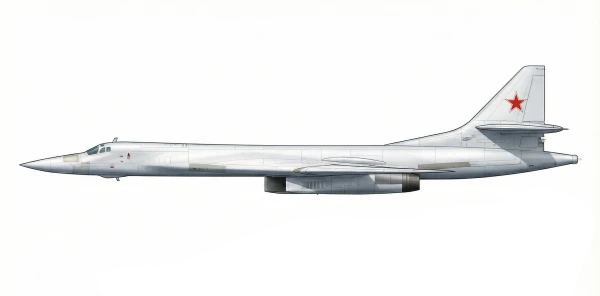
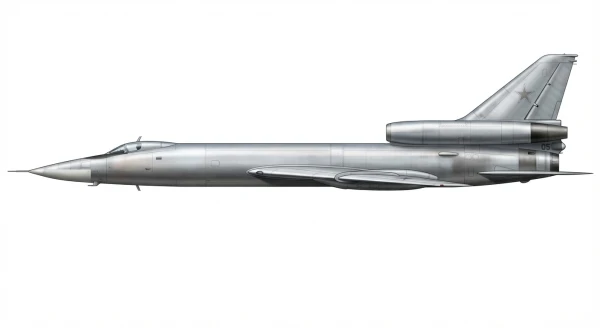
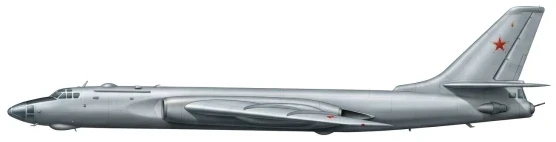
Description
The Tupolev Tu-22M, NATO reporting name Backfire, is a Soviet supersonic variable-sweep wing long-range bomber developed in the 1960s and still the mainstay of Russian theatre-range strike aviation. Nuclear-capable and built around large stand-off missiles, it was flown by the Soviet Air Forces as a missile carrier and by Soviet Naval Aviation in the long-range maritime anti-shipping role, where its job was to find and attack American carrier groups. Western intelligence at one point reported it as the Tu-26. 497 were built, and the type has seen combat in Afghanistan, Chechnya, Georgia, Syria and Ukraine.
Development
By 1962 it was clear that the Tu-22 was inadequate as a bomber. Beyond widespread unserviceability, its handling was dangerous: its landing speed was far higher than that of previous bombers, it tended to pitch up and strike its tail on landing, and all-round visibility was poor. Tupolev began work on a major update that year, planning to add a variable-sweep wing and uprated engines, with wind tunnel testing at TsAGI.
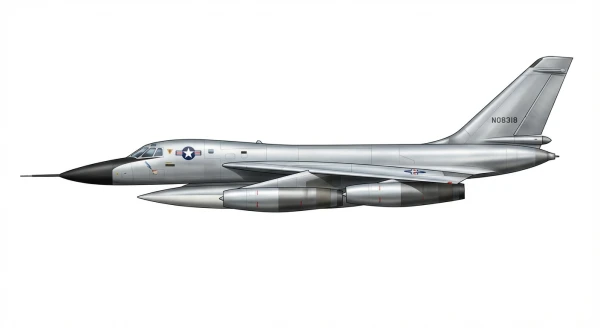
At the same time Sukhoi was developing the T-4, a four-engine titanium aircraft with canards conceived as an answer to the XB-70 and requiring a major research effort to reach its intended cruise speed. Tupolev offered the Air Force something evolutionary and cheap instead. The Soviet government was sceptical about replacing the Tu-22 so soon after it entered service, so the Air Force and Tupolev presented the design as an update of the existing aircraft rather than a new one — a framing that also helped both parties avoid awkward questions about the Tu-22's deficiencies and deflect the ICBM lobby. The design was approved on 28 November 1967 together with its main weapon, the Kh-22 missile. The resulting Samolyot 145 drew on the Tu-22's weapon system and borrowed features from the abandoned Tu-98.
The Tu-22M designation was used again during the SALT II negotiations, creating the impression that the aircraft was a modification of the Tu-22. Whether this was deliberate deception aimed at the West or an internal device to ease budget approval remains disputed. US intelligence had known of the aircraft since 1969 and photographed it by satellite in 1970; its existence came as a shock, since Nikita Khrushchev had insisted that ICBMs would make the bomber obsolete.
Modernisation
An initial upgrade, Adaptation-45.03M, began in 1990 around a new radar but was abandoned before production. Work on the NV-45 radar started in 2007, flew on a Tu-22M in 2008, and was fitted to four more repaired aircraft in 2014–2015. A contract for a full mid-life upgrade, the Tu-22M3M, was signed in September 2014, adding a modified NV-45M radar, new navigation equipment, a revised flight control system and a defensive electronic suite replacing the tail gun, with much of the avionics shared with the Tu-160M2. Planned armament included the Kh-32, the subsonic Kh-SD, the hypersonic Kh-MT and the Kh-47M2 Kinzhal. A separate and simpler programme, SVP-24-22, adapted avionics developed for the Su-24 — a new computer, navigation system and digital radar processing — and entered production for delivery from 2012.
Design
The Backfire is built around a variable-geometry wing, spreading to 20° for take-off and cruise and sweeping to 65° for supersonic and low-level penetration, with a span of 34.28 m spread and 23.3 m swept. Two Kuznetsov NK-25 afterburning turbofans of some 25,300 kgf each are buried in the fuselage, and the aircraft carries 54 tonnes of internal fuel. Maximum take-off weight is 126 tonnes, maximum range 6,800 km, and combat radius about 2,500 km with a typical 10,000 kg weapons load. Compared with the Tu-22 Blinder it doubled the range, raised maximum speed beyond Mach 1.8, and increased offensive payload to 24,000 kg. The crew of four — pilot, co-pilot, navigator and weapon systems officer — sit in a conventional forward cockpit rather than the Tu-22's difficult layout.
Armament
Weapons are carried in an internal bay and on wing and fuselage pylons, up to 24,000 kg in total. The classic anti-ship and anti-radar load is up to three Kh-22 or modernised Kh-32 missiles, the weapon the aircraft was designed around. Alternatively it can carry up to six Kh-15 short-range attack missiles on an MKU-6-1 rotary launcher in the bay plus four more on underwing pylons, or up to eighteen FAB-500 general-purpose bombs, or naval mines. Since 2018 the type has been tested and used with up to four Kh-47M2 Kinzhal air-launched ballistic missiles. Defensive armament on the Tu-22M3 is a single GSh-23 23 mm cannon in a remotely controlled tail turret.
Operational History
The first two Tu-22M(0) aircraft reached Long Range Aviation's 42nd Combat Training Centre at Dyagilevo near Ryazan in February 1973 and began practice sorties in March. The type was first shown publicly in 1980 during a major Warsaw Pact exercise, in which naval Tu-22M2s mined parts of the Baltic to simulate opposition to an amphibious landing. The first simulated attack on a NATO carrier group came between 30 September and 1 October 1982, when eight aircraft locked onto the task forces of USS Enterprise and USS Midway in the North Pacific and closed to within striking distance; the restrained American reaction is thought to have been intended to allow observation of Soviet tactics.
The Tu-22M was first used in combat in Afghanistan, deployed from December 1987 to January 1988 in support of the attempt to relieve the siege of Khost, bombing forts, bases and supply dumps. It returned in October 1988, when sixteen Tu-22M3s covered the Soviet withdrawal by attacking access routes, striking at night to prevent regrouping and interdicting supplies arriving from Iran and Pakistan, with the last Afghan operation flown at the Salang pass in January 1989.
Serviceability was a persistent problem. Poor manufacturing quality gave the engines and airframes short lives, the Air Force at one point sought to prosecute Tupolev over the state in which both the Tu-22M and the Tu-160 had been rushed into service, and bureaucratic obstruction of spare parts left some aircraft grounded for up to six months; the mission-capable rate in August 1991 was around 30 to 40 per cent.
370 aircraft remained in Commonwealth of Independent States service at the dissolution of the Soviet Union and production ended in 1993. The 60 airframes inherited by Ukraine were dismantled by 2006 under the Nunn–Lugar Cooperative Threat Reduction programme. Russia used the Tu-22M3 near Grozny in 1995, resumed long-range patrolling with it in August 2007, and lost a Tu-22MR reconnaissance aircraft to a Georgian Buk-M1 on 9 August 2008. Simulated attacks on Japanese and Swedish targets through the 2010s, and supersonic transits of the Baltic, kept the type in the news.
From January 2016 Tu-22M3s flew repeated strike waves in Syria around Deir ez-Zor, Palmyra, Al-Sukhnah and Arak, at times operating from Iran's Hamedan airbase. Since April 2022 the type has been used against Ukraine, first at Mariupol, launching Kh-22 missiles and dropping reactivated FAB-3000 bombs. Ukrainian drone attacks have struck Tu-22Ms on the ground at Dyagilevo in December 2022 and Soltsy in August 2023, and Operation Spiderweb destroyed four aircraft at Belaya air base on 1 June 2025. The IISS Military Balance credited Russia with 57 Tu-22Ms in service in 2024, while Ukrainian military intelligence estimated only 27 were operable in 2023.
Variants
- Tu-22M0 and Tu-22M1 — pre-production and early aircraft, built in small numbers.
- Tu-22M2 (Backfire-B) — the first major service standard, entering service in 1976 with more capable engines than the earlier machines.
- Tu-22M3 (Backfire-C) — introduced in 1983 and the definitive version, with NK-25 engines, wedge-shaped intakes, a revised nose, 65° maximum wing sweep and roughly double the payload of the M2.
- Tu-22MR — the reconnaissance derivative.
- Tu-22M3M — the mid-life upgrade contracted in 2014, with new radar, navigation and defensive systems and provision for the Kh-32 and Kinzhal missiles.
Frequently Asked Questions
What type of aircraft is the Tu-22M / Tu-26 Backfire?
What is the maximum speed of the Tu-22M / Tu-26 Backfire?
What is the range of the Tu-22M / Tu-26 Backfire?
When did the Tu-22M / Tu-26 Backfire first fly?
How many Tu-22M / Tu-26 Backfire have been built?
Which countries operate the Tu-22M / Tu-26 Backfire?
How much does a Tu-22M / Tu-26 Backfire cost?
What is the service ceiling of the Tu-22M / Tu-26 Backfire?
- AUG 52026 Updated Description, range and 2 more fields updated
- JUN 262026 Updated Missiles updated
- APR 72026 Updated Sources and cross-references refreshed