Tu-22 Blinder
Soviet supersonic bomber, operational during the Cold War, notable for reconnaissance and maritime strike missions. Key figures: top speed 1,510 km/h, range 4,900 km, service ceiling 13,300 m, max takeoff weight 92,000 kg, unit price $15M, built 311.
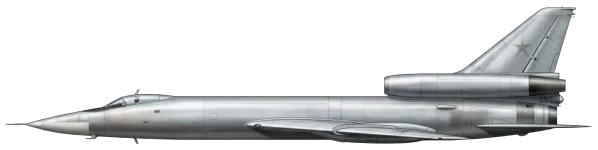
| Crew | 3 |
| Length | 41.6 m (136.5 ft) |
| Wingspan | 23.2 m (76.0 ft) |
| Height | 10.1 m (33.2 ft) |
| Wing area | 162 m² (1743.8 sqft) |
| Empty weight | 40,000 kg (88,185 lbs) |
| Max. takeoff weight | 92,000 kg (202,825 lbs) |
| Powerplant | 2 × turbojets Dobrynin RD-7M-2 16,509 kgf each |
| Ejection seat | Tupolev K-22 |
| Maximum speed | 1510 km/h (Mach 1.4) |
| Operational range | 4,900 km (3,045 mi) |
| Service ceiling | 13,300 m (43,635 ft) |
| Climb rate | 12.7 m/s (41.7 ft/s) |
- Air-to-Surface Raduga Kh-22 Burya (AS-4 Kitchen)
- Low-Drag JSC NPO Basalt FAB-500
Description
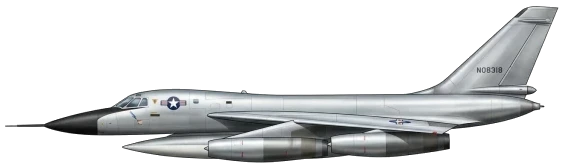
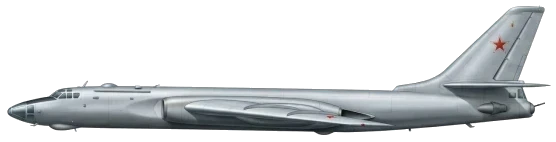
The origins of the Tu-22 date back to the 1950s, when the design bureaus of Tupolev and Ilyushin began studying the development of supersonic strategic bombers in response to the American Convair B-58 Hustler. In the Soviet inventory, the new aircraft was intended to replace the Tupolev Tu-16 Badger. In order to meet the official demand for a supersonic bomber, Tupolev proposed a completely new model, designated Project 105, in the mid-1950s. The production of pre-production aircraft began in 1960, and the Soviet Union was able to showcase the Tupolev Tu-22B to the world during the grand Tushino air parade on July 9, 1961. It was later named the Blinder by NATO.
Design
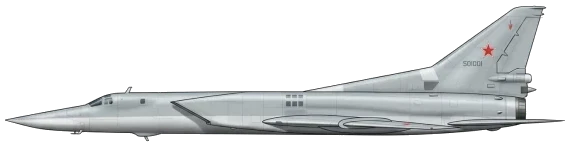
The appearance of the Tu-22 caused quite a stir among Western military officials, as its design was unconventional. Unlike the heavy bombers produced before it, the Tu-22 had a futuristic look, with a carefully designed aerodynamics aimed at achieving the highest possible speed for the new bomber. Significant efforts were made to integrate the bomb bay, landing gear, and cockpit. This pursuit of speed was a clear choice to prioritize speed over payload capacity in order to penetrate the defenses of Western countries. With a 55° swept-wing configuration, the Tu-22 also featured a unique engine placement, with its two engines not located under the wings but at the rear of the fuselage, at the base of the tail. This allowed for increased fuel capacity and engine efficiency. Behind the pressurized cockpit, there was a large internal fuel tank. In terms of armament, all Blinder aircraft were equipped with one (sometimes two) 23mm cannon in the tail turret and were capable of carrying 9 tons of bombs, typically unguided 500kg FAB-500 bombs. To fulfill their missions, the Tu-22B had the Rubin-A navigation and attack system. Reconnaissance versions were equipped with cameras and electronic surveillance equipment. There are approximately ten known versions of the Tu-22, with the main ones mentioned here.
Key versions:
-
Tu-22B (Blinder-A): dedicated bomber version, only 15 produced.
-
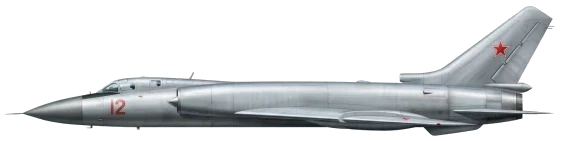
Tu-22K (Blinder-B): dedicated anti-ship warfare version, with a single AS-4 Kitchen/Kh-22 missile under the fuselage, with 4 known sub-versions (K, KD, KP, and KPD); 150 produced.
-
Tu-22R (Blinder-C): dedicated reconnaissance version, with 5 known sub-versions (R, RD, RK, RDK, and RDM); 127 produced, with half for the Soviet naval aviation.
-
Tu-22U (Blinder-D): dedicated training version, with a unique second raised cockpit, with 2 known sub-versions (U and UD); 47 produced.
-
Tu-22P (Blinder-E): dedicated for electronic warfare and ELINT missions, with 2 known sub-versions (P and PD); 47 produced.
-
Tu-22KP: dedicated for electronic warfare and anti-radar, equipped with a Kh-22P missile.
It should be noted that versions including the letter "D" were equipped with an in-flight refueling probe.
Operational History
Despite its qualities, the Tu-22 was considered a disappointment. The Tu-22B bomber was inferior in many aspects compared to the Tu-16 it was supposed to replace. The cockpit design was not successful: visibility was poor, the arrangement of controls was poorly done, and the crews complained that their seats were uncomfortable, which posed problems during long-distance flights. These flights were further compromised by the Tu-22's limited range: 4,900 kilometers when empty, quickly reduced when carrying a payload. By the 1980s, the Tu-22 had limited military value, which allowed for its export.
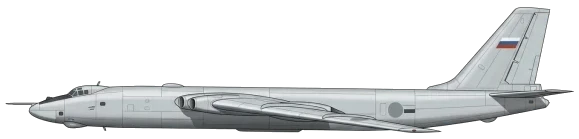
Indeed, the Tu-22 was used in combat on several occasions. The Soviets deployed their aircraft in Afghanistan for bombing missions. By the time of the fall of the USSR, it seems that only about a hundred Blinders remained in service, with most of them being replaced by the more modern Tu-22M Backfire. Currently, only a handful of aircraft are still in service in Russia, mainly used for reconnaissance. Ukraine also retired the aircraft it inherited in 1991 from service. In 1991, the end also came for the Iraqi Blinders. Twelve Blinders were delivered, most of which were lost during the war against Iran (1980-1988). The remaining ones were destroyed during the allied operations that followed the Iraqi occupation of Kuwait. Libya received around ten aircraft, which it deployed in Chad during the 1980s. They distinguished themselves, notably during the bombing of N'Djamena airport by a single Blinder, which dropped three bombs on the runway during a low-altitude attack on February 17, 1986. Two Blinders were shot down in 1987, one by a French MIM-23 Hawk missile. It appears that the Libyan Blinders are no longer airworthy. Some can be seen rusting away in the open air at the former NATO air base in Tripoli.
Frequently Asked Questions
What type of aircraft is the Tu-22 Blinder?
What is the maximum speed of the Tu-22 Blinder?
What is the range of the Tu-22 Blinder?
When did the Tu-22 Blinder first fly?
How many Tu-22 Blinder have been built?
Which countries operate the Tu-22 Blinder?
How much does a Tu-22 Blinder cost?
What is the service ceiling of the Tu-22 Blinder?
- AUG 52026 Updated Climb rate added; thrust updated
- JUL 232026 Updated Sources and cross-references refreshed
- APR 72026 Updated Sources and cross-references refreshed