Vulcan
British jet-powered, tailless, delta-wing strategic bomber, operated from 1956 until 1984, primarily used as a high-altitude nuclear deterrent during the Cold War. Key figures: top speed 1,039 km/h, range 4,195 km, service ceiling 17,000 m, max takeoff weight 77,111 kg, built 134.
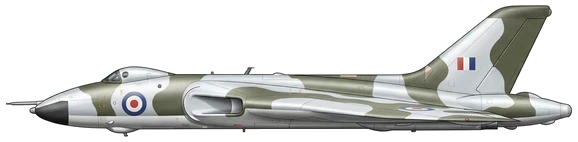
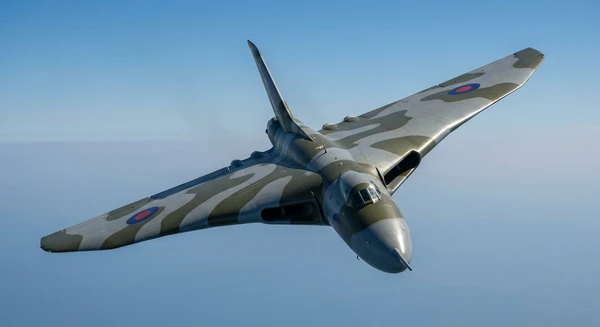
| Crew | 5 (pilot, co-pilot, AEO, navigator radar, navigator plotter) |
| Length | 29.6 m (97.1 ft) |
| Wingspan | 30.3 m (99.4 ft) |
| Height | 8.1 m (26.5 ft) |
| Wing area | 330.2 m² (3554.2 sqft) |
| Empty weight | 37,908 kg (83,573 lbs) |
| Max. takeoff weight | 77,111 kg (170,000 lbs) |
| Powerplant | 4 × Bristol Olympus Mk.101 49 kN each |
| Maximum speed | 1039 km/h (646 mph) |
| Operational range | 4,195 km (2,607 mi) |
| Service ceiling | 17,000 m (55,774 ft) |
- Air-to-Surface Blue Steel
- Air-to-Ground GAM-87 Skybolt
- Anti-Radiation AGM-45 Shrike
- Unguided 1,000 lb conventional bomb
- Nuclear Blue Danube
- Nuclear Violet Club
- Nuclear U.S. Mark 5
- Nuclear Yellow Sun Mk.1
- Nuclear Yellow Sun Mk.2
- Nuclear Red Beard
- Nuclear WE.177B
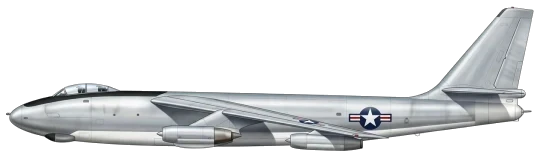
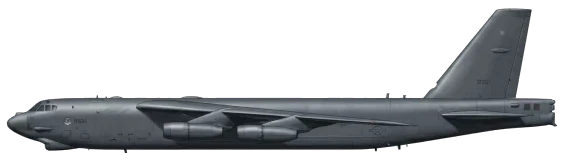
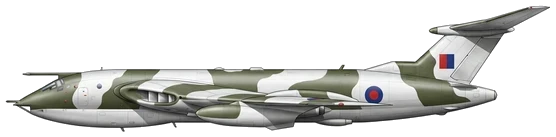
Description
The Avro Vulcan, later known as the Hawker Siddeley Vulcan, was a jet-powered, tailless, delta-wing strategic bomber operated by the Royal Air Force (RAF) from 1956 until 1984. Designed by A.V. Roe and Company to satisfy Specification B.35/46, the project used several reduced-scale Avro 707 aircraft to test delta-wing principles. The first prototype, VX770, flew on 30 August 1952. Total production reached 134 aircraft, consisting of 45 B.1 and 89 B.2 models.
Design
The airframe was constructed primarily of light alloy and featured a five-man crew in a pressurized cabin. The pilot and co-pilot were equipped with Martin-Baker ejection seats, while the three rear crew members—navigator radar, navigator plotter, and air electronics officer (AEO)—exited via the entrance door. Power was provided by four Rolls-Royce Olympus turbojet engines buried in the wing roots. The B.2 variant introduced the larger Phase 2C wing and transitioned from the B.1’s 112V DC electrical system to a 200V AC system. Avionics included H2S Mk9 radar, a navigation bombing computer, and electronic countermeasures (ECM) systems housed in an extended tail cone. Later B.2 modifications added terrain-following radar and a heading reference system based on the Blue Steel missile’s inertial platform.
Armament
Armament was carried in a single internal bomb bay. Conventional capacity was 21 1,000 lb bombs. Nuclear payloads included Blue Danube, Violet Club, Yellow Sun Mk.1 and Mk.2, Red Beard, and WE.177B gravity bombs. The B.2 was also modified to carry the Blue Steel stand-off missile. During the 1982 Falklands War, aircraft were fitted with underwing pylons to carry AGM-45 Shrike anti-radar missiles and ECM pods.
Operational History
The Vulcan served as the backbone of the United Kingdom's airborne nuclear deterrent. From 1962, aircraft were held on Quick Reaction Alert (QRA), prepared for takeoff within 15 minutes. While originally designed for high-altitude flight, the fleet transitioned to low-level penetration tactics in the mid-1960s. During Operation Black Buck in 1982, Vulcans flew 3,889-mile missions from Ascension Island to Port Stanley. The type also performed maritime radar reconnaissance and aerial refueling roles before its final withdrawal from service.
Variants
- B.1: The initial production variant equipped with Olympus 101, 102, or 104 engines and a pure delta wing.
- B.1A: B.1 aircraft retrofitted with B.2-style ECM equipment in an enlarged tail cone and in-flight refueling probes.
- B.2: An improved version featuring a larger, thinner Phase 2C wing, uprated Olympus 200 or 300-series engines, and an AC electrical system.
- B.2 (MRR): Nine aircraft modified for maritime radar reconnaissance, featuring LORAN C navigation and the removal of terrain-following radar.
- K.2: Six B.2 airframes converted into single-point tankers with a hose drum unit in the tail and three additional bomb-bay fuel tanks.
Frequently Asked Questions
What type of aircraft is the Vulcan?
What is the maximum speed of the Vulcan?
What is the range of the Vulcan?
When did the Vulcan first fly?
How many Vulcan have been built?
Which countries operate the Vulcan?
What is the service ceiling of the Vulcan?
- JUN 262026 Updated Bombs and missiles updated
- MAY 102026 Created Page created: Vulcan