Z-19
Chinese light reconnaissance and attack helicopter, developed in the early 21st century, utilized by the People's Liberation Army for combat and scouting operations. Key figures: top speed 280 km/h, range 700 km, service ceiling 6,000 m, max takeoff weight 4,250 kg, built 186. In service with 1 air force as of 2026 — China (120).
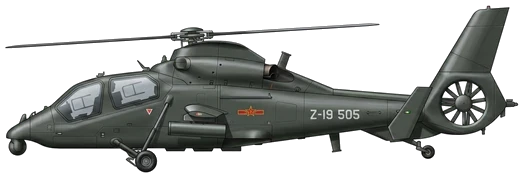
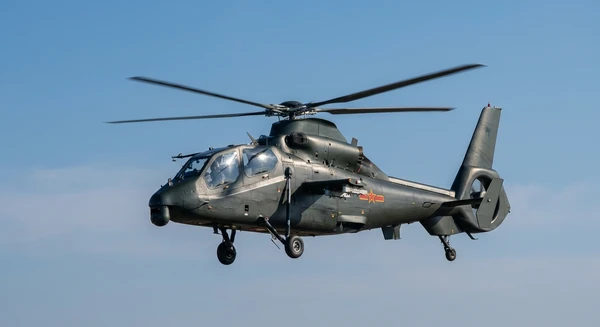
| Crew | 2 (pilot, observer) |
| Length | 12 m (39.4 ft) |
| Wingspan | 11.9 m (39.1 ft) |
| Height | 4.0 m (13.2 ft) |
| Wing area | 111.8 m² (1203.3 sqft) |
| Empty weight | 2,350 kg (5,181 lbs) |
| Max. takeoff weight | 4,250 kg (9,370 lbs) |
| Powerplant | 2 × WZ-8C turboshaft 700 kW each |
| Maximum speed | 280 km/h (174 mph) |
| Operational range | 700 km (435 mi) |
| Endurance | 4 hours |
| Service ceiling | 6,000 m (19,685 ft) |
| Climb rate | 9.0 m/s (29.5 ft/s) |

- Rocket Pod Rockets
- Gun Pod Gun pods
- Gun Pod Cannon pods
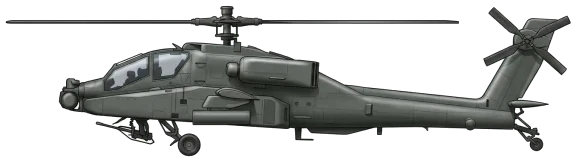
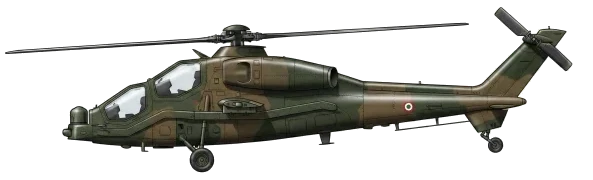
Description
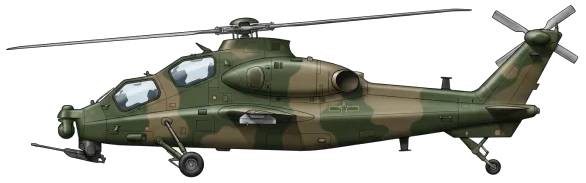
The Harbin Z-19 is a light reconnaissance and attack helicopter developed by the Harbin Aircraft Manufacturing Corporation (HAMC) for the People's Liberation Army Air Force and Ground Force Army Aviation. It is a tandem-seat combat variant of the Harbin Z-9, which is a license-built version of the Eurocopter AS365 Dauphin. Designed by Wu Ximing of the 602nd Research Institute, the helicopter's development history follows a pattern similar to the Bell AH-1 Cobra's derivation from the UH-1. The Aviation Industry Corporation of China officially named the Z-19 "Black Whirlwind" in November 2012.
Design
The Z-19 features a fenestron tail to reduce acoustic signature and exhausts designed to lower its infrared signature. Power is provided by two WZ-8C turboshaft engines, each delivering 700 kW. It utilizes a four-blade main rotor fitted with an unknown type of millimeter-wavelength electronically scanned array fire-control radar. For crew protection and targeting, the tandem cockpit features armor plating, crash-resistant seats, and an advanced helmet-mounted sight for its pilot and observer. Sensor systems are mounted in a turret containing forward-looking infrared (FLIR), TV, and a laser rangefinder.
Armament
The helicopter does not carry a nose-mounted machine gun or autocannon. Its armament is carried on two pylons configured for rocket pods, gun pods, cannon pods, up to eight HJ-8 or other anti-tank, air-to-surface, or anti-ship missiles, or up to eight TY-90 air-to-air missiles.
Operational History
The primary operator of the Z-19 is the People's Liberation Army Ground Force.
Variants
- Z-19: The original version in service with the People's Liberation Army Ground Force.
- Z-19E: The export variant of the Z-19, which conducted its first flight on 18 May 2017.
Frequently Asked Questions
What type of aircraft is the Z-19?
What is the maximum speed of the Z-19?
What is the range of the Z-19?
When did the Z-19 first fly?
How many Z-19 have been built?
Which countries operate the Z-19?
What is the service ceiling of the Z-19?
- JUN 302026 Created Page created: Z-19; then built, first flight and service entry year added