GlobalMilitary.net Open-source military intelligence Updated daily

210 Centurion vs Cessna 340

210 Centurion vs Cessna 340 at a glance — top speed 378 vs 452 km/h, range 1,667 vs 2,602 km, max takeoff weight 1,814 vs 2,717 kg, built 9,240 vs 1,351 units.

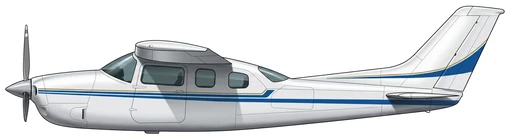
Cessna 210 Centurion military transport aircraft side profile drawing
🇺🇸 210 Centurion
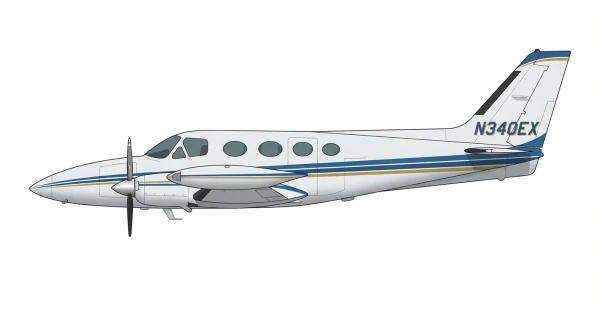
Cessna 340 military transport aircraft side profile drawing
🇺🇸 Cessna 340
Specifications
210 Centurion Cessna 340
Origin country 🇺🇸 United States 🇺🇸 United States
Category Military Transport Aircraft Military Transport Aircraft
Manufacturer Cessna Cessna
First flight 1 January 1957 1 January 1970
Year introduced 1957 1972
Number produced 9240 units 1351 units
Average unit price -- $140K
Wing area 16.3 m² 17.1 m²
Wingspan 11.2 m 11.6 m
Height 3.0 m 3.8 m
Length 8.6 m 10.5 m
Maximum speed 378 km/h 452 km/h
Operational range 1,667 km 2,602 km
Service ceiling 8,230 m 9,100 m
Max. takeoff weight 1,814 kg 2,717 kg
Empty weight 1,045 kg 1,779 kg
Total thrust 1 x 231 kW 2 x 230 kW
Performance Radar Chart

Detailed Comparison

The Cessna 210 Centurion utilizes a high-wing, single-engine airframe optimized for downward visibility and austere field operations, whereas the Cessna 340 relies on a low-wing, twin-engine configuration built around a pressurized cabin for high-altitude personnel transport. Both entered military service through the commercial off-the-shelf pipeline, filling utility and liaison roles for air forces bypassing purpose-built military transports.

Development and Design

Cessna developed the 210 as a retractable-gear progression from the fixed-gear 182, eliminating wing struts in 1967 to reduce drag via a cantilever wing. The high-wing geometry inherently clears ground obstacles and protects the engine from debris on unprepared strips. The 340 emerged from a modular assembly approach, combining the tail and landing gear of the Cessna 310 with the wings of the 414. Its low-wing layout prioritizes aerodynamic efficiency and cabin pressurization. To support the pressurized differential, the 340 requires a reinforced, heavier structure, resulting in an empty weight of 1779 kg compared to the 210's 1045 kg.

Specifications and Performances

The 340's twin Continental TSIO-520 engines push the aircraft to a maximum speed of 452 km/h. This is 74 km/h faster than the single-engine 210. The twin-engine configuration increases fuel consumption but yields a 2602 km range, nearly 1000 km further than the 210. Climb rates heavily favor the 340 (8.4 m/s versus 4.7 m/s), allowing it to reach its 9100 m service ceiling rapidly. However, the 340's heavier footprint and higher stall speeds demand longer, better-prepared runways, restricting access to the unimproved landing zones where the lighter 210 operates.

Deployment and usage

Military operators assign these aircraft to divergent mission profiles based on their airframe geometry:

  • The 210 Centurion executes border patrol, aerial survey, and counter-narcotics observation. Air forces in Bolivia, Paraguay, and several African states deploy it over dense canopy or desert terrain where its unshadowed downward observation angles dictate its use.
  • The Cessna 340 functions as a staff liaison transport. Its twin-engine redundancy satisfies military safety directives for over-water or night instrument flights transporting personnel.

The Bolivian Air Force's continued use of the 210—despite fatal crashes like the 2026 Cochabamba incident—proves the platform's entrenched status in aviation branches requiring low operating costs over multi-engine redundancy.

Conclusion

For tactical observation and austere utility missions, the Cessna 210 is the superior platform. Its high-wing visibility, lighter footprint, and single-engine economics allow sustained patrol operations from rough airstrips where multi-engine aircraft cannot operate safely. The Cessna 340 wins in the staff transport role. Its engine redundancy, pressurized cabin, and 2602 km range dictate its use for point-to-point transit between paved military airfields rather than low-level tactical work.

Change comparison vs

Frequently Asked Questions

Which is faster, the 210 Centurion or Cessna 340?
The Cessna 340 is faster with a maximum speed of 452 km/h compared to the 210 Centurion's 378 km/h, a difference of 74 km/h.
Which has longer range, the 210 Centurion or Cessna 340?
The Cessna 340 has a longer range at 2,602 km compared to the 210 Centurion's 1,667 km.
Which can fly higher, the 210 Centurion or Cessna 340?
The Cessna 340 has a higher service ceiling at 9,100 meters (29,855 ft) compared to the 210 Centurion's 8,230 meters (27,001 ft).
Which is heavier, the 210 Centurion or Cessna 340?
The Cessna 340 has a higher maximum takeoff weight at 2,717 kg compared to the 210 Centurion's 1,814 kg.
Which is larger, the 210 Centurion or Cessna 340?
The Cessna 340 is longer at 10.5 meters compared to the 210 Centurion's 8.6 meters.
Which entered service first, the 210 Centurion or Cessna 340?
The 210 Centurion entered service first in 1957, 15 years before the Cessna 340 which entered service in 1972.
Which has been built in greater numbers, the 210 Centurion or Cessna 340?
The 210 Centurion has been produced in greater numbers with 9,240 units compared to 1,351 units of the Cessna 340.