SH-3 Sea King vs SA321 Super Frelon
SH-3 Sea King vs SA321 Super Frelon at a glance — top speed 267 vs 275 km/h, range 1,005 vs 1,020 km, max takeoff weight 10,002 vs 13,000 kg, built 1,300 vs 110 units.
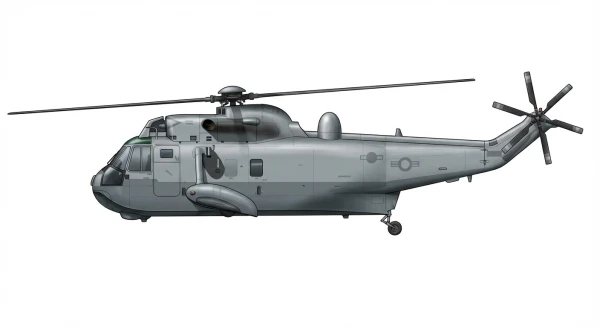
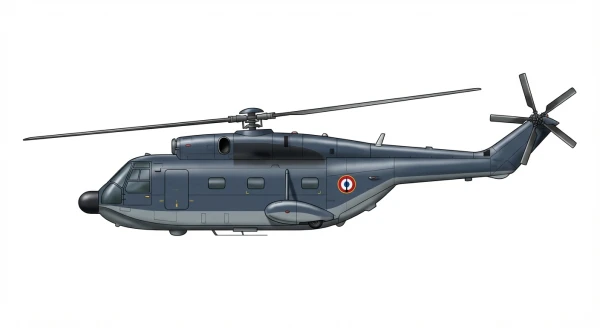
| SH-3 Sea King | SA321 Super Frelon | |
|---|---|---|
| Origin country | 🇺🇸 United States | 🇫🇷 France |
| Category | Military Helicopters | Military Helicopters |
| Manufacturer | Sikorsky | Aérospatiale |
| First flight | 11 March 1959 | 7 December 1962 |
| Year introduced | 1961 | 1966 |
| Number produced | 1300 units | 110 units |
| Average unit price | $25 million | $3.5 million |
| Wingspan | 19.0 m | 18.9 m |
| Height | 5.1 m | 6.7 m |
| Length | 16.7 m | 23.0 m |
| Maximum speed | 267 km/h | 275 km/h |
| Operational range | 1,005 km | 1,020 km |
| Service ceiling | 4,481 m | 3,100 m |
| Max. takeoff weight | 10,002 kg | 13,000 kg |
| Empty weight | 5,382 kg | 6,865 kg |
| Total thrust | 2 x 1,044 kW | 3 x 1,155 kW |
Detailed Comparison
The American SH-3 Sea King and the French SA321 Super Frelon represent two Cold War-era approaches to medium-heavy naval helicopters. While both feature amphibious hulls and were adapted for anti-submarine warfare (ASW), the Sea King originated as a dedicated ASW platform for the US Navy, whereas the Super Frelon was conceived primarily as a heavy transport. This fundamental difference is reflected in their respective twin-engine versus tri-engine configurations and overall scale.
Development and Design
The Sikorsky SH-3 Sea King was a significant development in naval aviation. First flown in 1959, it was one of the first helicopters to integrate both hunter (dipping sonar) and killer (torpedoes/depth charges) capabilities into a single airframe, streamlining ASW operations. Its twin General Electric T58 turbines were a standard for its time, and its fully amphibious hull allowed for water landings in emergencies. The aircraft's robust, adaptable design facilitated its evolution into numerous roles beyond ASW.
Developed slightly later, the Aérospatiale SA321 Super Frelon was a larger and more powerful design. Its defining feature is its three-engine configuration, using Turbomeca Turmo turbines. This design choice provided enhanced performance, particularly in hot-and-high conditions, and increased safety for over-water operations. Acknowledging a successful concept, Aérospatiale based the Super Frelon's hull design on that of the Sea King. With far fewer units built (110 vs. over 1300), the Super Frelon was a more specialized asset.
Specifications and Performances
A comparison of specifications reveals the different design priorities. The Super Frelon is a substantially larger and heavier aircraft, with a max takeoff weight of 13,000 kg compared to the Sea King's 10,002 kg. This greater mass is managed by its three engines, which deliver a combined potential power output significantly higher than the Sea King's two. Despite this, their maximum speeds are nearly identical, with the Super Frelon at 275 km/h and the Sea King at 267 km/h.
Performance metrics highlight their intended roles. The Sea King exhibits a superior climb rate of 11.1 m/s, more than double the Super Frelon's 5.0 m/s, suggesting greater agility. It also possesses a higher service ceiling of 4,481 m versus the Super Frelon's 3,100 m. The Sea King's specified range of 965 km was considerable for its time and vital for extended ASW patrols.
Deployment and usage
The SH-3 Sea King's operational history is characterized by its sheer numbers and versatility. It was the backbone of US Navy carrier-based ASW for decades and was widely exported. Its roles expanded to include:
- Search and Rescue (SAR)
- Logistics and personnel transport
- Mine countermeasures
- VIP transport (as the VH-3)
The Super Frelon served a more focused role, primarily with the French Navy and export customers. It excelled as a troop and equipment transport due to its large cabin and payload capacity. Critically, it was adapted into a potent anti-surface warfare (ASuW) platform armed with the AM39 Exocet anti-ship missile, a capability not standard on the ASW-focused Sea King. The Sea King's specified armament, the B57 nuclear depth bomb, underscores its strategic ASW mission during the Cold War.
Conclusion
The SH-3 Sea King was a revolutionary and highly successful ASW helicopter whose rugged, adaptable design led to a long and varied service life across the globe. Its legacy is defined by its mass production, versatility, and central role in Cold War naval doctrine. The SA321 Super Frelon, while less numerous, was a capable heavy-lift and transport helicopter. Its tri-engine configuration provided significant power, and its armament with Exocet missiles made it a credible anti-ship threat. Ultimately, the Sea King stands as a multi-role workhorse, while the Super Frelon represents a more specialized, heavy-duty asset for transport and maritime strike.