TAI Aksungur vs TAI Anka
TAI Aksungur vs TAI Anka at a glance — top speed 250 vs 217 km/h, range 6,500 vs 2,500 km, max takeoff weight 3,300 vs 1,700 kg, built 12 vs 102 units.
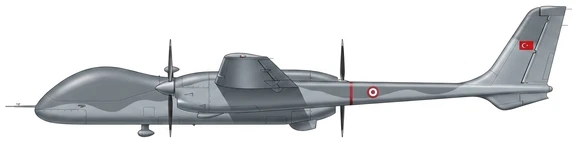
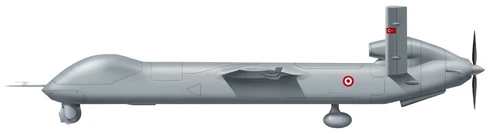
| TAI Aksungur | TAI Anka | |
|---|---|---|
| Origin country | 🇹🇷 Turkey | 🇹🇷 Turkey |
| Category | Military Drones | Military Drones |
| Manufacturer | TAI | TAI |
| First flight | 20 March 2019 | 30 December 2010 |
| Year introduced | 2021 | 2017 |
| Number produced | 12 units | 102 units |
| Average unit price | $17.5 million | $30 million |
| Wingspan | 24.2 m | 17.5 m |
| Height | 3.1 m | -- m |
| Length | 12.5 m | 8.6 m |
| Maximum speed | 250 km/h | 217 km/h |
| Operational range | 6,500 km | 2,500 km |
| Service ceiling | 12,192 m | 9,144 m |
| Max. takeoff weight | 3,300 kg | 1,700 kg |
| Empty weight | 1,800 kg | 700 kg |
| Total thrust | 2 x 160 kW | 1 x 130 kW |
Detailed Comparison
Derived from the foundational architecture of the TAI Anka, the TAI Aksungur represents a substantial leap in Turkish unmanned capabilities, shifting from a standard Medium-Altitude Long-Endurance (MALE) profile to a high-capacity, twin-engine platform. While the Anka established Turkey's indigenous drone production footprint starting in the early 2000s, the Aksungur, introduced nearly a decade later, addresses the need for extended station time and heavier payload integration, effectively doubling the operational capacity of its predecessor while retaining common control systems.
Development and Design
The Anka project began in 2004 to secure Turkish technological independence, focusing on indigenous mission computers and flight control software. Its design favors a modular open architecture, allowing variants like the SATCOM-equipped Anka-S and the electronic warfare-focused Anka-I. Conversely, the Aksungur (originally designated Anka-2) leveraged these proven subsystems to achieve a rapid 18-month development cycle. The most distinct divergence is physical: the Aksungur adopts a twin-boom, high-wing configuration with tricycle gear, departing from the Anka’s traditional fuselage layout. This structural change accommodates two engines in a tractor configuration, specifically engineered to support maritime patrol and signals intelligence roles that require greater stability and redundant power.
Specifications and Performance
Performance metrics highlight a shift from tactical support to strategic persistence. The Aksungur utilizes two TEI-PD170 dual-turbocharged engines, doubling the propulsion of the single-engine Anka. This results in a Maximum Takeoff Weight (MTOW) of 3,300 kg for the Aksungur compared to the Anka's 1,700 kg. Consequently, the Aksungur offers a remarkable endurance of 60 hours—twice that of the Anka—and a service ceiling increased from 30,000 to 40,000 feet. Payload capacity reflects this scaling; while the Anka carries approximately 350 kg of munitions like MAM-L and Cirit, the Aksungur supports 750 kg across six hardpoints. This allows for heavier ordnance, including TEBER-81/82 laser-guided bombs and anti-submarine torpedoes, which are beyond the Anka's flight envelope.
Deployment and Usage
The Anka has accumulated over 90,000 flight hours, serving as a tactical staple in Syria, Iraq, and Libya, often utilizing SATCOM for beyond-line-of-sight strikes. Its export success in nations like Tunisia and Kazakhstan validates its reliability in active combat zones. The Aksungur, entering service in 2021, has carved a niche in naval operations, notably performing anti-submarine warfare in the Aegean Sea using sonobuoys. However, the platform faces the vulnerabilities inherent to large MALE drones; recent operational history lists confirmed combat losses, including interceptions by air defense systems in Iraq. While the Anka functions as a widespread workhorse, the Aksungur is increasingly positioned for specialized long-endurance surveillance and heavy strike missions for clients like Algeria and Angola.
Conclusion
Ultimately, these platforms do not compete but rather form a tiered aerial echelon. The Anka remains an effective, cost-efficient solution for standard reconnaissance and light strike duties, evidenced by its broad export appeal and combat log. The Aksungur serves as a force multiplier, trading compactness for the lift capacity required for heavy munitions and maritime dominance. As Turkish Aerospace Industries expands its footprint, the transition from the Anka to the Aksungur illustrates a clear trajectory toward larger, heavier, and more persistent unmanned systems capable of executing complex multi-domain operations.