Iveco Freccia vs VBCI
Iveco Freccia vs VBCI at a glance — weight 31,500 vs 32,000 kg, top speed 110 vs 100 km/h, range 800 vs 750 km, crew 3 + 8 vs 2 + 9-man combat group.
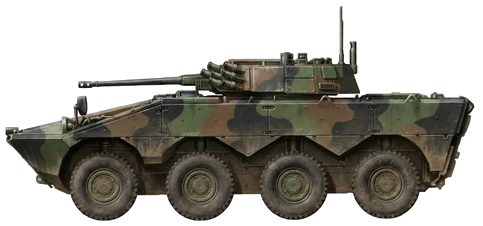
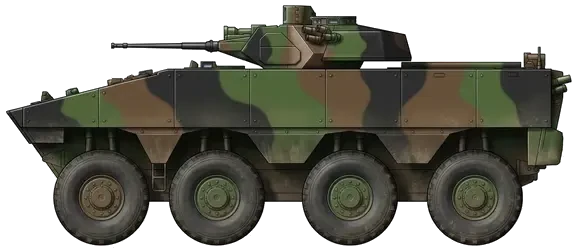
| Iveco Freccia | VBCI | |
|---|---|---|
| Origin country | 🇮🇹 Italy | 🇫🇷 France |
| Category | Infantry Fighting Vehicle | Infantry Fighting Vehicle |
| Type | Infantry Fighting Vehicle | Infantry fighting vehicle |
| Manufacturer | Iveco Defence Vehicles and OTO Melara | Nexter Systems |
| Number produced | 283 units | 640 units |
| Estimated unit price | $6.5 million | $4.8 million |
| Combat weight | 31.5 tons | 32.0 tons |
| Maximum speed | 110 km/h | 100 km/h |
| Operational range | 800 km | 750 km |
| Length | 8.56 m | 7.60 m |
| Width | 2.99 m | 2.98 m |
| Height | 3.18 m | 3.00 m |
| Crew | 3 + 8 | 2 + 9-man combat group |
| Iveco Freccia | VBCI | |
|---|---|---|
| Main armament | KBA 25 mm autocannon | 40mm CTA 40CT autocannon |
| Secondary weapon | Spike LR anti-tank missiles | co-axial 7.62 mm machine gun |
| Engine | Iveco 8262, 550 hp (410 kW) | 600 hp Volvo D13 turbocharged diesel engine |
Detailed Comparison
The Italian VBM Freccia and the French VBCI are 8×8 wheeled infantry fighting vehicles introduced in 2008 to replace Cold War-era tracked platforms. Both vehicles utilize wheeled configurations to lower maintenance costs and improve strategic mobility compared to their predecessors, the M113 and AMX-10P. While the Freccia serves as a direct derivative of the Centauro tank destroyer, the VBCI was developed independently by France following the dissolution of the multinational VBM program.
Development and Design
The Freccia, produced by the Iveco-OTO Melara Consortium, features a hull constructed from high-hardness monocoque steel integrated with ceramic ballistic armor. Its design borrows heavily from the Centauro, sharing drive train components. The vehicle's electronic architecture follows NATO STANAG 4754, integrating the SICCONA command system. The Nexter Systems VBCI utilizes an aluminum hull reinforced with modular THD steel and titanium armor plates, designed for field replacement. A key design constraint for the VBCI was air transportability via the Airbus A400M, which influenced its physical dimensions.
Protection and Firepower
The Freccia offers frontal protection against 30mm APFSDS rounds and side defense against 14.5mm AP. Its V-shaped floor resists mines up to 8kg TNT. Standard armament includes a Hitfist turret with an Oerlikon KBA 25mm autocannon and Spike LR missiles, providing inherent anti-tank capability. The upgraded Freccia PLUS integrates a 30mm chain gun and Spike LR2.
The VBCI's modular armor resists 14.5mm API rounds, with a 32T variant adding reinforced undercarriage protection against IEDs. The standard French Army variant mounts a stabilized GIAT M811 25mm autocannon (400 rounds/minute). Unlike the standard Freccia, the baseline VBCI lacks integrated anti-tank missiles. However, the export-oriented VBCI-2 variant creates a disparity in firepower by integrating a 40mm CTA 40CT autocannon and Akeron MP ATGMs.
Mobility and Logistics
Powered by an Iveco 8262 engine (550 hp), the 31.5-ton Freccia reaches speeds of 110 km/h with an 800 km range. Later variants upgrade to a 720 hp powerplant. The VBCI employs a Volvo D13 diesel engine (600 hp), achieving 100 km/h over a 750 km operational range. The Freccia accommodates a crew of 3 plus 8 infantry, while the VBCI carries a crew of 2 plus a 9-man combat group.
Deployment and Combat Record
The Italian Army utilizes the Freccia in the "Pinerolo," "Aosta," and "Sassari" mechanized brigades. International tests with Russia failed to produce orders, though it remains a candidate for Chile. The VBCI has seen active combat with the French Army in Afghanistan and Mali (Operation Serval). Export adoption occurred later in the program's life, with Greece confirming a procurement program in 2025 and Qatar signing a letter of intent.
Conclusion
The Freccia emphasizes organic anti-armor capability in its baseline configuration through standard missile integration, making it suited for high-intensity conventional warfare. The VBCI prioritizes infantry squad capacity and armor modularity, a design choice validated during asymmetric counter-insurgency operations in the Sahel. While the Freccia benefits from logistical commonality with the Centauro family, the VBCI's higher production numbers (640 vs 283) and recent export interest suggest a wider adoption trajectory for the French platform.