EBRC Jaguar vs Nexter Griffon
EBRC Jaguar vs Nexter Griffon at a glance — weight 25,000 vs 24,500 kg, top speed 90 vs 90 km/h, range 800 vs 800 km, crew — vs —.
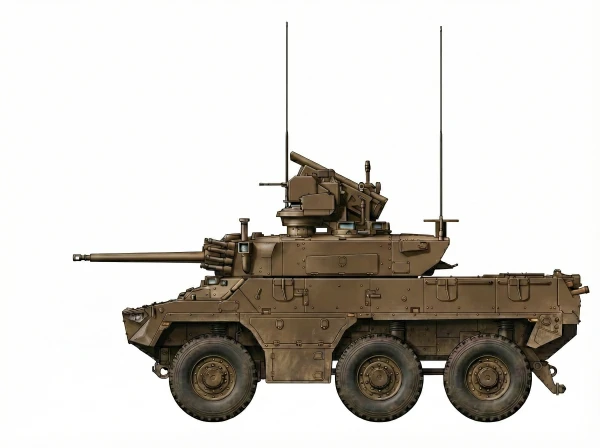
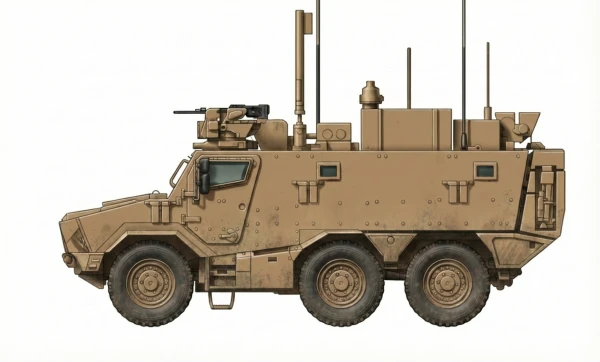
| EBRC Jaguar | Nexter Griffon | |
|---|---|---|
| Origin country | 🇫🇷 France | 🇫🇷 France |
| Category | Light Armoured Vehicle | Armored Personnel Carrier |
| Type | Armoured fighting and reconnaissance vehicle | Multirole armoured personnel carrier |
| Manufacturer | KNDS France / Arquus / Thales | Arquus / Nexter / Thales |
| Number produced | 60 units | 575 units |
| Estimated unit price | $6.3 million | $1.1 million |
| Combat weight | 25.0 tons | 24.5 tons |
| Maximum speed | 90 km/h | 90 km/h |
| Operational range | 800 km | 800 km |
| Length | 7.80 m | 7.58 m |
| Width | 2.99 m | 2.54 m |
| Height | 2.80 m | 2.60 m |
| Crew | 3 (driver + gunner + commander) | 10 (1 pilot, 1 gunner + 8 soldiers max) |
| EBRC Jaguar | Nexter Griffon | |
|---|---|---|
| Main armament | 40 mm Cased Telescoped Armament System | 7.62 mm or 12.7 mm machine gun |
| Secondary weapon | 4 Akeron MP missiles | 40 mm LGA |
| Engine | Militarized Volvo D11 6-cylinder in-line turbodiesel engine, 500 hp (370 kW) | Renault 400 ch (300kW) |
Detailed Comparison
Both vehicles are central to France’s SCORPION modernization program, sharing a 6x6 chassis configuration and networked vetronics architecture while fulfilling divergent tactical roles. The EBRC Jaguar serves as a heavily armed reconnaissance and combat platform designed to replace the AMX-10 RC and ERC 90 Sagaie, whereas the VBMR Griffon functions primarily as an armored personnel carrier intended to supersede the VAB fleet.
Development and Design
Developed by a consortium of KNDS France, Arquus, and Thales, both vehicles prioritize "collaborative combat" via the SICS combat information system. The Jaguar, initiated in 2009, focuses on replacing legacy fire support assets. Its design integrates complex sensor suites for the "SCORPION bubble" network, requiring a twelve-year development cycle. The Griffon, launched later in 2014, utilizes a semi-modular architecture to ensure high component commonality across variants, including troop transport, command post, and mobile mortar carriers. While the Griffon entered service in 2019 with 575 units built, the Jaguar followed in 2022 with a more limited production run of 60 units to date.
Protection and Firepower
The Jaguar prioritizes offensive capability with a 40mm Cased Telescoped Armament System and Akeron MP missiles, providing beyond-line-of-sight anti-tank lethality. It employs a three-person crew and integrates acoustic localization and laser warning receivers for threat detection. In contrast, the Griffon carries defensive armament via a Hornet remote station fitted with a 7.62mm/12.7mm machine gun or 40mm grenade launcher. Its primary focus is the protection of up to eight dismounted soldiers against ballistics and CBRN threats. Both platforms utilize modular armor and the GALIX smoke discharger system, but the Jaguar's sensor suite offers superior situational awareness for direct combat engagements.
Mobility and Logistics
Both vehicles operate on 6x6 chassis with a maximum speed of 90 km/h and an operational range of 800 km. The Jaguar possesses a superior power-to-weight ratio, utilizing a 500 hp Volvo D11 engine for its 25.0-ton combat weight, alongside variable ground clearance for complex terrain. The Griffon, weighing 24.5 tons, utilizes a 400 hp Renault unit. The Jaguar's complexity is reflected in its unit cost of $6.34 million, over four times the Griffon's $1.5 million price tag. To mitigate maintenance burdens, the Jaguar features embedded health monitoring sensors for predictive maintenance.
Deployment and Combat Record
Since entering service in 2022, the Jaguar has integrated into French light cavalry regiments such as the 1st Foreign Cavalry Regiment. The Griffon, active since 2019, serves widely in transport and command roles. Both platforms have been selected by Belgium under the CaMo programme and by Luxembourg. They operate within a digitalized ecosystem where the Jaguar acts as a sensor node, capable of sharing target data instantaneously with Griffon units to coordinate maneuvers.
Conclusion
The EBRC Jaguar is optimized for high-intensity reconnaissance and direct fire support, providing the anti-armor punch required for the vanguard of the battle group. The VBMR Griffon functions as the backbone of infantry mobility, offering essential protection and connectivity for troop movements. Together, they replace a generation of Cold War armor with a tiered, interoperable force structure where the Jaguar detects and engages threats to clear the path for Griffon-mounted infantry.