Afghanistan Military Forces
Afghanistan ranks #99 of 169 militaries worldwide in 2026, with 170,000 active troops. The Afghan Army fields 30 main battle tanks; the Air Force flies 34 aircraft, including 1 combat aircraft. Landlocked, Afghanistan has no navy and no nuclear weapons.
Armed Forces in 2026
| Domain | Strength | Composition |
|---|---|---|
| Air Force | 34 aircraft | 1 combat 23 helicopters |
| Ground Forces | 30 tanks | |
| Personnel | 170,000 active |
ATLAS Index (Aggregate Total of Land, Air and Sea strength)
Full ranking →| Pillar | Weight | Score | Basis |
|---|---|---|---|
| Manpower | 10% | 45.6 | Active, reserve & paramilitary personnel |
| Ground forces | 20% | 21.0 | ARMS inventory power: armour & artillery by type and era, attack helicopters, armament |
| Naval power | 20% | 0.0 | SEAS inventory power: hulls by type, size and era, air wing, sustainment, armament |
| Air power | 25% | 15.2 | AIRS inventory power: aircraft by type and generation, enablers, armament |
| Nuclear deterrent | 10% | 0.0 | No declared nuclear capability |
| Defense budget | 15% | 13.2 | Annual spending, purchasing-power adjusted |
| Availability | modifier | ground ×0.80 · naval ×1.00 · air ×0.90 | Budget per point of each force, from the branch indexes |
Country File
| Population | 43.8M (2025) |
| GDP | $17.8 billion (2024) |
| GDP per capita | $405 |
| Military budget | $278M (2021) |
| Share of GDP | 1.8% (2021) |
| Share of govt spending | 10.3% (2021) |
| Military spending per capita | $7 (2021) |
| Inflation rate | -6.6% (2024) |
| Capital | Kabul |
| Region | Asia |
| Land area | 652,867 km² |
| Land borders | 5,529 km |
| Bordering countries | 6 |
| Currency | AFN |
Strategic Overview in 2026
Strategic Position
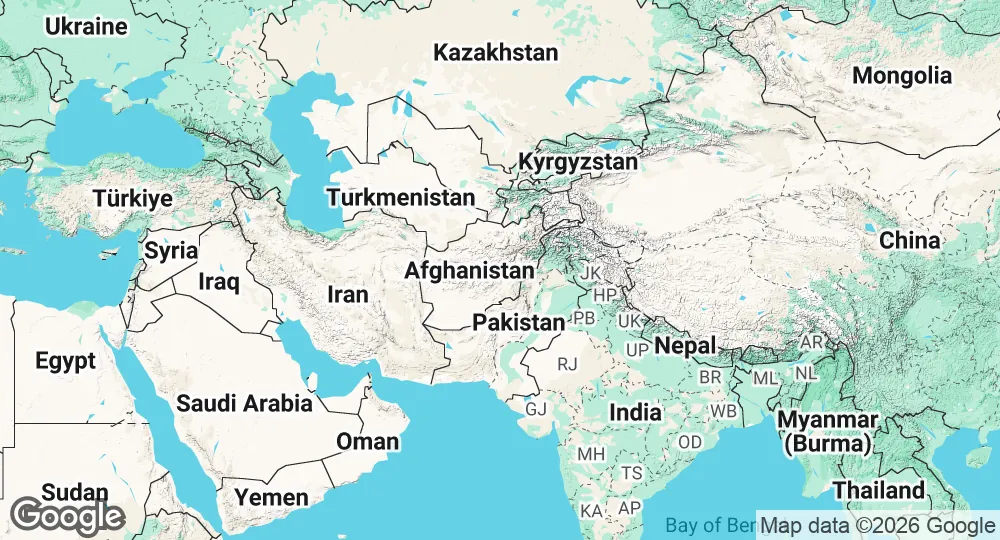
Afghanistan is a landlocked state at the crossroads of Central and South Asia, bordering Iran, Pakistan, Turkmenistan, Uzbekistan, Tajikistan, and China. The primary security concerns of the Islamic Emirate of Afghanistan center on domestic counter-insurgency, particularly against the Islamic State-Khorasan Province (ISKP), and border security. Tensions along the Durand Line with Pakistan, long marked by skirmishes and disputes over border fencing and the presence of militant groups, escalated from October 2025 into the most direct confrontation between the two states since 2021: Afghan cross-border operations in February 2026 were met by Pakistani airstrikes on Kabul and other cities, an Eid al-Fitr truce in March has repeatedly been tested, and Pakistani strikes on Afghan territory continued into September 2026.
The state currently holds no memberships in international military alliances or regional defense pacts such as NATO or the Collective Security Treaty Organization (CSTO). Defense policy is characterized by a transition from an insurgent force to a conventional state military. Strategic priorities include the consolidation of territorial control, the suppression of internal armed opposition, and the professionalization of its security apparatus. Bilateral security relations are primarily pragmatic and focused on counter-terrorism and border management with regional neighbors, including China, Russia, Iran, and the Central Asian republics.
Military Forces
The military structure of Afghanistan is centralized under the Ministry of Defense and the Ministry of Interior. The primary land force is the Islamic Emirate Army, which is organized into regional corps. These corps are stationed in major urban and strategic centers, including Kabul, Kandahar, Herat, Mazar-i-Sharif, Jalalabad, Kunduz, Helmand, and Paktia. Security responsibilities are shared with the General Directorate of Intelligence (GDI) and the Ministry of Interior, which oversees the national police and specialized border security units.
Personnel numbers are estimated at approximately 150,000 active members across all security branches. This force comprises former insurgent fighters integrated into a formal hierarchy alongside some technical personnel from previous administrations.
The inventory consists almost entirely of equipment captured or abandoned during the 2021 withdrawal of international forces and the collapse of the former Afghan National Defense and Security Forces (ANDSF).
-
Ground Forces: The army operates Humvee light armored vehicles, M1117 Guardian armored security vehicles, and International MaxxPro Mine Resistant Ambush Protected (MRAP) vehicles. Tracked armor is limited, though the force maintains a small number of Soviet-era T-55 and T-62 main battle tanks. Artillery assets include D-30 122mm howitzers and various truck-mounted multi-barrel rocket launchers.
-
Air Force: The air force operates a mix of rotary and fixed-wing aircraft. The rotary-wing fleet includes Mi-17 and Mi-35 helicopters, alongside US-manufactured MD-530 light attack and UH-60 Black Hawk helicopters. Fixed-wing assets include A-29 Super Tucano light attack aircraft and C-130 Hercules and Cessna 208 Caravan transport aircraft.
-
Specialized Units: The Badri 313 Battalion and the Red Unit (Sre Khita) serve as elite infantry and rapid response forces, equipped with modern small arms, night-vision optics, and tactical gear.
Defense Industry
Afghanistan possesses a negligible domestic arms manufacturing sector. Activity is focused on the maintenance, repair, and overhaul (MRO) of existing equipment through the Abu Bakr Sadiq and Central Workshops. These facilities are used to refurbish captured armored vehicles, light aircraft, and helicopters. Engineers within these workshops have demonstrated the ability to repair airframes and ground platforms without manufacturer support by cannibalizing parts from non-functional units. There is no domestic production of heavy weaponry, advanced electronics, or aircraft. The state relies on the illicit market or covert procurement for specialized components and ammunition not already present in stockpiles.
Strategic Trends
The primary strategic shift is the ongoing conversion of the force from a decentralized guerilla organization to a conventional military with a standardized command and control system. This includes the introduction of standardized uniforms, formal rank structures, and centralized training programs at the Kabul Military Training Center.
Procurement priorities focus on the serviceability of aviation assets and the acquisition of surveillance technology, including unmanned aerial vehicles (UAVs) for border monitoring and counter-insurgency. However, the military faces severe constraints due to the lack of international recognition, which prevents formal procurement of spare parts, specialized munitions, and advanced technology from global manufacturers.
Defense spending is not publicly detailed in a standardized format, but a high proportion of the national budget is allocated to the security ministries to maintain internal stability and border defenses. The long-term force structure aims to integrate various paramilitary and former insurgent elements into a cohesive national army, though this process is limited by fiscal constraints and the lack of external military assistance. Over the 2025-2026 period, the military has prioritized the fortification of the eastern and northern borders to mitigate cross-border infiltration and reinforce territorial integrity.
Military Expenditure: information from the Stockholm International Peace Research Institute (SIPRI) Military Expenditure Database. Last updated on 26 September 2026. Suggest a change
Frequently Asked Questions
How large is Afghanistan's military?
What is Afghanistan's defense budget?
How does Afghanistan rank militarily in the world?
Does Afghanistan have nuclear weapons?
How many aircraft does Afghanistan's air force have?
How many tanks does Afghanistan have?
What percentage of GDP does Afghanistan spend on defense?
What is Afghanistan's military personnel per capita?
- SEP 262026 Updated Overview updated: 2025-2026 confrontation with Pakistan along the Durand Line
- SEP 252026 Updated Population added for 2025; GDP series revised
- AUG 42026 Updated Global Military Index updated in a site-wide editorial pass
- JUL 162026 Updated Global Military Index updated in a site-wide editorial pass
- JUN 162026 Updated Economic and demographic series refreshed (3 yearly records)
- JAN 172026 Updated Main battle tank count and Global Military Index updated
- JAN 132026 Updated Description updated