Azerbaijan Military Forces
Azerbaijan ranks #49 of 170 militaries worldwide in 2026, with 64,050 active troops. The Azerbaijani Army fields 5,385 ground vehicles, including 497 main battle tanks; the Air Force flies 210 aircraft, including 39 combat aircraft; the Navy operates 26 warships. Landlocked, Azerbaijan has no navy and no nuclear weapons.
Armed Forces in 2026
| Domain | Strength | Composition |
|---|---|---|
| Air Force | 210 aircraft | 39 combat 101 helicopters 4 air bases +36 on order |
| Azerbaijani Navy | 26 warships | 1 major combatants |
| Ground Forces | 5,385 vehicles | 497 main battle tanks |
| Personnel | 64,050 active | 300,000 reserve 15,000 paramilitary |
ATLAS Index (Aggregate Total of Land, Air and Sea strength)
Full ranking →| Pillar | Weight | Score | Basis |
|---|---|---|---|
| Manpower | 10% | 50.5 | Active, reserve & paramilitary personnel |
| Ground forces | 20% | 52.3 | ARMS inventory power: armour & artillery by type and era, attack helicopters, armament |
| Naval power | 20% | 14.5 | SEAS inventory power: hulls by type, size and era, air wing, sustainment, armament |
| Air power | 25% | 26.4 | AIRS inventory power: aircraft by type and generation, enablers, armament |
| Nuclear deterrent | 10% | 0.0 | No declared nuclear capability |
| Defense budget | 15% | 31.9 | Annual spending, purchasing-power adjusted |
| Availability | modifier | ground ×0.93 · naval ×1.20 · air ×1.13 | Budget per point of each force, from the branch indexes |
Country File
| Population | 10.2M (2024) |
| GDP | $74.3 billion (2024) |
| GDP per capita | $7,284 |
| Military budget | $3.8B (2024) |
| Share of GDP | 5.1% (2024) |
| Military spending per capita | $371 (2024) |
| Inflation rate | 2.21% (2024) |
| Capital | Baku |
| Region | Asia |
| Land area | 86,100 km² |
| Land borders | 2,013 km |
| Bordering countries | 5 |
| Currency | AZN |
Strategic Overview in 2026
Strategic Position
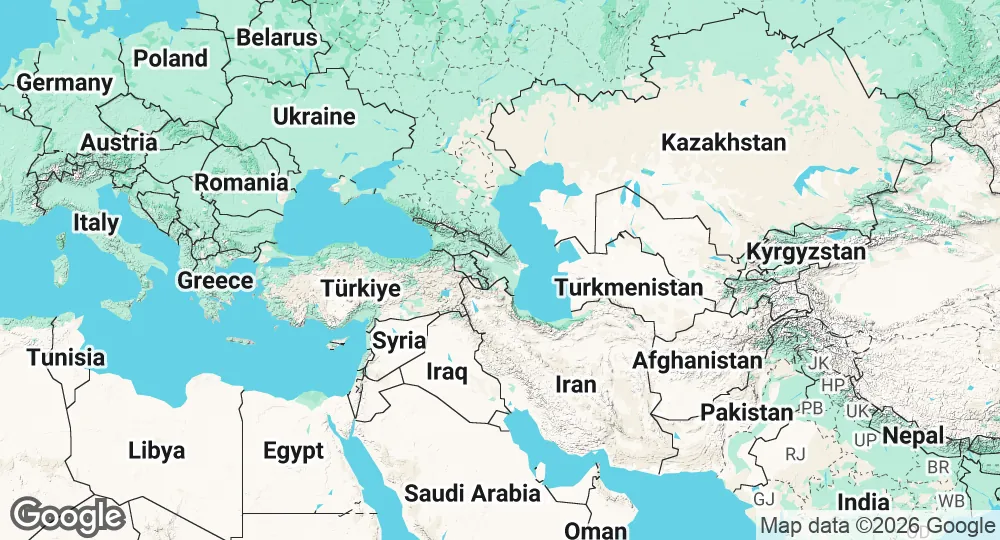
Azerbaijan's defense posture is defined by its geographic location in the South Caucasus, bordering Armenia, Georgia, Russia, Iran, and Turkey, with an eastern coastline on the Caspian Sea. The state’s primary security priority is the maintenance of territorial integrity and the deterrence of regional rivals, particularly following the dissolution of the Nagorno-Karabakh conflict.
The defense doctrine is increasingly aligned with the Turkish military model, a transition accelerated by the 2021 Shusha Declaration. This bilateral agreement with Turkey establishes a mutual defense pact, stipulating that an attack on one signatory constitutes an attack on both. In December 2025, this relationship was further formalized through a memorandum on mutual security reinforcement, which aims to integrate command structures under a "one army" framework.
Beyond Turkey, Azerbaijan maintains a trilateral security dialogue with Pakistan and Turkey, and a long-standing military-technical partnership with Israel. While formerly a recipient of Russian military hardware, Azerbaijan has recently diversified its procurement sources, moving toward Chinese, Pakistani, and Western systems. Relations with Iran remain a point of strategic concern, influencing the deployment of forces along the southern border and the expansion of the Caspian fleet.
Military Forces
The Armed Forces of the Republic of Azerbaijan consist of the Land Forces, the Air and Air Defense Forces, and the Navy. Paramilitary organizations that support the regular military during conflict include the State Border Service and the Internal Troops.
Personnel The military maintains approximately 80,000 active-duty personnel, supported by a reserve force of roughly 300,000. Paramilitary forces contribute an additional 20,000 personnel.
Land Forces The army is the largest branch and has undergone structural reorganization into mechanized and commando units. It fields a fleet of main battle tanks consisting of T-72 and T-90 variants. Armored mobility is provided by BTR and BMP series vehicles alongside more modern mine-resistant ambush-protected (MRAP) platforms. The artillery component includes a mix of Soviet-era systems and advanced rocket artillery such as the Israeli LORA and Turkish TRG-300.
Air and Air Defense Forces The Air Force is currently in a phase of transition. In late 2025, Azerbaijan inducted its first batch of JF-17 Block III multirole fighters from Pakistan to modernize its combat fleet, which has traditionally relied on MiG-29 and Su-25 aircraft. The branch is characterized by its extensive use of unmanned aerial vehicles (UAVs), including the Bayraktar TB2 and Akinci from Turkey, and the Harop and Orbiter series from Israel. Air defense is provided by S-300PMU2, HQ-9BE, and various short-to-medium-range missile systems.
Navy Operating in the Caspian Sea, the Navy maintains a fleet of patrol boats, minesweepers, and landing craft. It focuses on the protection of offshore energy infrastructure and maritime border security.
Specialized Units The "Yashma" Special Forces and newly established Commando brigades are specialized for rapid reaction, unconventional warfare, and high-tempo mountain operations.
Defense Industry
The Ministry of Defense Industry oversees domestic production, which has shifted from basic maintenance to the manufacturing of advanced systems. Azerbaijan produces a variety of small arms, mortars, ammunition, and armored vehicles under license.
A central element of the domestic industry is the development of a military-industrial cluster. This includes joint ventures with Turkish firms for the local assembly of UAV components and the production of precision-guided munitions. Strategic agreements signed in 2025 involve collaboration with Israeli and Slovakian companies to enhance domestic capabilities in electronic warfare and artillery production. While Azerbaijan still relies on imports for high-end platforms like fighter aircraft and long-range air defense, it has achieved self-sufficiency in many categories of ammunition and light tactical equipment.
Strategic Trends
Defense spending for 2026 is approximately $5.1 billion, representing roughly 21% of the total state budget. This funding level remains elevated as the military modernizes its command-and-control infrastructure to meet NATO standards, facilitated by Turkish advisors.
A major procurement priority is the expansion of the air wing through a multi-billion dollar contract for JF-17 Block III fighters, intended to eventually replace the Soviet-origin fleet. Simultaneously, the military is integrating artificial intelligence into its reconnaissance-strike complexes to refine its network-centric warfare capabilities.
Operational focus has shifted toward the "Zangezur corridor" and the reinforcement of the border with Armenia. Challenges include the need to integrate disparate hardware from Russia, Israel, and NATO-aligned Turkey into a unified digital battlefield management system and the ongoing requirement to manage complex security relations with neighboring Iran and Russia.
Military Expenditure: CIA World Factbook. Last updated on 11 August 2026. Suggest a change
Frequently Asked Questions
How large is Azerbaijan's military?
What is Azerbaijan's defense budget?
How does Azerbaijan rank militarily in the world?
Does Azerbaijan have nuclear weapons?
How many aircraft does Azerbaijan's air force have?
How large is Azerbaijan's navy?
How many tanks does Azerbaijan have?
What percentage of GDP does Azerbaijan spend on defense?
What is Azerbaijan's military personnel per capita?
Does Azerbaijan have paramilitary forces?
- AUG 112026 Updated Global Military Index updated
- AUG 42026 Updated Global Military Index updated in a site-wide editorial pass
- AUG 32026 Updated Global Military Index updated
- JUL 222026 Updated Rank insignia and ranks overview added
- JUL 162026 Updated Global Military Index updated in a site-wide editorial pass
- JUN 162026 Updated Yearly statistics, military spending and military spending share of GDP updated
- JAN 172026 Updated Main battle tank count and Global Military Index updated