JF-17 Thunder
Jointly developed by China and Pakistan, the combat aircraft has seen deployment in multiple military operations since 2007. Key figures: top speed 1,960 km/h, range 900 km, service ceiling 16,700 m, max takeoff weight 12,701 kg, unit price $25M, built 144. In service with 4 air forces as of 2026 — Pakistan (156), Myanmar (7), Azerbaijan (5) and 1 other.
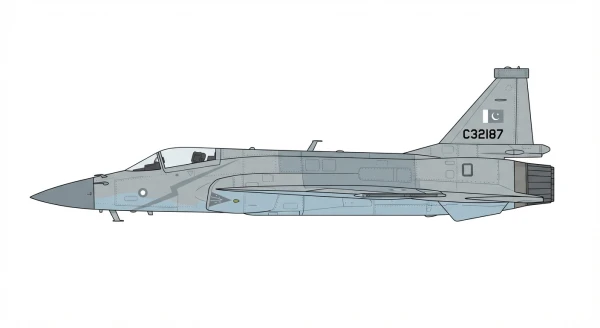
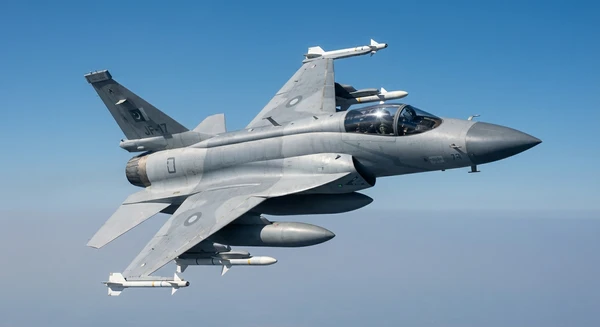
| Crew | 1 |
| Length | 14 m (45.9 ft) |
| Wingspan | 9 m (29.5 ft) |
| Height | 4.8 m (15.6 ft) |
| Wing area | 24.4 m² (262.6 sqft) |
| Empty weight | 6,411 kg (14,134 lbs) |
| Max. takeoff weight | 12,701 kg (28,001 lbs) |
| Powerplant | 1 × turbofan Klimov RD-93 8,606 kgf each |
| Ejection seat | Martin-Baker Mk 16LE |
| Maximum speed | 1960 km/h (Mach 1.96) |
| Operational range | 900 km (559 mi) |
| Service ceiling | 16,700 m (54,790 ft) |
| Climb rate | 300.0 m/s (984.3 ft/s) |
-
 Pakistan
156 +27
Pakistan
156 +27
-
 Myanmar
7 +9
Myanmar
7 +9
-
 Azerbaijan
5 +35
Azerbaijan
5 +35
-
 Nigeria
3
Nigeria
3
-
 Libya
0 +16
Libya
0 +16
- Air-to-Surface AM39 Exocet
- Air-to-Surface CASIC YJ-83 (CSS-N-8 Saccade)
- Air-to-Air Medium-Range Leihua Electronic Technology Research Institute PL-12
- Anti-Radiation MAR-1
- Cruise Missiles NESCOM Ra'ad
- Air-to-Air Short-Range PL-5
- Air-to-Air Short-Range PL-10
- Air-to-Air Long-Range PL-15
Recent Events — JF-17 Thunder
1 event →
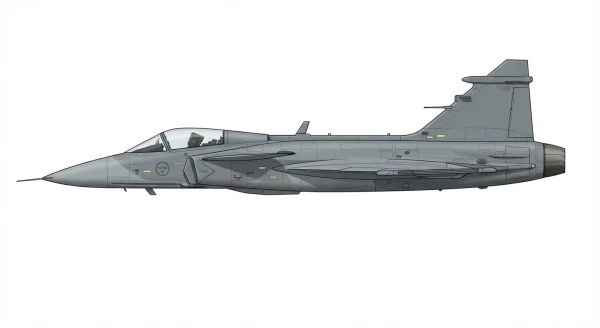

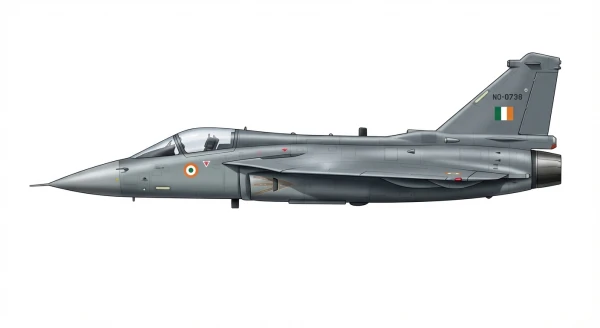
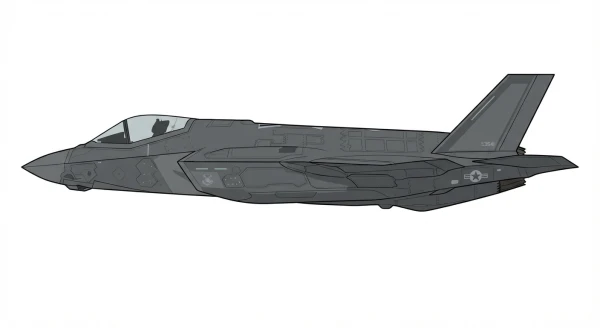
Description
The CAC/PAC JF-17 Thunder, designated FC-1 Xiaolong in China, is a single-engine lightweight supersonic multirole combat aircraft jointly developed by China's Chengdu Aircraft Corporation and the Pakistan Aeronautical Complex. Designed to replace Pakistan's aging fleet of third-generation combat aircraft, the fighter performs air superiority, interception, precision ground attack, maritime strike, close air support, and reconnaissance. It entered service with the Pakistan Air Force in 2007 as a cost-effective platform to complement the F-16.
Development
The joint development program formally began with a 1995 memorandum of understanding between Pakistan and China. Prototype production commenced in September 2002, and prototype PT-01 performed its maiden flight in August 2003. A redesigned prototype, PT-04, flew in April 2006, incorporating diverterless supersonic inlets, enlarged leading edge root extensions, and a modified vertical fin. The Pakistan Aeronautical Complex manufactures 58 percent of the airframe and conducts final assembly at Kamra, with 42 percent produced in China. Deliveries to the Pakistan Air Force included 70 Block 1 aircraft, 33 Block 2 aircraft, and 26 dual-seat JF-17B models prior to the initiation of Block 3 serial production in December 2020.
Design
The semi-monocoque airframe uses aluminum alloys, with composite materials incorporated into later production blocks to reduce weight. Aerodynamic features include cropped-delta wings, root extensions, and diverterless supersonic inlets. Flight controls utilize a digital fly-by-wire system in pitch and stability augmentation in roll and yaw. Engine options include the Klimov RD-93 afterburning turbofan on earlier variants and the RD-93MA on Block 3 aircraft. Cockpit equipment includes three color multi-function displays, a wide-angle holographic head-up display, and a Martin-Baker PK16LE zero-zero ejection seat. Sensors include an NRIET KLJ-7 pulse-Doppler radar or an air-cooled KLJ-7A AESA radar.
Armament
Internal armament consists of a single 23 mm GSh-23-2 twin-barrel autocannon. Up to 3,400 kg (7,500 lb) of ordnance is mounted across seven external hardpoints on Blocks 1 and 2, while Block 3 adds an eighth chin-mounted hardpoint. Air-to-air weaponry includes short-range PL-5E II and PL-10E missiles alongside beyond-visual-range PL-12 and PL-15E missiles. Surface attack munitions comprise MAR-1 anti-radiation missiles, CM-400AKG supersonic missiles, C-802AK anti-ship missiles, Ra'ad-II cruise missiles, laser-guided bombs, and unguided gravity bombs.
Operational History
The Pakistan Air Force inducted its first operational unit, No. 26 Black Spiders Squadron, in February 2010. Pakistani JF-17s conducted strike missions in South Waziristan and Operation Zarb-e-Azb, shot down an Iranian drone in 2017, performed ground strikes during the 2019 skirmish with India, and carried out cross-border strikes in Iran and Afghanistan in 2024. Export operations include 11 Block 2 aircraft delivered to Myanmar and three Block 2 aircraft to Nigeria for counter-insurgency operations. In 2024, Azerbaijan contracted for 40 Block 3 aircraft, with deliveries commencing in October 2025.
Variants
- JF-17 Block 1: Initial single-seat production variant equipped with an NRIET KLJ-7 radar and powered by a Klimov RD-93 turbofan.
- JF-17 Block 2: Single-seat variant featuring air-to-air refueling capability, increased composite structure, and updated avionics.
- JF-17B Block 2: Dual-seat trainer and operational variant incorporating internal fuel storage within a modified vertical stabilizer and enlarged dorsal spine.
- JF-17 Block 3: Single-seat variant equipped with a KLJ-7A AESA radar, wide-angle HUD, IRST sensor, and an eighth hardpoint.
- JF-17 Block 4 (PFX-Alpha): Under-development variant designed to integrate indigenously developed IRST sensors and an AESA radar-jamming suite.
Frequently Asked Questions
What type of aircraft is the JF-17 Thunder?
What is the maximum speed of the JF-17 Thunder?
What is the range of the JF-17 Thunder?
When did the JF-17 Thunder first fly?
How many JF-17 Thunder have been built?
Which countries operate the JF-17 Thunder?
How much does a JF-17 Thunder cost?
What is the service ceiling of the JF-17 Thunder?
- AUG 272026 Updated Unit price re-based (flyaway cost of the most-produced variant, then-year USD convention)
- AUG 62026 Updated Description updated
- AUG 52026 Updated Climb rate added; powerplant and thrust updated
- AUG 12026 Updated Manufacturer updated
- JUL 232026 Updated Sources and cross-references refreshed
- JUN 262026 Updated Missiles updated
- APR 72026 Updated Picture credits updated in a site-wide editorial pass