Burundi Military Forces 🇧🇮
Military Strength Overview
| 🛩️ Air Force | 12 active aircraft |
| 🪖 Active Troops | 30,050 personnels |
| 👮♀️ Paramilitary | 21,000 personnels |
Global Military Index
| 🪖 Manpower (15%) | 65.2 | Active, reserve & paramilitary: 36350 effective |
| 🛡️ Ground Firepower (20%) | 23.1 | Main battle tanks: 10 |
| ⚓ Naval Power (20%) | 0.0 | Weighted by ship type: carriers, submarines, destroyers... |
| ✈️ Air Power (25%) | 28.5 | Weighted by aircraft type: combat, bombers, helicopters... |
| ☢️ Nuclear Deterrent (10%) | 0.0 | No declared nuclear capability |
| 💰 Defense Budget (10%) | 34.4 | $172M annual military spending |
Methodology: Log-scaled composite index using SIPRI, IISS, and GMNET data. Each pillar is normalized to 0-100, then weighted by strategic importance.
Geography

| Capital | Gitega |
| Land Area | 25,680 km² |
| Coastline Length | 0 km |
National Flag
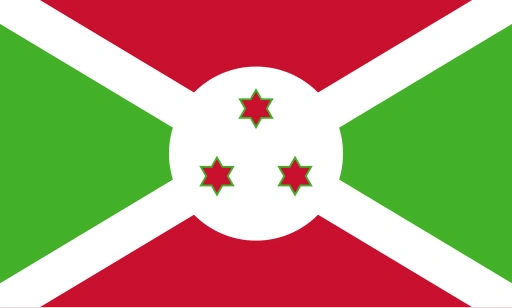
Defense Statistics & Key Metrics
| Population | 13.7 million (2023) |
| GDP | $2.6 billion (2023) |
| GDP per capita | $193 (2023) |
| Military Budget | $171.8 million (2024) |
| Share of GDP in Milex | 3.8% (2024) |
| Share of Govt Expenditures | 12.5% (2024) |
| Military spends per capita | $12 (2024) |
| Inflation Rate | 20.21% (2024) |
| Military Personnel | 31,000 (2020) |
Burundian Military Budget History
Population and Military Personnel Trends
GDP and Inflation Rate Trends
Strategic Overview in 2026
Strategic Position
Burundi is situated in the African Great Lakes region, a landlocked territory bordered by Rwanda, the Democratic Republic of the Congo (DRC), and Tanzania. Primary security concerns are dictated by the presence of non-state armed groups in the eastern DRC and the periodic volatility of relations with neighboring Rwanda. A specific focus is directed toward the Résistance pour un État de Droit au Burundi (RED-Tabara), an insurgent group operating from Congolese territory.
Burundi is a member of the East African Community (EAC) and the African Union (AU). The National Defence Force of Burundi (FDNB) is an active participant in regional security initiatives, including the African Union Transition Mission in Somalia (ATMIS). In 2025, Burundi maintained a bilateral security agreement with the DRC, facilitating the deployment of Burundian troops to South Kivu for counter-insurgency operations. Defense doctrine prioritizes internal stability, border security, and the maintenance of a professional force capable of securing international peacekeeping contracts, which serve as a source of revenue and operational training.
Military Forces
The National Defence Force of Burundi (FDNB) is organized into three primary branches: the Land Force, the Air Force, and the Marine Unit. Total active personnel are estimated at approximately 30,000. The command structure is centralized under the Ministry of National Defence and War Veterans.
The Land Force is the primary component of the FDNB, organized into infantry battalions, an armored regiment, and supporting artillery and engineer units. The inventory consists of T-54 and T-55 main battle tanks, alongside BRDM-2 reconnaissance vehicles and AML-60/90 armored cars. Mechanized infantry units utilize BTR-60 and BTR-80 armored personnel carriers. For counter-insurgency and convoy protection, the army operates mine-protected vehicles, including the RG-31 Nyala and Casspir. Artillery support is provided by D-30 122mm howitzers and BM-21 Grad multiple rocket launchers.
The Air Force operates a small inventory focused on rotary-wing assets and light trainers. The fleet includes Mi-24 and Mi-35 attack helicopters and Mi-8/17 transport helicopters. Training is conducted using SIAI-Marchetti SF-260 turboprop aircraft. The FDNB lacks dedicated fixed-wing fighter or ground-attack aircraft.
The Marine Unit operates on Lake Tanganyika, which forms a border with the DRC and Tanzania. Its inventory consists of small patrol boats and rigid-hull inflatable boats (RHIBs) used for littoral surveillance and the prevention of maritime infiltration by rebel groups.
Specialized capabilities include the Brigade Spéciale de Protection des Institutions (BSPI), a unit dedicated to the protection of high-ranking government officials and sensitive infrastructure.
Defense Industry
Burundi does not possess a domestic defense industry capable of manufacturing complex weapon systems. The military is entirely dependent on foreign imports for its hardware, including small arms, ammunition, and vehicles. Historical procurement patterns show a reliance on Russian, Chinese, and French equipment. Maintenance and repair of heavy equipment are typically handled by internal workshops or through service agreements with foreign contractors. There are no known domestic production lines for armored vehicles or aircraft.
Strategic Trends
Modernization efforts in 2025 and 2026 focus on enhancing the mobility and surveillance capabilities of the Land Force. Procurement priorities include light armored vehicles and unmanned aerial vehicles (UAVs) for reconnaissance in the rugged terrain bordering the DRC. The FDNB is also seeking to upgrade its communications equipment to improve coordination between units deployed abroad and central command.
Defense spending is estimated at approximately 2% of GDP. A primary constraint facing the FDNB is the volatility of international funding for peacekeeping operations. These missions provide the financial resources necessary to sustain personnel salaries and equipment maintenance; any reduction in AU or UN mandates directly impacts the military's operational readiness.
The military remains involved in the DRC, where it operates both independently and in coordination with the Congolese armed forces (FARDC). This deployment serves as a forward-defense strategy to neutralize RED-Tabara militants before they can launch cross-border incursions. Internally, the military continues to manage the ethnic integration quotas established by the Arusha Accords, though centralized political control over the officer corps remains a defining characteristic of the current force structure.
Frequently Asked Questions
How large is Burundi's military?
What is Burundi's defense budget?
How does Burundi rank militarily in the world?
Does Burundi have nuclear weapons?
How many aircraft does Burundi's air force have?
How many tanks does Burundi have?
What percentage of GDP does Burundi spend on defense?
What is Burundi's military personnel per capita?
Does Burundi have paramilitary forces?
Military Expenditure: SIPRI Milex. Suggest a change