Bolivia Military Forces 🇧🇴
Military Strength Overview
| 🛩️ Air Force | 67 active aircraft |
| 🪖 Active Troops | 34,100 personnels |
| 👮♀️ Paramilitary | 37,100 personnels |
Global Military Index
| 🪖 Manpower (15%) | 66.5 | Active, reserve & paramilitary: 45230 effective |
| 🛡️ Ground Firepower (20%) | 38.7 | Main battle tanks: 54 |
| ⚓ Naval Power (20%) | 0.0 | Weighted by ship type: carriers, submarines, destroyers... |
| ✈️ Air Power (25%) | 40.0 | Weighted by aircraft type: combat, bombers, helicopters... |
| ☢️ Nuclear Deterrent (10%) | 0.0 | No declared nuclear capability |
| 💰 Defense Budget (10%) | 43.3 | $655M annual military spending |
Methodology: Log-scaled composite index using SIPRI, IISS, and GMNET data. Each pillar is normalized to 0-100, then weighted by strategic importance.
Geography
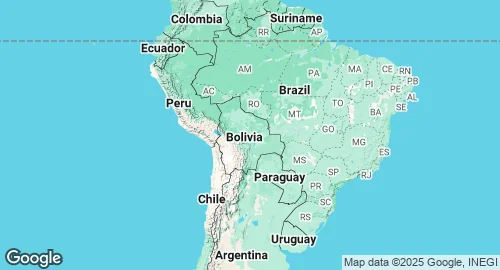
| Capital | Sucre |
| Land Area | 1,083,301 km² |
| Coastline Length | 0 km |
National Flag

Defense Statistics & Key Metrics
| Population | 12.2 million (2023) |
| GDP | $45.1 billion (2023) |
| GDP per capita | $3686 (2023) |
| Military Budget | $655.1 million (2024) |
| Share of GDP in Milex | 1.4% (2024) |
| Share of Govt Expenditures | 3.7% (2024) |
| Military spends per capita | $53 (2024) |
| Inflation Rate | 5.1% (2024) |
| Military Personnel | 71,000 (2020) |
Bolivian Military Budget History
Population and Military Personnel Trends
GDP and Inflation Rate Trends
Strategic Overview in 2026
Strategic Position
Bolivia is a landlocked state in central South America, sharing borders with Brazil, Paraguay, Argentina, Chile, and Peru. Its defense posture is defined by its lack of maritime access, a condition resulting from the 19th-century War of the Pacific. A permanent strategic priority remains the recovery of sovereign access to the Pacific Ocean, which sustains a persistent diplomatic and territorial dispute with Chile.
Primary security concerns involve internal social stability and border integrity. The military is tasked with combating transnational criminal organizations, particularly those involved in narcotrafficking, illegal mining, and smuggling across the Amazonian and Andean frontiers. Historically aligned with the Bolivarian Alliance for the Peoples of Our America (ALBA), Bolivia has maintained close defense cooperation with China, Russia, and Iran. However, the 2025 general elections initiated a shift toward pro-market and pro-Western foreign policies. Relations with the United States, characterized by restricted cooperation for over a decade, show signs of realignment in 2026 as the new administration seeks assistance in counter-narcotics and economic stabilization.
Military Forces
The Armed Forces of Bolivia consist of the Army, Air Force, and Navy, totaling approximately 35,000 to 40,000 active personnel. The National Police, while under the Ministry of Government, serves as a reserve force and participates in internal security operations.
- Army: The largest branch, organized into ten territorial divisions across six military regions. The armored component operates SK-105 Kürassier light tanks and EE-9 Cascavel armored cars. Mechanized units utilize EE-11 Urutu and M113 armored personnel carriers. Infantry equipment includes IMI Galil and FN FAL assault rifles.
- Air Force: Tasked with air defense, transport, and reconnaissance. The combat fleet relies on Hongdu K-8W Karakorum light attack and trainer aircraft, supported by Pilatus PC-7 trainers. The transport wing operates C-130 Hercules and Chinese-built MA60 aircraft. The helicopter fleet is composed of Harbin Z-9, Eurocopter AS332 Super Puma, and Bell UH-1 Iroquois models. The force lacks dedicated supersonic interceptors, a deficit addressed through the implementation of the Thales SIDACTA integrated air defense and traffic control system.
- Navy: Operates exclusively in riverine and lacustrine environments, primarily on Lake Titicaca and the extensive Amazonian river network. The fleet consists of river patrol craft, including Chinese-built Type 928 YC boats, and logistical support vessels. It maintains the "Mar para Bolivia" (Sea for Bolivia) doctrine to preserve maritime expertise despite being landlocked.
- Specialized Capabilities: The military operates a dedicated Cyberdefense department to monitor communications and protect state infrastructure from asymmetric threats.
Defense Industry
The domestic defense industry is overseen by the Corporación de las Fuerzas Armadas para el Desarrollo Nacional (COFEDENA). Industrial activities are limited to the production of small arms ammunition, uniforms, and the assembly of light tactical vehicles. Self-sufficiency is low, necessitating a heavy reliance on foreign imports for advanced platforms and electronics. Primary suppliers include China for aviation and light armored vehicles, and France for radar and surveillance systems.
Strategic Trends
Defense spending in 2025 and 2026 remains approximately 1.4% of GDP. Procurement priorities focus on border surveillance technologies, including the acquisition of unmanned aerial vehicles (UAVs) to monitor remote regions. The 2025 political transition has prompted a reassessment of military doctrine, emphasizing professionalization and the reduction of military involvement in civil governance following the period of institutional instability in the mid-2020s.
Operational readiness is constrained by an ongoing economic crisis characterized by foreign exchange shortages. These financial limitations hinder the acquisition of new interceptor platforms and the modernization of the aging armored fleet. Strategic planning for 2026 emphasizes "Integral Defense," a doctrine integrating military, social, and economic resources to maintain territorial sovereignty and internal order. Efforts are also underway to expand interoperability with regional neighbors through joint counter-smuggling operations.
Frequently Asked Questions
How large is Bolivia's military?
What is Bolivia's defense budget?
How does Bolivia rank militarily in the world?
Does Bolivia have nuclear weapons?
How many aircraft does Bolivia's air force have?
How many tanks does Bolivia have?
What percentage of GDP does Bolivia spend on defense?
What is Bolivia's military personnel per capita?
Does Bolivia have paramilitary forces?
Military Expenditure: SIPRI Milex. Suggest a change