Kenya Military Forces
Kenya ranks #78 of 170 militaries worldwide in 2026, with 24,100 active troops. The Kenyan Army fields 800 ground vehicles, including 78 main battle tanks; the Air Force flies 158 aircraft, including 23 combat aircraft; the Navy operates 22 warships. Kenya has no nuclear weapons.
Armed Forces in 2026
| Domain | Strength | Composition |
|---|---|---|
| Kenya Air Force | 158 aircraft | 23 combat 83 helicopters 3 air bases +2 on order |
| Kenya Navy | 22 warships | |
| Ground Forces | 800 vehicles | 78 main battle tanks |
| Personnel | 24,100 active | 5,000 paramilitary |
ATLAS Index (Aggregate Total of Land, Air and Sea strength)
Full ranking →| Pillar | Weight | Score | Basis |
|---|---|---|---|
| Manpower | 10% | 29.5 | Active, reserve & paramilitary personnel |
| Ground forces | 20% | 26.0 | ARMS inventory power: armour & artillery by type and era, attack helicopters, armament |
| Naval power | 20% | 20.1 | SEAS inventory power: hulls by type, size and era, air wing, sustainment, armament |
| Air power | 25% | 22.2 | AIRS inventory power: aircraft by type and generation, enablers, armament |
| Nuclear deterrent | 10% | 0.0 | No declared nuclear capability |
| Defense budget | 15% | 19.5 | Annual spending, purchasing-power adjusted |
| Availability | modifier | ground ×0.93 · naval ×1.03 · air ×0.91 | Budget per point of each force, from the branch indexes |
Country File
| Population | 57.5M (2025) |
| GDP | $135.9 billion (2025) |
| GDP per capita | $2,363 |
| Military budget | $1.3B (2024) |
| Share of GDP | 1.1% (2024) |
| Military spending per capita | $23 (2024) |
| Inflation rate | 4.07% (2025) |
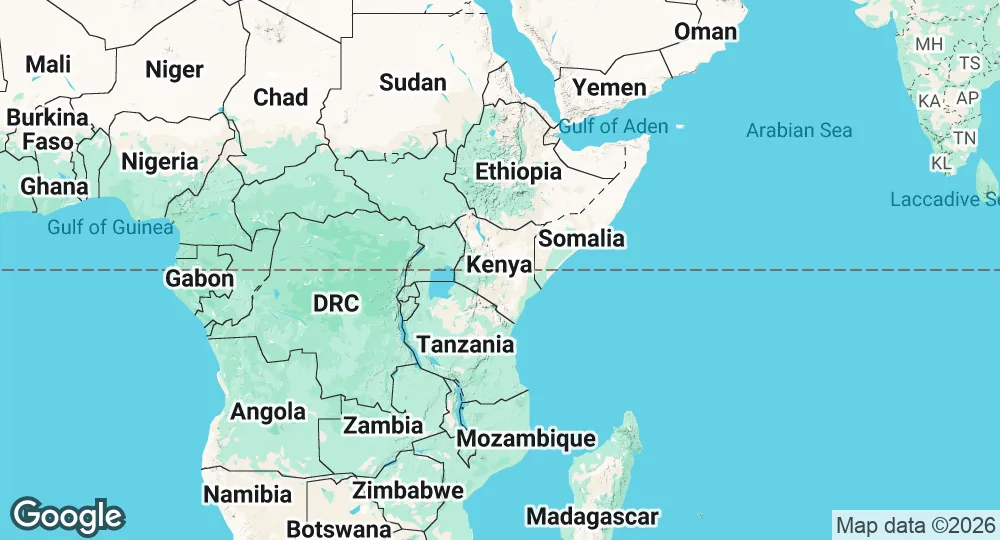
| Capital | Nairobi |
| Region | Africa |
| Land area | 569,140 km² |
| Coastline | 536 km |
| Land borders | 3,477 km |
| Bordering countries | 5 |
| Currency | KES |
Strategic Overview in 2026
Strategic Position
Kenya occupies a central role in East African security, primarily defined by its long-standing conflict with the al-Shabaab insurgent group and its status as a major regional military power. The country’s defense doctrine prioritizes territorial integrity, maritime security in the Indian Ocean, and participation in multilateral peace support operations. Primary security concerns include the spillover of instability from Somalia, internal banditry in the North Rift region, and emerging threats from the Red Sea maritime corridor.
In June 2024, Kenya was designated a Major Non-NATO Ally (MNNA) by the United States, making it the first sub-Saharan African nation to hold this status. This designation facilitates deeper bilateral security cooperation, including preferential access to training and military equipment. However, as of late 2025, this status is subject to a legislative review by the United States Congress focused on Kenya’s growing diplomatic and security engagements with China, Russia, and Iran. Kenya also maintains a significant bilateral defense relationship with the United Kingdom through the British Army Training Unit Kenya (BATUK), which operates a permanent base at Nyati Barracks in Nanyuki and facilitates joint exercises for up to six British infantry battalions annually.
Regionally, Kenya is a member of the East African Community (EAC) and historically participates in the African Union Transition Mission in Somalia (ATMIS). In 2025, Kenya expanded its international security profile by leading the Multinational Security Support (MSS) mission in Haiti, which transitioned into a United Nations-mandated Gang Suppression Force (GSF) in late 2025.
Military Forces
The Kenya Defence Forces (KDF) are structured into three primary branches: the Kenya Army, the Kenya Air Force, and the Kenya Navy. Total active personnel are approximately 50,000, with ongoing recruitment cycles in 2025 and 2026 aimed at expanding the General Service Officer (GSO) and specialist ranks.
The Kenya Army is the largest branch and operates a fleet of main battle tanks, including the Vickers Mk 3. Its armored capability is supported by a variety of infantry fighting vehicles and armored personnel carriers, such as the Hizir 4x4, Bastion, Puma M26, and WZ-551. Field artillery includes 105mm and 155mm towed howitzers. Specialized units include the Special Operations Regiment (SOR), which has been utilized extensively in counter-terrorism operations.
The Kenya Air Force operates a fleet of F-5 Tiger II fighters for air defense and ground attack roles. Its rotary-wing inventory includes MD 530F, Bell Huey II, and Mi-171 helicopters. Transport needs are met by C-27J Spartan and Harbin Y-12 aircraft. The branch is currently integrating the Spyder air defense system and operates various unmanned aerial vehicles (UAVs), including the Bayraktar TB2.
The Kenya Navy focuses on littoral defense and anti-piracy operations, maintaining a fleet of patrol vessels and the flagship KNS Jaseri. In early 2025, the Navy participated in the joint "Bahari" vision statement with India to enhance maritime security and operational readiness.
Specialized non-traditional capabilities include the Kenya Space Agency (KSA) and a dedicated Cyber Team. In 2025, the KDF Cyber Team secured a first-place finish in the international Defence Cyber Marvel challenge, indicating a development in digital defensive operations.
Defense Industry
Kenya maintains a modest domestic defense industrial base centered on the Kenya Ordnance Factories Corporation (KOFC) in Eldoret. KOFC manufactures small arms ammunition to NATO standards, including 5.56x45mm, 7.62x51mm, and 9x19mm calibers. The corporation also produces precision-engineered parts, tools, and tactical gear.
In the maritime sector, the Kenya National Shipyard (KNS), with facilities in Mombasa and Kisumu, provides capacity for shipbuilding, maintenance, and repair. The shipyard is intended to support the Kenya Navy and the Coast Guard while reducing reliance on foreign maintenance contracts. While Kenya remains largely dependent on imports from the United States, Turkey, and Europe for heavy platforms, these domestic facilities reflect a policy shift toward greater self-sufficiency in maintenance and small-caliber munitions.
Strategic Trends
The 2025/2026 defense budget allocated approximately KES 202.3 billion to the KDF, representing roughly 1% of GDP. Modernization efforts, organized under the "Project Horizon" initiative, focus on acquiring advanced Intelligence, Surveillance, and Reconnaissance (ISR) tools, AI-integrated systems, and modern air defense batteries.
A primary constraint facing the military is the technological obsolescence of legacy systems, particularly in the Air Force and Army’s heavy armor. Recent procurement priorities have shifted away from heavy conventional platforms toward light, mobile, and technologically advanced assets suited for asymmetric warfare. This includes the planned 2026 stand-up of a Cyber Shield Command in Nairobi to address electronic warfare threats. Additionally, the military is increasingly integrated into national development projects, such as infrastructure and maritime trade security, through its "Blue Economy" strategic objectives.
Military Expenditure: CIA World Factbook. Last updated on 25 September 2026. Suggest a change
Frequently Asked Questions
How large is Kenya's military?
What is Kenya's defense budget?
How does Kenya rank militarily in the world?
Does Kenya have nuclear weapons?
How many aircraft does Kenya's air force have?
How large is Kenya's navy?
How many tanks does Kenya have?
What percentage of GDP does Kenya spend on defense?
What is Kenya's military personnel per capita?
Does Kenya have paramilitary forces?
- SEP 252026 Updated Population, GDP and inflation added for 2025; GDP series revised
- AUG 112026 Updated Global Military Index updated
- AUG 102026 Updated Rank insignia and ranks overview added
- AUG 42026 Updated Global Military Index updated in a site-wide editorial pass
- AUG 32026 Updated Global Military Index updated
- JUL 162026 Updated Global Military Index updated in a site-wide editorial pass
- JUN 162026 Updated Yearly statistics, military spending and 2 more fields updated