Sri Lanka Military Forces 🇱🇰
Military Strength Overview
| 🛩️ Air Force | 99 active aircraft |
| ⚓️ Naval forces | 270 ships in fleet |
| 🪖 Active Troops | 265,900 personnels |
| ⛑️ Reserve Troops | 5,500 personnels |
| 👮♀️ Paramilitary | 30,400 personnels |
Global Military Index
| 🪖 Manpower (15%) | 77.8 | Active, reserve & paramilitary: 277770 effective |
| 🛡️ Ground Firepower (20%) | 36.7 | Main battle tanks: 44 |
| ⚓ Naval Power (20%) | 51.3 | Weighted by ship type: carriers, submarines, destroyers... |
| ✈️ Air Power (25%) | 45.7 | Weighted by aircraft type: combat, bombers, helicopters... |
| ☢️ Nuclear Deterrent (10%) | 0.0 | No declared nuclear capability |
| 💰 Defense Budget (10%) | 48.1 | $1333M annual military spending |
Methodology: Log-scaled composite index using SIPRI, IISS, and GMNET data. Each pillar is normalized to 0-100, then weighted by strategic importance.
Geography
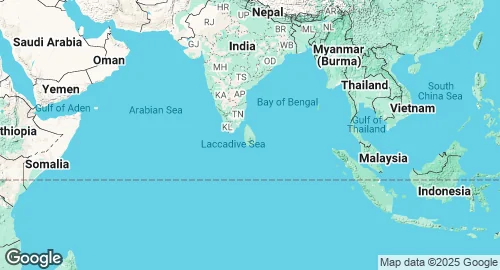
| Capital | Sri Jayawardenapura Kotte |
| Land Area | 62,732 km² |
| Coastline Length | 1,340 km |
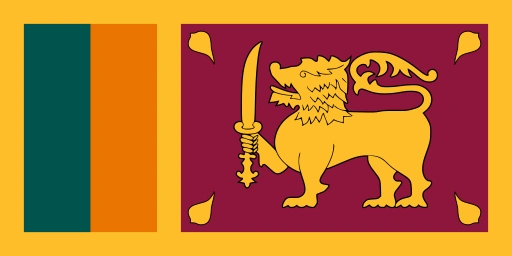
National Flag
Defense Statistics & Key Metrics
| Population | 22.0 million (2023) |
| GDP | $84.4 billion (2023) |
| GDP per capita | $3828 (2023) |
| Military Budget | $1.3 billion (2024) |
| Share of GDP in Milex | 1.4% (2024) |
| Share of Govt Expenditures | 7.2% (2022) |
| Military spends per capita | $58 (2024) |
| Inflation Rate | -0.43% (2024) |
| Military Personnel | 317,000 (2020) |
Sri Lankan Military Budget History
Population and Military Personnel Trends
GDP and Inflation Rate Trends
Strategic Overview in 2026
Strategic Position
Sri Lanka occupies a central maritime location in the Indian Ocean, situated adjacent to major Sea Lines of Communication (SLOCs) that connect the Middle East and Africa with East Asia. Geopolitical concerns focus on maintaining maritime security and neutralizing non-traditional threats, including narcotics trafficking, human smuggling, and illegal, unreported, and unregulated (IUU) fishing within its Exclusive Economic Zone (EEZ).
The state maintains a policy of non-alignment while engaging in security cooperation with regional and global powers. Relations with India are governed by proximity and shared security interests, notably through the Security and Growth for All in the Region (SAGAR) initiative and regular maritime exercises. Military cooperation with China includes significant infrastructure investment in the ports of Colombo and Hambantota, alongside the provision of naval and ground equipment. Strategic engagement with the United States and Australia focuses on maritime domain awareness and search and rescue (SAR) capabilities through programs like the Building Partner Capacity initiative.
National defense doctrine is currently transitioning from an internal security and counter-insurgency (COIN) focus toward a maritime-centric posture. The "Strategy 2030 and Beyond" framework prioritizes the protection of maritime interests and humanitarian assistance and disaster relief (HADR) capabilities over large-scale land-based conventional warfare.
Military Forces
The Sri Lanka Armed Forces are overseen by the Ministry of Defence and the National Security Council, with the President serving as Commander-in-Chief. The structure consists of the Army, Navy, and Air Force. Total active personnel are approximately 200,000, though a state-mandated downsizing program is currently reducing these numbers across all branches.
The Sri Lanka Army (SLA) is the largest service, maintaining approximately 150,000 active troops. It is organized into several corps and regiments, including specialized units such as the Commando Regiment and the Special Forces Regiment. Armored capabilities include T-55AM2 main battle tanks, supported by BMP-series infantry fighting vehicles and BTR-80 and WZ551 armored personnel carriers. Artillery units operate 122mm and 130mm howitzers and RM-70 multi-barrel rocket launchers.
The Sri Lanka Navy (SLN) consists of approximately 40,000 personnel. It operates a fleet of Advanced Offshore Patrol Vessels (AOPVs), including former U.S. Hamilton-class cutters, Indian Saryu-class vessels, and a Chinese Type 053H2G frigate. These capital ships are supported by a fleet of Fast Attack Craft (FAC) and Inshore Patrol Craft (IPC), many of which are utilized for coastal surveillance and anti-poaching operations. The SLN also maintains a Marine Corps and a Special Boat Squadron (SBS).
The Sri Lanka Air Force (SLAF) maintains approximately 27,000 to 30,000 personnel. Its combat capability is centered on a modernization program for five Kfir multirole fighters, upgraded to 4.5-generation standards with advanced avionics and radar. The transport and surveillance fleet includes Beechcraft King Air 360ER and 350 aircraft, C-130 Hercules, and Harbin Y-12 aircraft. Rotary assets include Bell 206, Bell 412, Mi-17, and TH-57 Sea Ranger helicopters.
Defense Industry
Sri Lanka maintains a modest domestic defense industry primarily focused on naval construction and land vehicle modification. Colombo Dockyard provides ship repair and construction services for the Navy, specializing in small patrol boats and offshore support vessels.
The Sri Lanka Electrical and Mechanical Engineering (SLEME) Regiment produces indigenous armored vehicles, including the Uni-Buffalo and the Unicob Mine-Resistant Ambush-Protected (MRAP) vehicles. These platforms utilize locally manufactured hulls and modified chassis from imported commercial and military trucks. While self-sufficiency exists in small arms ammunition and basic tactical vehicle production, the military remains heavily reliant on imports from China, India, Israel, and the United States for advanced sensors, aircraft, and heavy armor.
Strategic Trends
The primary strategic trend is the "right-sizing" initiative, which aims to reduce the Army to 135,000 personnel by 2025 and 100,000 by 2030. This shift is driven by the need to rationalize defense spending following a national economic crisis. The 2025 defense budget is approximately LKR 437 billion, representing about 1.7% of GDP. Despite downsizing, the budget includes salary increases and capital expenditure for technological upgrades.
Procurement priorities are shifting toward maritime and air domain awareness. The SLAF is scheduled to retire its remaining F-7 fighter fleet in 2026, making the upgraded Kfir jets the sole operational fighter capability. Future force structure plans emphasize a leaner, more mobile military equipped with advanced radar, drone security units, and electronic warfare systems. Constraints include aging naval platforms—many of which are nearing the end of their operational life—and the fiscal requirement to align military spending with International Monetary Fund (IMF) recovery targets.
Frequently Asked Questions
How large is Sri Lanka's military?
What is Sri Lanka's defense budget?
How does Sri Lanka rank militarily in the world?
Does Sri Lanka have nuclear weapons?
How many aircraft does Sri Lanka's air force have?
How large is Sri Lanka's navy?
How many tanks does Sri Lanka have?
What percentage of GDP does Sri Lanka spend on defense?
What is Sri Lanka's military personnel per capita?
Does Sri Lanka have paramilitary forces?
Military Expenditure: SIPRI Milex. Suggest a change