DHC-5 Buffalo
Canadian tactical transport aircraft, primarily utilized during the 1960s, notably deployed for civilian and military air-drop operations. Key figures: top speed 467 km/h, range 1,100 km, service ceiling 9,449 m, max takeoff weight 22,317 kg, unit price $25M, built 122. In service with 3 air forces as of 2026 — Egypt (8), Ethiopia (1), Sudan (1).
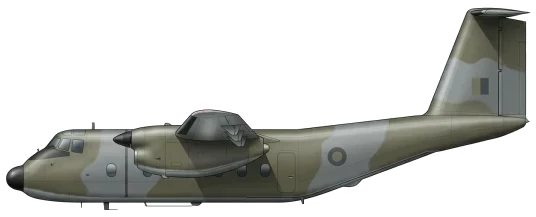
| Length | 24 m (78.7 ft) |
| Wingspan | 29 m (95.1 ft) |
| Height | 8.8 m (28.8 ft) |
| Wing area | 88 m² (947.2 sqft) |
| Empty weight | 11,412 kg (25,159 lbs) |
| Max. takeoff weight | 22,317 kg (49,201 lbs) |
| Powerplant | 2 × turboprops General Electric CT64-820-4 2,336 kW each |
| Maximum speed | 467 km/h (290 mph) |
| Operational range | 1,100 km (684 mi) |
| Service ceiling | 9,449 m (31,001 ft) |
| Climb rate | 11.8 m/s (38.7 ft/s) |


Description
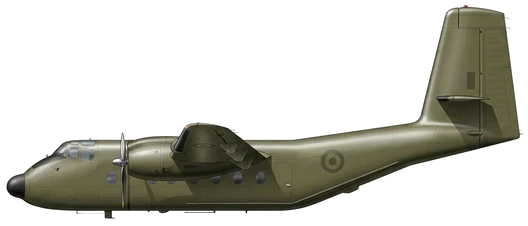
The de Havilland Canada DHC-5 Buffalo is a twin-turboprop short takeoff and landing (STOL) utility transport built in Canada, developed from the piston-engined DHC-4 Caribou. It first flew on 9 April 1964 and served with the Royal Canadian Air Force as the CC-115 from the mid-1960s until January 2022, alongside more than a dozen export operators. It is known for takeoff and landing distances shorter than those of many light aircraft, and for its later use as a search-and-rescue platform and as a testbed for NASA powered-lift research.
Development
The Buffalo originated in a 1962 United States Army requirement for a STOL transport carrying the same payload as the CH-47A Chinook. De Havilland Canada enlarged the Caribou airframe and substituted General Electric T64 turboprops for the Pratt & Whitney R-2000 piston engines, having already flown a T64-powered Caribou on 22 September 1961. The design won the Army competition in early 1963 and four aircraft were ordered as the YAC-2, later CV-7A and then C-8A; all four were delivered in 1965. No further US orders followed, as the 1966 Johnson-McConnell agreement transferred large fixed-wing transports to the USAF, which retained the C-123 Provider. DHC-5A production ended in 1972 after sales to Brazil and Peru, restarting with the DHC-5D in 1974 and ending in December 1986. A civil "Transporter" programme was abandoned after the demonstrator (C-GCTC) was destroyed at the 1984 Farnborough Airshow. Viking Air bought the DHC-1 to DHC-7 type certificates from Bombardier on 24 February 2006 and proposed a DHC-5NG with PW150 engines and a glass cockpit; it was not shortlisted in the 2016 Canadian competition won by the C-295.
Design
The DHC-5D is powered by two General Electric CT64-820-4 turboprops of 3,133 shp driving 14 ft 6 in three-bladed Hamilton Standard fully feathering, reversible-pitch propellers. Span is 96 ft 0 in over a 945 sq ft high-mounted wing of 9.75 aspect ratio, with a T-tail and length of 79 ft 0 in. Maximum takeoff weight is 49,200 lb, empty weight 25,160 lb, and payload 18,000 lb, 41 troops or 24 stretchers, flown by a crew of three. Cruise speed is 227 kn at 10,000 ft, range 600 nmi with maximum payload and 1,770 nmi ferry, service ceiling 31,000 ft. Company figures for the DHC-5A give a 1,210 ft takeoff over a 50 ft obstacle at 41,000 lb. On 16 February 1976 a DHC-5D set time-to-height records in the 12,000–16,000 kg class, reaching 9,000 m in 8 min 3.5 sec.
Operational History
A US Army prototype deployed to Bien Hoa Air Base, South Vietnam, in late 1965 for a three-month evaluation with the 2nd Flight Platoon, 92nd Aviation Company. The RCAF took 15 CC-115s, initially with No. 429 Squadron at CFB St Hubert, later passing to Nos. 413, 424 and 442 Squadrons. Three served UN missions in the Middle East with No. 116 Transport Unit; CC-115 115461 was shot down by a Syrian surface-to-air missile on 9 August 1974, killing nine. From 1975 the fleet converted to domestic search and rescue, ending with No. 442 Squadron at CFB Comox. Export users included Egypt, Brazil, Peru, Kenya, Zambia, Oman, Sudan, Tanzania, Mauritania, Mexico, Ecuador, Chile, Cameroon and the UAE. Twenty-six hull losses have been recorded; the deadliest was a Peruvian DHC-5D that struck a mountain near Tarma on 21 June 1989, killing 59.
Variants
- DHC-5: Original US Army STOL tactical utility transport, designated AC-2, later CV-7A and C-8A.
- DHC-5A: Production transport for Brazil, Peru and Canada, the latter as the CC-115.
- DHC-5D: Improved version with two 2,336 kW General Electric CT64-820-4 turboprops, produced 1974–1986.
- DHC-5E Transporter: Civil transport version, abandoned after the 1984 Farnborough crash.
- C-8A research aircraft: Three NASA conversions covering the augmentor-wing jet STOL, Quiet Short-Haul and air-cushion landing system programmes.
Frequently Asked Questions
What type of aircraft is the DHC-5 Buffalo?
What is the maximum speed of the DHC-5 Buffalo?
What is the range of the DHC-5 Buffalo?
When did the DHC-5 Buffalo first fly?
How many DHC-5 Buffalo have been built?
Which countries operate the DHC-5 Buffalo?
How much does a DHC-5 Buffalo cost?
What is the service ceiling of the DHC-5 Buffalo?
- AUG 302026 Updated Description updated
- JUL 232026 Updated Sources and cross-references refreshed
- APR 72026 Updated Sources and cross-references refreshed
- JAN 122026 Updated Range updated in a site-wide editorial pass