Eswatini Military Forces
Open-source order of battle for 2026, 5 aircraft.
Armed Forces in 2026
| Domain | Strength | Composition |
|---|---|---|
| Military of Eswatini Air Wing | 5 aircraft | 5 helicopters |
Global Military Index
Full ranking →| Pillar | Weight | Score | Basis |
|---|---|---|---|
| Manpower | 15% | 0.0 | Active, reserve & paramilitary personnel |
| Ground forces | 20% | 0.0 | Tanks, armor & artillery weighted by type |
| Naval power | 20% | 0.0 | Weighted by hull type: carrier tiers, nuclear vs conventional submarines |
| Air power | 25% | 7.4 | Weighted by aircraft type and fleet age |
| Nuclear deterrent | 10% | 0.0 | No declared nuclear capability |
| Defense budget | 10% | 15.2 | Annual spending, purchasing-power adjusted |
| Readiness | modifier | ×1.00 | Budget per soldier: proxy for training, maintenance & technology |
Country File
| Population | 1.2M (2024) |
| GDP | $4.9 billion (2024) |
| GDP per capita | $3,910 |
| Military budget | $68.0 million (2024) |
| Share of GDP | 1.4% (2024) |
| Military spending per capita | $55 (2024) |
| Inflation rate | 2.6% (2019) |
| Capital | Mbabane |
| Region | Africa |
| Land area | 17,204 km² |
| Land borders | 535 km |
| Bordering countries | 2 |
| Currency | SZL |
Strategic Overview in 2026
Strategic Position
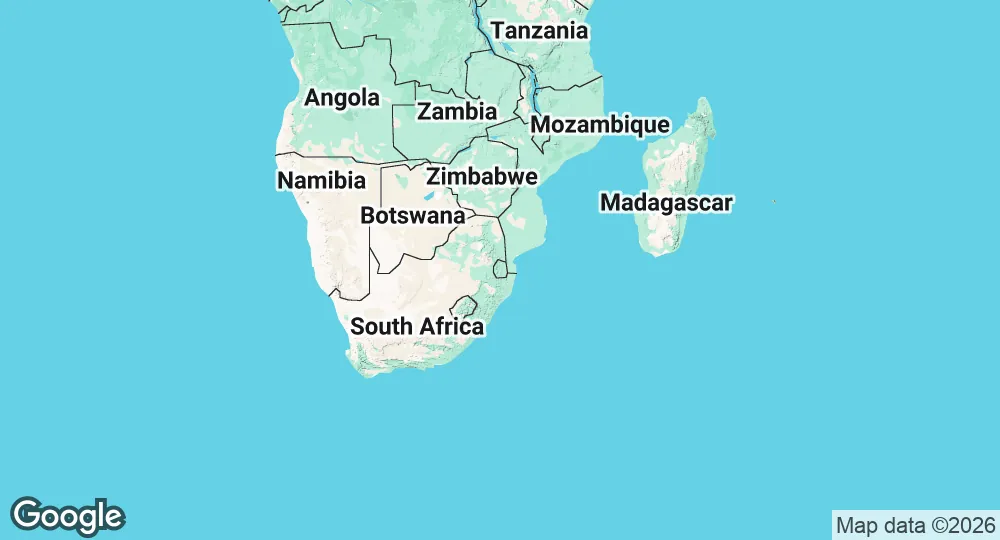
Eswatini is a landlocked monarchy in Southern Africa, bordered by South Africa to the north, west, and south, and Mozambique to the east. The nation’s defense posture is primarily inward-facing, with a focus on regime stability, border security, and internal order. Geopolitical concerns center on the management of porous borders to mitigate the smuggling of narcotics, firearms, and livestock, as well as the regulation of illegal migration.
As a member of the Southern African Development Community (SADC), Eswatini is a signatory to the SADC Protocol on Politics, Defence, and Security Cooperation. This provides a framework for regional collective security and conflict resolution. The military also participates in the African Union (AU) security architectures. Relationships with neighbors are dominated by an economic and geographic reliance on South Africa, though the military maintains independent control over its borders and internal security operations. Strategic priorities emphasize the protection of the absolute monarchy and the prevention of domestic unrest, particularly following periods of pro-democracy activism in the early 2020s.
Military Forces
The Umbutfo Eswatini Defence Force (UEDF) is the national military organization, with the King serving as the Commander-in-Chief and substantive Minister of Defence. The force is organized into two primary components: the Army and a small Air Wing. There is no navy, though the military maintains small units for riverine and border patrol duties.
Personnel strength consists of approximately 3,000 to 3,500 active-duty troops and an estimated 1,000 personnel in reserve. Paramilitary support is provided by the Royal Eswatini Police Service, which coordinates with the military on internal security and border enforcement.
Army
The Army is the primary maneuver force and is structured around infantry battalions supported by specialized sub-units. It is tasked with territorial defense and assisting civil authorities during domestic emergencies or protests.
- Armored Vehicles: The force operates wheeled armored personnel carriers and mine-resistant ambush-protected (MRAP) vehicles, including the RG-31 Nyala and Casspir.
- Small Arms: Standard infantry equipment includes the R4 and Galil assault rifles, alongside various light and medium machine guns.
Air Wing
The Air Wing provides limited transport, reconnaissance, and medical evacuation capabilities. It is not equipped for air superiority or sustained strike missions.
- Fixed-Wing: The inventory includes utility and transport aircraft such as the Cessna 337 and IAI Arava.
- Rotary-Wing: Light utility helicopters, specifically the Alouette III and potentially newer light variants, are used for VIP transport and border surveillance.
Notable units include the Royal Guard, which is responsible for the direct protection of the Monarchy and royal installations. The military also maintains an intelligence department focused on internal monitoring and vetting.
Strategic Trends
The UEDF is currently engaged in a period of infrastructure expansion and personnel renewal. In late 2025 and early 2026, the military initiated a large-scale recruitment program to increase operational readiness. A key trend in 2025 has been the rigorous screening of recruits by the military’s intelligence wing to ensure political loyalty to the monarchy, including the monitoring of social media activities.
Modernization efforts are concentrated on border infrastructure rather than high-technology weapon systems. In 2025, the government reported the construction of seven new forward bases, primarily in the Shiselweni region and along high-pressure border zones, to improve the living conditions of deployed troops and enhance logistics for counter-smuggling operations.
Defense spending remains consistent with previous years, typically ranging between 1.5% and 2.0% of GDP. The 2025/2026 defense budget emphasizes recurrent expenditure, such as personnel salaries and facility maintenance, with a smaller portion allocated to capital projects like base construction and vehicle refurbishment.
Primary constraints facing the military include limited domestic maintenance capabilities for specialized equipment and the ongoing impact of public health challenges, specifically HIV/AIDS, on personnel readiness. Furthermore, the force faces scrutiny from international human rights organizations regarding its role in managing domestic protests and its internal vetting processes.
Frequently Asked Questions
What is Eswatini's defense budget?
How does Eswatini rank militarily in the world?
Does Eswatini have nuclear weapons?
How many aircraft does Eswatini's air force have?
What percentage of GDP does Eswatini spend on defense?
Military Expenditure: CIA World Factbook. Suggest a change