RG-31 Nyala
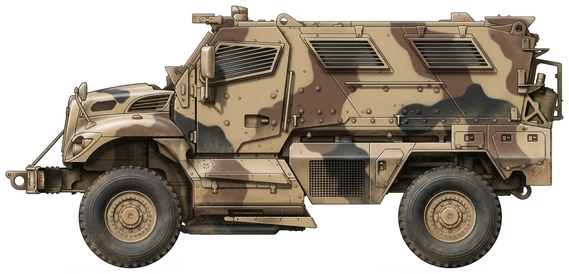
Introduced in 1995, the South African RG-31 Nyala is an armored personnel carrier featuring a V-shaped hull designed to deflect mine blasts away from occupants. Key figures: weight 7.28 t, top speed 100 km/h, range 900 km, built 2,520. In service with 5 armies — United States (516), Spain (150), United Arab Emirates (76) and 2 others.
| Sub-type | Mine-Resistant Ambush Protected Vehicle |
| Crew | 5 to 10 personnels |
| Range | 900 km |
| Mass | 7.3 tons |
| Height | 2.63 m (8.6 ft) |
| Width | 2.47 m (8.1 ft) |
| Length | 6.4 m (21.0 ft) |
| Max. speed | 100 km/h (62 mph) |
| Engine | 300 hp |
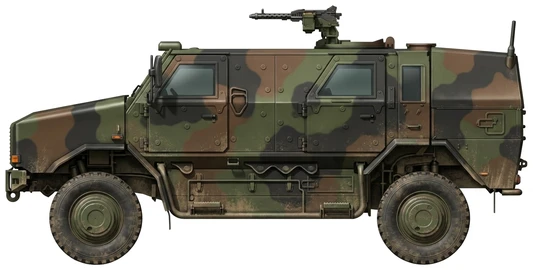
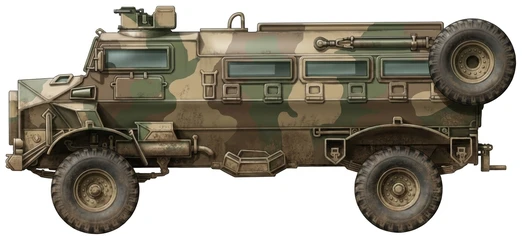
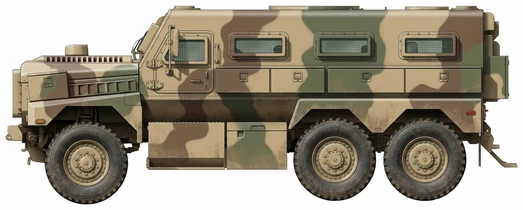
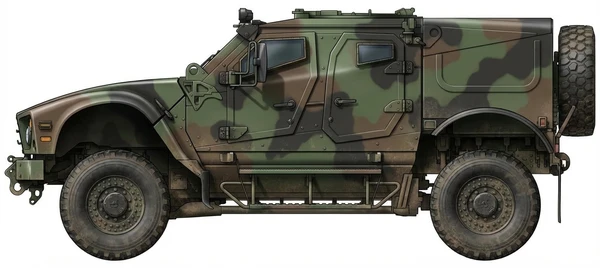
Description
The RG-31 Nyala is a 4×4 multi-purpose mine-resistant ambush-protected (MRAP) vehicle manufactured by Land Systems OMC in South Africa and FNSS Defence Systems in Turkey. Derived from the TFM Industries Mamba APC, the vehicle is built on a UNIMOG chassis featuring a V-shaped, all-steel welded monocoque hull and elevated suspension. Classified as a Category 1 MRAP by the United States Department of Defense, the hull provides small-arms and blast protection, designed to withstand the simultaneous detonation of two TM-57 anti-tank mines. Crew capacity ranges from 5 to 10 personnel depending on the variant, with access provided by two air-actuated front doors and a large air-actuated rear door.
Production encompasses armored personnel carrier and utility cargo configurations. Variants include the Mk3A, Mk5, extended Mk5E featuring increased ballistic and blast protection, Mk5LHM pickup, ambulance, Mk6E, and the RG-31M, which is equipped with a central tire inflation system and a military wiring harness. The Charger variant was produced for United States forces using Detroit Diesel or Cummins engines. The Agrab variant integrates the Super Rapid Advanced Mortar System. Available armaments include remote weapon stations such as the Protector or Samson RWS, as well as armored gunner hatches. Upgrades introduced at the Letterkenny Army Depot included independent suspension, upgraded transmissions, revised engines, 360-degree spotlights, and armored hatches.
The RG-31 is operated by military forces, security agencies, police units, non-governmental organizations, and the United Nations. Operating nations include the United States, Canada, Spain, the United Arab Emirates, Colombia, Burundi, Rwanda, Eswatini, Mali, Nigeria, Indonesia, Iraq, South Africa, Senegal, Somalia, and Ukraine. Operational deployments include action in Afghanistan with ISAF forces, Iraq, Kosovo under KFOR, Bosnia and Herzegovina under UNPROFOR, Lebanon under UNIFIL, and Mali under MINUSMA. The vehicle has also seen service during the Colombian Armed Conflict, the Ivorian Civil War, the intervention in Yemen by United Arab Emirates forces, and in Syria with UNDOF, where units were captured by rebel groups and later taken by the Syrian Army. Spain supplied a combat ambulance variant to Ukraine as military aid.
Frequently Asked Questions
What type of vehicle is the RG-31 Nyala?
What is the weight of the RG-31 Nyala?
What is the maximum speed of the RG-31 Nyala?
What is the operational range of the RG-31 Nyala?
How many crew members does the RG-31 Nyala require?
How many RG-31 Nyala have been built?
- AUG 292026 Updated Re-filed as a protected mobility vehicle (was Light)
- AUG 42026 Updated Number built and service entry year added
- AUG 22026 Created Page created: RG-31 Nyala