Tajikistan Military Forces
Tajikistan ranks #115 of 170 militaries worldwide in 2026, with 8,800 active troops. The Tajik Army fields 38 main battle tanks; the Air Force flies 26 aircraft. Landlocked, Tajikistan has no navy and no nuclear weapons.
Armed Forces in 2026
| Domain | Strength | Composition |
|---|---|---|
| Air Force | 26 aircraft | 20 helicopters |
| Ground Forces | 38 tanks | |
| Personnel | 8,800 active | 20,000 reserve 7,500 paramilitary |
ATLAS Index (Aggregate Total of Land, Air and Sea strength)
Full ranking →| Pillar | Weight | Score | Basis |
|---|---|---|---|
| Manpower | 10% | 27.1 | Active, reserve & paramilitary personnel |
| Ground forces | 20% | 22.5 | ARMS inventory power: armour & artillery by type and era, attack helicopters, armament |
| Naval power | 20% | 0.0 | SEAS inventory power: hulls by type, size and era, air wing, sustainment, armament |
| Air power | 25% | 12.0 | AIRS inventory power: aircraft by type and generation, enablers, armament |
| Nuclear deterrent | 10% | 0.0 | No declared nuclear capability |
| Defense budget | 15% | 12.9 | Annual spending, purchasing-power adjusted |
| Availability | modifier | ground ×0.80 · naval ×1.00 · air ×1.05 | Budget per point of each force, from the branch indexes |
Country File
| Population | 10.6M (2024) |
| GDP | $14.2 billion (2024) |
| GDP per capita | $1,341 |
| Military budget | $256M (2024) |
| Share of GDP | 1.8% (2024) |
| Military spending per capita | $24 (2024) |
| Inflation rate | 6% (2016) |
| Capital | Dushanbe |
| Region | Asia |
| Land area | 141,510 km² |
| Land borders | 3,651 km |
| Bordering countries | 4 |
| Currency | TJS |
Strategic Overview in 2026
Strategic Position
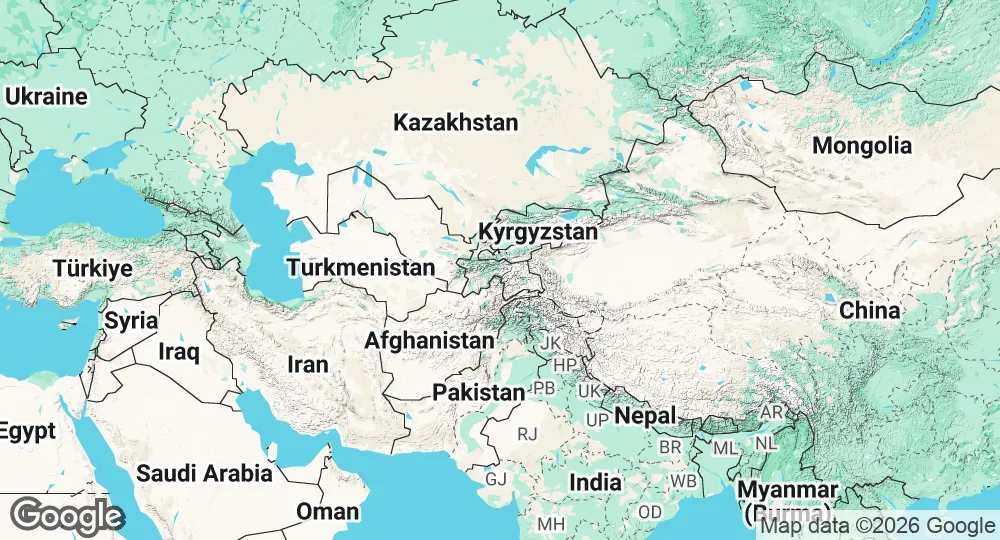
Tajikistan occupies a critical geographic position in Central Asia, characterized by a 1,357-kilometer border with Afghanistan. Primary security concerns center on cross-border militancy, specifically threats from groups such as ISIS-K and the Taliban, as well as large-scale narcotics trafficking and arms smuggling. The rugged, mountainous terrain of the Gorno-Badakhshan Autonomous Region further complicates border surveillance and internal security.
Defense policy is anchored in deep structural integration with the Russian Federation and membership in the Collective Security Treaty Organization (CSTO). Under a bilateral agreement extending to 2042, Tajikistan hosts Russia’s 201st Military Base, the largest Russian land force deployment outside its borders. In March 2025, the two nations signed a Strategic Partnership Program for 2026–2030, formalizing long-term military-technical cooperation.
Tajikistan also maintains a growing security relationship with China. Beijing operates a dedicated security facility in the Gorno-Badakhshan region to monitor the Wakhan Corridor and coordinates with Dushanbe through the Shanghai Cooperation Organization (SCO). While the 2025 China-Tajikistan Foreign Ministers' Strategic Dialogue emphasized counter-terrorism and border management, Tajikistan also balances regional tensions with Kyrgyzstan over unresolved border demarcations in the Fergana Valley.
Military Forces
The Armed Forces of the Republic of Tajikistan are divided into the Land Forces, Air and Air Defense Forces, and Mobile Forces. Command is centralized under the Ministry of Defense and the General Staff.
Personnel and Structure The military maintains approximately 10,000 to 15,000 active-duty personnel. This is supplemented by a substantial paramilitary force of roughly 20,000, including the Border Guards—under the State Committee for National Security (GKNB)—and Interior Ministry troops. Conscription is mandatory for males aged 18 to 27, with a two-year service obligation.
Land Forces The army is primarily a light-infantry and motorized force optimized for mountain warfare. Its inventory consists almost exclusively of Soviet and Russian-origin hardware. The force operates T-72 and T-62 main battle tanks. Armored transport and reconnaissance are provided by BMP-1 and BMP-2 infantry fighting vehicles, along with BTR-70, BTR-80, and BTR-82A armored personnel carriers. Artillery support includes 122mm 2S1 Gvozdika and 152mm 2S3 Akatsiya self-propelled howitzers, as well as BM-21 Grad and 9P140 Uragan multiple launch rocket systems.
Air and Air Defense Forces The air arm is limited and lacks fixed-wing combat aircraft. Its operational capability is centered on a helicopter fleet featuring Mi-24 Hind attack helicopters and Mi-8/17 Hip transport platforms. Training is conducted using L-39 Albatros aircraft. Air defense relies on Russian-integrated systems, including the S-300PS surface-to-air missile (SAM) system operated at the Russian 201st base. In early 2025, the Tajik military displayed newly acquired Chinese HQ-17AE short-range SAM systems, providing a mobile defense capability against precision-guided munitions and unmanned aerial vehicles (UAVs).
Defense Industry
Tajikistan’s domestic defense industry is limited, resulting in a near-total reliance on military-technical assistance from Russia, China, and Iran. The most notable domestic production involves unmanned systems. An Iranian-licensed factory in Dushanbe produces Ababil-2 tactical UAVs and loitering munitions. In late 2025, the Ministry of Industry and New Technologies announced a memorandum with UAE-based QullaAI to establish a localized production line for AI-driven drones and electronic warfare systems, with the first models expected to enter service in 2026.
Strategic Trends
Defense spending for 2025 is approximately $446 million, representing 2.8% of GDP. This reflects an upward trend in the budget intended to address regional instability and modernize border infrastructure. A primary procurement priority is the expansion of UAV capabilities; Tajikistan has expressed interest in Turkish Bayraktar TB2 platforms and continued acquisition of Iranian systems to counter asymmetric threats.
Force modernization is currently being managed through the CSTO Targeted Inter-State Program, which is scheduled to begin the delivery of specialized weapons and logistics equipment for the Afghan border in 2026. This multi-stage program extends to 2029 and focuses on enhancing rapid-response capabilities and the technical fortification of mountain outposts. Despite these investments, the military faces persistent constraints, including the obsolescence of Soviet-era armored vehicles and internal challenges related to financial oversight and the professionalization of the conscript-heavy officer corps.
Military Expenditure: CIA World Factbook. Last updated on 4 August 2026. Suggest a change
Frequently Asked Questions
How large is Tajikistan's military?
What is Tajikistan's defense budget?
How does Tajikistan rank militarily in the world?
Does Tajikistan have nuclear weapons?
How many aircraft does Tajikistan's air force have?
How many tanks does Tajikistan have?
What percentage of GDP does Tajikistan spend on defense?
What is Tajikistan's military personnel per capita?
Does Tajikistan have paramilitary forces?
- AUG 42026 Updated Global Military Index updated in a site-wide editorial pass
- JUL 162026 Updated Global Military Index updated in a site-wide editorial pass
- JUN 162026 Updated Yearly statistics, military spending and 2 more fields updated
- MAR 162026 Updated Reserve personnel added
- JAN 172026 Updated Main battle tank count and Global Military Index updated
- JAN 132026 Updated Description added