Uzbekistan Military Forces 🇺🇿
Military Strength Overview
| 🛩️ Air Force | 196 active aircraft |
| 🪖 Active Troops | 48,000 personnels |
| 👮♀️ Paramilitary | 20,000 personnels |
Global Military Index
| 🪖 Manpower (15%) | 67.6 | Active, reserve & paramilitary: 54000 effective |
| 🛡️ Ground Firepower (20%) | 56.3 | Main battle tanks: 340 |
| ⚓ Naval Power (20%) | 0.0 | Weighted by ship type: carriers, submarines, destroyers... |
| ✈️ Air Power (25%) | 55.2 | Weighted by aircraft type: combat, bombers, helicopters... |
| ☢️ Nuclear Deterrent (10%) | 0.0 | No declared nuclear capability |
| 💰 Defense Budget (10%) | 48.6 | $1440M annual military spending |
Methodology: Log-scaled composite index using SIPRI, IISS, and GMNET data. Each pillar is normalized to 0-100, then weighted by strategic importance.
Geography
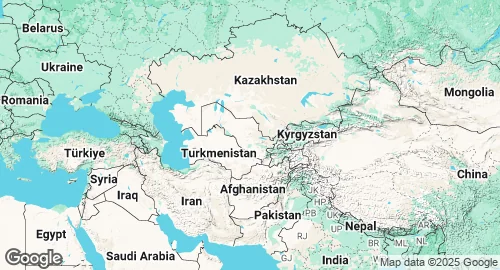
| Capital | Tashkent |
| Land Area | 425,400 km² |
| Coastline Length | 0 km |
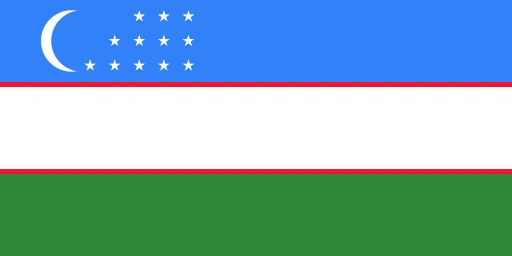
National Flag
Defense Statistics & Key Metrics
| Population | 34.9 million (2022) |
| GDP | $90.1 billion (2022) |
| GDP per capita | $2579 (2022) |
| Military Budget | $1.4 billion (2018) |
| Share of GDP in Milex | 2.9% (2018) |
| Share of Govt Expenditures | 11.1% (2018) |
| Military spends per capita | $45 (2018) |
| Inflation Rate | 11.45% (2022) |
| Military Personnel | 68,000 (2020) |
Uzbek Military Budget History
Population and Military Personnel Trends
GDP and Inflation Rate Trends
Strategic Overview in 2026
Strategic Position
Uzbekistan occupies a central position in Central Asia, being the only state in the region to share borders with all other Central Asian nations—Kazakhstan, Kyrgyzstan, Tajikistan, and Turkmenistan—as well as Afghanistan. Its defense posture is primarily defined by the requirement to maintain border security and prevent the spillover of regional instability, particularly from the Afghan frontier.
Uzbekistan maintains a policy of non-alignment, formalizing its refusal to join military blocs or host foreign military bases through its 2012 Defense Doctrine and subsequent legislative updates. While it was previously a member of the Collective Security Treaty Organization (CSTO), it suspended its membership in 2012 and has since focused on bilateral security arrangements. The country is a member of the Shanghai Cooperation Organization (SCO) and participates in regional counter-terrorism exercises under the SCO’s Regional Anti-Terrorist Structure (RATS), which is headquartered in Tashkent.
In 2024 and 2025, Uzbekistan expanded its strategic partnerships, signing enhanced military cooperation agreements with Turkey and maintaining a foundational security relationship with Russia. It also engages in periodic border security training and equipment procurement programs with the United States and China. Relations with neighboring Kyrgyzstan and Tajikistan have stabilized following the resolution of several border demarcation disputes, leading to increased joint military exercises focused on counter-insurgency and mountain warfare.
Military Forces
The Armed Forces of the Republic of Uzbekistan are organized under the Ministry of Defense, with the President serving as Supreme Commander-in-Chief. The structure includes the Ground Forces, Air and Air Defense Forces, National Guard, and the Border Guard. Total active personnel are estimated between 50,000 and 60,000, supported by a paramilitary National Guard of approximately 20,000.
Ground Forces
The Ground Forces are organized into five military districts: Tashkent, Northwest, Southwest, Central, and Eastern. The inventory consists of Soviet-origin platforms alongside newer Western and Turkish acquisitions. - Armor: Operates T-72 and T-64 main battle tanks. - Infantry Mobility: Utilizes BMP-2 infantry fighting vehicles and BTR-80/82 armored personnel carriers. Modernization efforts have introduced Ejder Yalcin and Vuran 4x4 vehicles from Turkey, as well as American MaxxPro MRAPs. - Artillery: Maintains BM-21 Grad and BM-27 Uragan multiple rocket launchers, supplemented by 2S1 Gvozdika and 2S3 Akatsiya self-propelled howitzers.
Air and Air Defense Forces
The Air Force operates a mix of fixed-wing combat aircraft and a growing fleet of unmanned aerial vehicles (UAVs). - Combat Aircraft: Maintains MiG-29 fighters and Su-25 ground-attack aircraft. - Transport: Operates Airbus C295W and Soviet-era Il-76 transport planes. - Rotary Wing: Fields Mi-24 and Mi-35 attack helicopters, as well as Mi-8 and Mi-17 transport helicopters. - Unmanned Systems: Operates Bayraktar TB2 (Turkey) and Wing Loong (China) medium-altitude long-endurance UAVs. - Air Defense: Utilizes FD-2000 (Chinese HQ-9) long-range surface-to-air missile systems alongside upgraded Soviet S-125 and S-200 batteries.
Specialized Capabilities
The Ministry of Defense maintains specialized Special Operations Forces (SOF) trained for counter-terrorism and reconnaissance. These units have undergone joint training with Turkish and American counterparts.
Defense Industry
Uzbekistan has sought to increase domestic production through the State Committee for Defense Industry. The domestic industry focuses on the maintenance, repair, and modernization of Soviet-era equipment, but has transitioned toward the manufacture of light armored vehicles.
- Land Systems: The Kranch-Agro and Uzbekistan Defense Industry plants produce the Tarlon and Arslon 4x4 armored vehicles. These platforms are designed for border patrol and internal security roles.
- UAVs: Domestic development includes the Lochin (Falcon) series of small tactical reconnaissance and strike drones, which entered serial production to reduce reliance on imported tactical systems.
- Maintenance: The country maintains domestic facilities for the overhaul of Su-25 and MiG-29 airframes, as well as the modernization of T-72 tanks to the B3 standard.
Strategic Trends
Uzbekistan is currently executing a multi-year modernization program aimed at replacing obsolete Soviet hardware with digitalized command-and-control systems and modern strike capabilities. Defense spending is estimated at approximately 3.5% to 4% of GDP, though official figures remain classified.
A primary trend is the diversification of procurement. While Russia remains a source for aviation and heavy armor, Uzbekistan has shifted toward Turkey for UAVs and armored vehicles, and China for air defense and electronic warfare systems. This diversification is intended to mitigate risks associated with international sanctions and supply chain disruptions.
Force structure shifts emphasize mobility and small-unit tactics over traditional heavy-maneuver warfare. This is reflected in the increased procurement of light armored vehicles and the prioritization of special forces training. Internal constraints include a continued reliance on foreign-made high-tech components and the need for standardized training across a force that operates equipment from disparate NATO and non-NATO sources. In 2025, the government prioritized the development of a unified digital battlespace to integrate its various UAV and artillery assets.
Frequently Asked Questions
How large is Uzbekistan's military?
What is Uzbekistan's defense budget?
How does Uzbekistan rank militarily in the world?
Does Uzbekistan have nuclear weapons?
How many aircraft does Uzbekistan's air force have?
How many tanks does Uzbekistan have?
What percentage of GDP does Uzbekistan spend on defense?
What is Uzbekistan's military personnel per capita?
Does Uzbekistan have paramilitary forces?
Military Expenditure: SIPRI Milex. Suggest a change