Venezuela Military Forces
Venezuela ranks #60 of 170 militaries worldwide in 2026, with 123,000 active troops. The Venezuelan Army fields 1,087 ground vehicles, including 172 main battle tanks; the Air Force flies 226 aircraft, including 54 combat aircraft; the Navy operates 45 warships. Venezuela has no nuclear weapons.
Armed Forces in 2026
| Domain | Strength | Composition |
|---|---|---|
| Air Force | 226 aircraft | 54 combat 74 helicopters 10 air bases +4 on order |
| Bolivarian Navy of Venezuela | 45 warships | |
| Ground Forces | 1,087 vehicles | 172 main battle tanks |
| Personnel | 123,000 active | 8,000 reserve 220,000 paramilitary |
ATLAS Index (Aggregate Total of Land, Air and Sea strength)
Full ranking →| Pillar | Weight | Score | Basis |
|---|---|---|---|
| Manpower | 10% | 47.1 | Active, reserve & paramilitary personnel |
| Ground forces | 20% | 31.2 | ARMS inventory power: armour & artillery by type and era, attack helicopters, armament |
| Naval power | 20% | 26.1 | SEAS inventory power: hulls by type, size and era, air wing, sustainment, armament |
| Air power | 25% | 27.9 | AIRS inventory power: aircraft by type and generation, enablers, armament |
| Nuclear deterrent | 10% | 0.0 | No declared nuclear capability |
| Defense budget | 15% | 16.7 | Annual spending, purchasing-power adjusted |
| Availability | modifier | ground ×0.80 · naval ×0.80 · air ×0.80 | Budget per point of each force, from the branch indexes |
Country File
| Population | 28.4M (2024) |
| GDP | $119.8 billion (2024) |
| GDP per capita | $4,218 |
| Military budget | $719M (2024) |
| Share of GDP | 0.6% (2024) |
| Military spending per capita | $25 (2024) |
| Inflation rate | 254.95% (2016) |
| Capital | Caracas |
| Region | America |
| Land area | 882,050 km² |
| Coastline | 2,800 km |
| Land borders | 4,993 km |
| Bordering countries | 3 |
| Currency | VES |
Strategic Overview in 2026
Strategic Position
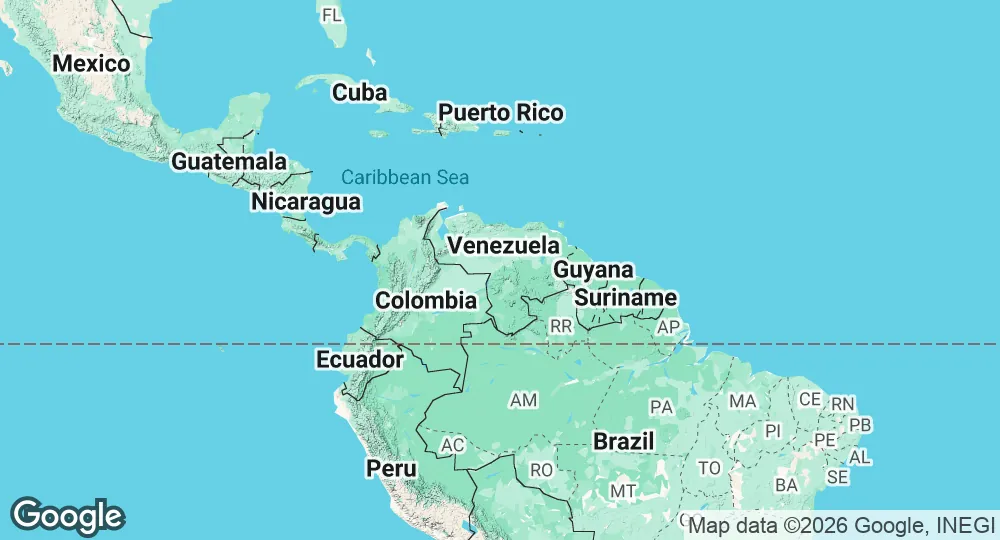
Venezuela occupies a pivotal maritime and terrestrial position in northern South America, bordering the Caribbean Sea, the North Atlantic Ocean, Colombia, Brazil, and Guyana. Its primary security concerns are defined by long-standing territorial disputes, regional isolation, and the perceived threat of foreign intervention.
The most acute territorial flashpoint remains the Esequibo region, a resource-rich territory comprising two-thirds of Guyana. Throughout 2025, Venezuela intensified military activities in the border zone, including the construction of airstrips and the deployment of naval patrols into contested waters. This dispute is subject to ongoing review by the International Court of Justice, with a decision anticipated in 2026.
Venezuela maintains a strategic alignment with extra-hemispheric powers to offset diplomatic and economic isolation. A Strategic Partnership Treaty signed with Russia in May 2025 established a framework for comprehensive military-technical cooperation. Relationships with Iran and China provide access to drone technology, surveillance systems, and financial credit. Conversely, relations with the United States and the Caribbean Community (CARICOM) remain adversarial, exacerbated by the January 2026 U.S. military operation in Caracas and the subsequent transition of executive authority to an interim administration.
Military Forces
The Bolivarian National Armed Forces (FANB) are organized under the Strategic Operational Command (CEOFANB), which coordinates five primary branches: the Army, Navy, Air Force, National Guard, and the National Bolivarian Militia. The defense doctrine is based on the concept of "Integral Defense," which integrates regular military units with civilian militias to conduct asymmetric warfare.
Personnel Active-duty personnel are estimated at 125,000 to 150,000. This is supplemented by the National Guard, which maintains approximately 25,000 personnel focused on internal security. The National Bolivarian Militia claims a membership exceeding 4 million, though its combat-effective strength is considerably lower.
Army The Army operates a fleet of Russian-origin T-72B1V main battle tanks and BMP-3 infantry fighting vehicles. Armored units also utilize BTR-80A personnel carriers and older AMX-30 tanks. Artillery capabilities include Msta-S self-propelled howitzers and Grad and Smerch multiple launch rocket systems.
Air Force The backbone of the Air Force consists of Su-30MK2 multirole fighters. It also maintains a small fleet of F-16A/B aircraft, though maintenance is constrained by a lack of American-sourced spare parts. Air transport and attack roles are supported by Mi-17 and Mi-35 helicopters. The country operates a layered integrated air defense system (IADS) featuring S-300VM long-range, Buk-M2 medium-range, and Pechora-2M short-range surface-to-air missiles.
Navy Naval assets include Type 209 submarines and a fleet of patrol vessels and frigates. Coastal defense is reinforced by Iranian-designed Zolfaghar-class fast attack craft equipped with anti-ship missiles.
Defense Industry
The domestic defense sector is dominated by the state-owned Compañía Anónima Venezolana de Industrias Militares (CAVIM). Its primary production focus is small arms and ammunition. Under Russian license, CAVIM produces AK-103 assault rifles at facilities in Maracay. The industry also manufactures the Zamorana pistol and the Catatumbo sniper rifle.
Venezuela has established a domestic UAV production capability with Iranian technical assistance. The El Libertador Air Base serves as a hub for the assembly and maintenance of the ANSU-100 (Mohajer-2 variant) and the Mohajer-6 reconnaissance and strike drones. While these programs provide a degree of self-sufficiency in tactical surveillance, the military remains heavily dependent on Russia and China for advanced radar, electronic warfare systems, and heavy platform components.
Strategic Trends
The FANB has shifted its focus toward asymmetric defense and the protection of internal stability. Defense spending as a percentage of GDP has historically remained low, and procurement is often facilitated through oil-for-arms swaps rather than direct budgetary allocations.
A primary constraint is the impact of international sanctions, which has led to widespread equipment cannibalization and a decline in the operational readiness of western-origin hardware. Following the U.S. military raid in early 2026, the command structure faces fragmentation, and the future of Russian and Iranian military-technical missions is uncertain. Procurement priorities in 2025 shifted toward passive detection equipment, GPS scramblers, and long-range loitering munitions to counter perceived vulnerabilities in conventional air and maritime defenses.
Military Expenditure: CIA World Factbook. Last updated on 4 August 2026. Suggest a change
Frequently Asked Questions
How large is Venezuela's military?
What is Venezuela's defense budget?
How does Venezuela rank militarily in the world?
Does Venezuela have nuclear weapons?
How many aircraft does Venezuela's air force have?
How large is Venezuela's navy?
How many tanks does Venezuela have?
What percentage of GDP does Venezuela spend on defense?
What is Venezuela's military personnel per capita?
Does Venezuela have paramilitary forces?
- AUG 42026 Updated Global Military Index updated in a site-wide editorial pass
- AUG 32026 Updated Global Military Index updated
- JUL 162026 Updated Global Military Index updated in a site-wide editorial pass
- JUN 162026 Updated Yearly statistics, military spending and 2 more fields updated
- JAN 212026 Updated Rank insignia updated (63 entries)
- JAN 172026 Updated Main battle tank count and Global Military Index updated
- JAN 132026 Updated Description updated