Yemen Military Forces
Yemen ranks #86 of 170 militaries worldwide in 2026, with 40,000 active troops. The Air Force flies 156 aircraft, including 75 combat aircraft; the Navy operates 29 warships. Yemen has no nuclear weapons.
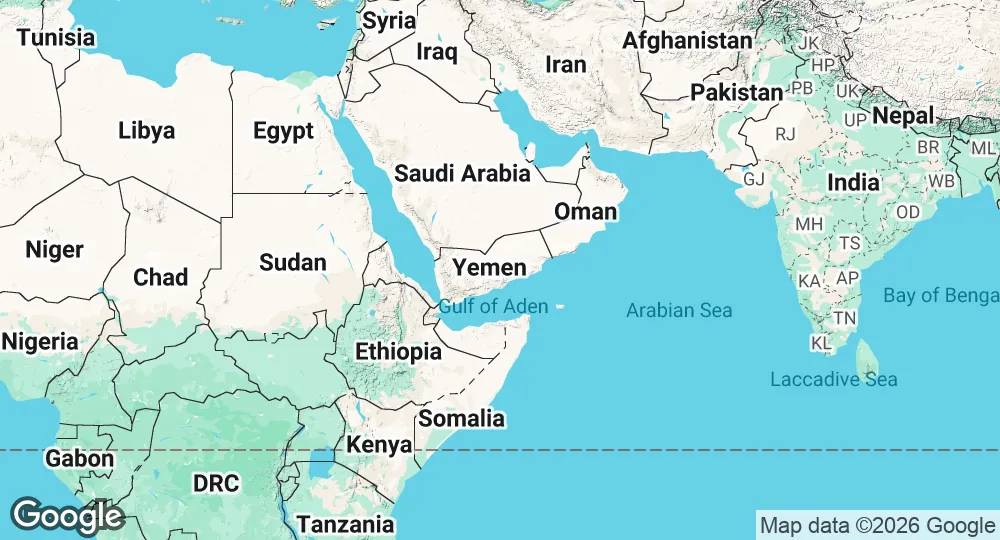

Armed Forces in 2026
| Domain | Strength | Composition |
|---|---|---|
| Air Force | 156 aircraft | 75 combat 40 helicopters 2 air bases |
| Yemeni Navy | 29 warships | |
| Personnel | 40,000 active |
ATLAS Index (Aggregate Total of Land, Air and Sea strength)
Full ranking →| Pillar | Weight | Score | Basis |
|---|---|---|---|
| Manpower | 10% | 33.4 | Active, reserve & paramilitary personnel |
| Ground forces | 20% | 0.0 | ARMS inventory power: armour & artillery by type and era, attack helicopters, armament |
| Naval power | 20% | 23.5 | SEAS inventory power: hulls by type, size and era, air wing, sustainment, armament |
| Air power | 25% | 24.7 | AIRS inventory power: aircraft by type and generation, enablers, armament |
| Nuclear deterrent | 10% | 0.0 | No declared nuclear capability |
| Defense budget | 15% | 20.8 | Annual spending, purchasing-power adjusted |
| Availability | modifier | ground ×0.98 · naval ×0.97 · air ×0.88 | Budget per point of each force, from the branch indexes |
Country File
| Population | 40.6M (2024) |
| GDP | $21.6 billion (2018) |
| GDP per capita | $532 |
| Military budget | $1.7B (2014) |
| Share of GDP | 4.0% (2014) |
| Share of govt spending | 14.3% (2014) |
| Military spending per capita | $58 (2014) |
| Inflation rate | 8.1% (2014) |
| Capital | Sana’a |
| Region | Asia |
| Land area | 527,968 km² |
| Coastline | 1,906 km |
| Land borders | 1,746 km |
| Bordering countries | 2 |
| Currency | YER |
Strategic Overview in 2026
Strategic Position
Yemen’s defense posture is defined by its internal fragmentation and its geographic control over the Bab el-Mandeb strait, a chokepoint connecting the Red Sea to the Gulf of Aden. As of early 2026, the country remains divided between the internationally recognized Presidential Leadership Council (PLC), based in Aden and supported by Saudi Arabia, and the Houthi-controlled Supreme Political Council (SPC) in Sana’a, backed by Iran.
The primary security concern for the PLC is the consolidation of military authority over diverse anti-Houthi factions and the defense of energy-rich governorates like Hadhramaut and Marib. A major strategic shift occurred in January 2026, when the PLC, with direct Saudi military support, dismantled the independent military infrastructure of the Southern Transitional Council (STC). This led to the formation of a unified Supreme Military Committee under Saudi-led coalition oversight to command all non-Houthi formations.
The Houthi strategic doctrine focuses on asymmetric deterrence and regional power projection as part of the Iranian-led "Axis of Resistance." Their priorities involve maintaining control over northern highlands and the Red Sea coastline to influence international maritime traffic. The Houthi leadership views the presence of Western naval task forces in the Red Sea as a direct threat to their sovereignty and utilizes long-range strike capabilities to pressure regional and international adversaries.
Military Forces
The Yemeni military environment is bifurcated into two distinct and competing command structures.
Presidential Leadership Council (PLC) Forces The PLC oversees a coalition of regular army units and specialized paramilitary formations. These include the Homeland Shield Forces—a Saudi-funded elite component—and the Giants Brigades, which specialize in high-intensity ground maneuvers. Following the January 2026 restructuring, these units operate under a unified command meant to integrate regional militias into the formal Ministry of Defense hierarchy.
- Personnel: The PLC and its affiliates maintain a force of approximately 250,000 active personnel.
- Equipment: The inventory consists of Soviet-era T-55, T-62, and T-72 main battle tanks. Ground mobility is supported by Western-supplied MRAPs, including Oshkosh M-ATVs and BTR-series armored personnel carriers.
- Naval/Air: Conventional air capabilities are largely non-operational. Naval assets are limited to patrol craft and coastal surveillance units focused on counter-smuggling.
Houthi (Ansar Allah) Forces Houthi forces have transitioned from an insurgent militia into a conventionalized military with specialized departments for missiles and UAVs.
- Personnel: Estimated at over 200,000 personnel, supplemented by extensive tribal levies.
- Ground Equipment: They operate captured T-72 and T-80 tanks and have modified various light vehicles into technicals.
- Strategic Missiles/UAVs: The force fields the Quds-series land-attack cruise missiles, Burkan-series ballistic missiles, and the Palestine-2 system, which Houthi officials claim has hypersonic capabilities. Their UAV inventory includes the Samad and Wa’id families, used for both reconnaissance and loitering munitions.
- Naval Capability: The Houthi "navy" prioritizes asymmetric maritime warfare, employing anti-ship ballistic missiles (ASBMs), anti-ship cruise missiles like the Ghadir, and unmanned surface vessels (USVs) for swarm attacks.
Defense Industry
The Houthi movement maintains an active domestic assembly and modification industry, though it remains heavily reliant on Iranian technology transfers. Defense industrial activities are centered in underground facilities near Sana’a and Saada.
Key domestic activities include:
- UAV Production: The assembly of drone airframes and the integration of smuggled engines and guidance systems.
- Missile Modification: Converting older Soviet-era surface-to-air missiles (SAMs) into surface-to-surface ballistic missiles and repainting or modifying Iranian-designed systems for local deployment.
- Asymmetric Naval Assets: The construction of improvised USVs and the assembly of naval mines.
In late 2025, PLC intelligence reports indicated efforts by the Iranian Revolutionary Guard Corps (IRGC) to relocate segments of their ballistic missile manufacturing chain to Houthi-controlled territory to shorten supply lines and bypass naval blockades.
Strategic Trends
The most significant shift in force structure is the 2026 unification of the southern military command. By dissolving the autonomous STC military wing, the PLC and Saudi Arabia seek to create a cohesive conventional force capable of sustained operations should political negotiations fail. This consolidation has also seen the withdrawal of Emirati-backed counter-terrorism units, leaving Saudi Arabia as the primary external security guarantor for the legitimate government.
For Houthi forces, the procurement priority has shifted toward enhancing the survivability of their mobile launch platforms and diversifying smuggling routes, increasingly utilizing Sudanese and Omani corridors to evade Red Sea interdictions. Modernization efforts are concentrated on long-range precision and the development of hydrogen fuel cell components for extended-range UAVs.
Defense spending remains impossible to quantify as a percentage of GDP due to the collapse of formal economic data; however, the Houthi administration continues to prioritize military wages and industrial subsidies over civilian infrastructure, while the PLC remains entirely dependent on Saudi financial grants to sustain its military payroll and procurement.
Military Expenditure: information from the Stockholm International Peace Research Institute (SIPRI) Military Expenditure Database. Last updated on 10 August 2026. Suggest a change
Yemeni Defense Manufacturing
Designed in YemenFrequently Asked Questions
How large is Yemen's military?
What is Yemen's defense budget?
How does Yemen rank militarily in the world?
Does Yemen have nuclear weapons?
How many aircraft does Yemen's air force have?
How large is Yemen's navy?
What percentage of GDP does Yemen spend on defense?
What is Yemen's military personnel per capita?
- AUG 102026 Updated Rank insignia and ranks overview added
- AUG 42026 Updated Global Military Index updated in a site-wide editorial pass
- AUG 32026 Updated Global Military Index updated
- JUL 242026 Updated Global Military Index updated
- JUL 162026 Updated Global Military Index updated in a site-wide editorial pass
- JUN 162026 Updated Yearly statistics and Global Military Index updated
- JAN 172026 Updated Global Military Index updated; main battle tank count removed