T-72
Ex-USSR main battle tank, entering service in 1973, with approximately 25,000 units built. Key figures: weight 44.5 t, top speed 60 km/h, range 500 km, unit cost $2M, built 25,000. In service with 25 armies — India (2,418), Russia (1,470), Turkmenistan (650) and 22 others.
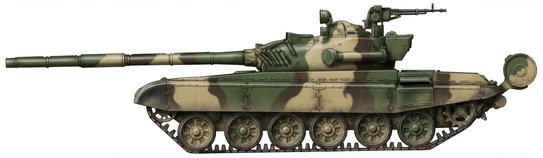
| Sub-type | Medium Main Battle Tank |
| Crew | 3 (commander, gunner, driver) personnels |
| Range | 500 km |
| Mass | 44.5 tons |
| Height | 2.23 m (7.3 ft) |
| Width | 3.59 m (11.8 ft) |
| Length | 9.73 m (31.9 ft) |
| Max. speed | 60 km/h (37 mph) |
| Engine | V-92S2F (T-72B3 & T-72B3M) 1,130 hp (840 kW) |
| Weapon 1 | 125 mm 2A46M-5 smoothbore gun |
| Weapon 2 | 7.62 mm PKT coax. machine gun |
| Weapon 3 | 12.7 mm NSVT |
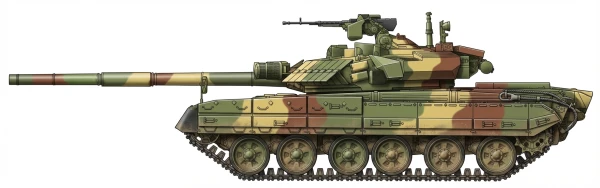
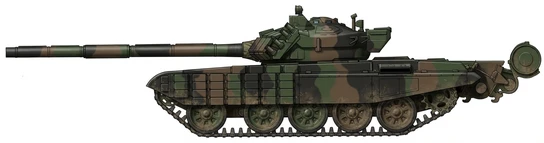
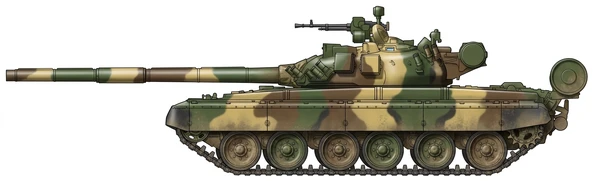
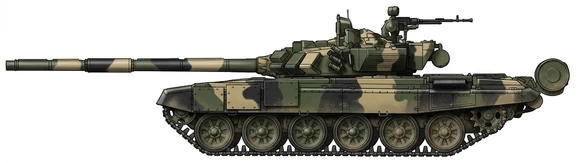
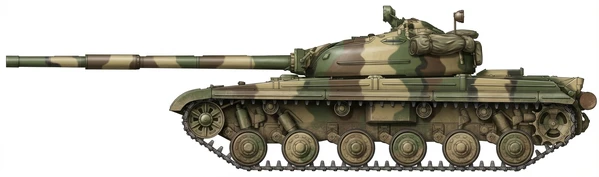
Description
The T-72 main battle tank, a product of Soviet design rivalry, entered production in 1973, following a design phase from 1967. Conceived at Uralvagonzavod, it evolved from the T-64 and Object 167M. Its development as Object 172 was spurred by the need for a more reliable and cost-effective "mobilization model" than the T-64, which faced engine issues. Kartsev's Object 172 ingeniously melded attributes from the T-64A, Object 167, and an upgunned T-62, incorporating the V-45 engine and Object 167’s suspension. After trials of the Object 172M variant, it was officially accepted into Soviet Army service in 1974.
The T-72 is a three-crew main battle tank, its design accommodating a commander, gunner, and driver through the incorporation of an automated loading system for its 125 mm smoothbore gun. This main armament is capable of firing various munitions, including anti-tank guided missiles. Defensive characteristics evolved significantly over its service life; initial models featured cast high hardness steel armour, which was later augmented with composite materials in variants like the T-72A, and subsequently, explosive reactive armour (ERA) became a common addition. Notably lightweight and compact compared to many Western contemporaries, the T-72 possesses an NBC (nuclear, biological, chemical) protection system and is engineered for deep wading, including submerged river crossings using a snorkel. The autoloader stores 22 rounds in a carousel at the hull bottom. The overall ammunition storage within the vehicle has, however, been identified as a design vulnerability, potentially leading to catastrophic secondary explosions if the armour is penetrated. While many early versions relied on infrared illuminators for night operations, later upgrades and export models offered thermal imaging capabilities.
Entering service in 1973, the T-72 became a ubiquitous presence in the arsenals of Warsaw Pact nations and was extensively exported to over 40 countries worldwide, with licensed and unlicensed production occurring in nations such as Poland, Czechoslovakia, and Yugoslavia (as the M-84). It has seen action in numerous global conflicts. Syrian T-72s engaged Israeli armour in the 1982 Lebanon War. Iraqi T-72s, including locally assembled "Lion of Babylon" variants, were prominent during the Iran-Iraq War and the 1991 Gulf War. Russian forces deployed T-72s in both Chechen Wars, adapting tactics after initial setbacks. The tank has been heavily utilized by all sides in the Syrian Civil War and has figured centrally in the Russo-Ukrainian War, where both Russia and Ukraine have employed various models, including modernized versions, and where substantial losses have been documented.
Frequently Asked Questions
What type of vehicle is the T-72?
What is the weight of the T-72?
What is the maximum speed of the T-72?
What is the operational range of the T-72?
How many crew members does the T-72 require?
How many T-72 have been built?
What weapons does the T-72 carry?
- SEP 42026 Verified Weight verified against the published specifications
- JUL 232026 Updated Sources and cross-references refreshed
- JAN 242026 Updated Cost updated