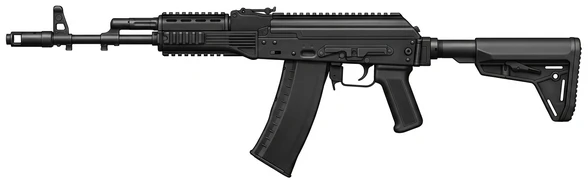
AK-12
| Fire rate | 700 rounds/min. |
| Caliber | 5.45 x 39 mm |
| Magazine | 30 - 60 rounds |
| Length | 922 mm (36.3 in) |
| Weight | 3.7 kg (8.2 lb) |
| Range | 440 m (1444 ft) |
Description
The development of the AK-12 began in 2011 at the Izhmash factory, which later became part of Kalashnikov Concern. Designed by Mikhail Kalashnikov, Vladimir Zlobin, and Sergey Urzhumcev, the project started as a private venture to participate in the Russian military's Ratnik trials. The design progressed through three prototype iterations between 2012 and 2015 to resolve defects, lower production costs, and address automatic fire issues. Kalashnikov Concern eventually abandoned these initial prototypes, utilizing the AK-400 prototype design instead to form the basis of the finalized production model. The rifle completed military trials in December 2017.
The weapon utilizes a gas-operated long-stroke piston system with a closed rotating bolt. Unlike legacy Kalashnikov rifles, the final production model features a free-floating barrel mounted to the receiver and a rigid, non-removable gas tube, which isolates the barrel from the handguard. Ergonomic elements include a side-folding, telescoping shoulder stock, an integrated pistol grip containing a maintenance kit, and a free-floating polymer handguard. The fire selector, which has extensions for index finger manipulation, provides safe, semi-automatic, two-round burst, and fully automatic options, though the burst mode was removed in later iterations. Sights consist of an adjustable aperture-type rear sight and a shrouded post front sight, mounted on an integrated Picatinny rail that replaced the legacy side dovetail rail. It feeds from polymer box magazines equipped with witness windows, a slanted base, and a glow-in-the-dark follower.
The Russian Federation adopted the rifle in January 2018, issuing it to the armed forces, National Guard, and interior affairs agencies. It has been used in combat during the Syrian civil war and the Russo-Ukrainian War, where Ukrainian forces also captured and utilized units. Armenia secured domestic manufacturing rights, Qatar adopted the platform for its military, and North Korean forces received the rifle in 2024. Variants include the AK-15, the export-oriented AK-19, and the AK-308 battle rifle. Short-barreled models are designated as the AK-12K and AK-15K, with sub-compact versions designated as the AK-12SK and AK-15SK. Upgrades to the base platform were released in 2020, 2021, and 2023, featuring changes to the stock, grip, muzzle devices, and safety mechanisms.