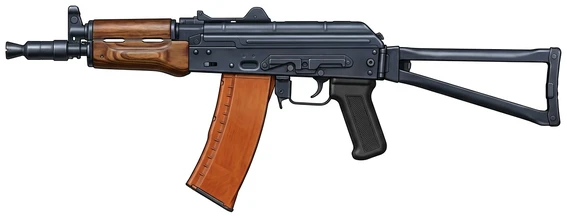
AKS-74U
| Fire rate | 730 rounds/min. |
| Caliber | 5.45 x 39 mm |
| Magazine | 30 rounds |
| Length | 735 mm (28.9 in) |
| Weight | 3.2 kg (7.1 lb) |
| Range | 300 m (984 ft) |
Description
Development began in 1973 under the Soviet "Modern" design competition, which sought a fully automatic carbine. The program drew initial influence from Peter Andreevich Tkachev’s experimental AO-46 design. Multiple designers submitted entries to the competition, including Mikhail Kalashnikov, Igor Stechkin, S. G. Simonov, A. S. Konstantinov, and Yevgeny Dragunov. In 1977, the Main Missile and Artillery Directorate (GRAU) selected Kalashnikov's submission—a shortened derivative of the AK-74 rifle—due to its comparable performance to rival designs and its compatibility with existing production tooling. Following troop trials with airborne divisions in the Transcaucasian Military District, the carbine was officially adopted in 1979. The Tula Arms Plant conducted the majority of production, which ceased in 1993.
The firearm utilizes a gas-operated, long-stroke piston system with a closed rotating bolt. To achieve its compact profile, the design features a shortened barrel and a reduced gas piston operating rod, which increases the cyclic rate of fire. The barrel features an accelerated twist rate to stabilize projectiles at lower velocities. A specialized chrome-lined muzzle booster with an internal expansion chamber and a conical nozzle is mounted to the gas block to regulate gas pressure and reduce muzzle flash. The front sight is integrated directly into the gas block, and the weapon lacks under-barrel storage for a cleaning rod. The handguards and gas tube are widened, and the receiver cover is hinged at the trunnion, pivoting upward to unlock the gas tube. Aiming is conducted via a front post and a rear U-shaped flip sight with constant battle-zero and extended-range settings. Furniture options include laminated wood or black glass-filled polyamide, and the weapon can be equipped with a specialized, silent under-barrel grenade launcher powered by blank cartridges.
Entering Soviet service in 1979, the carbine was issued to special forces, airborne infantry, rear-echelon support units, and vehicle and helicopter crews. It saw deployment during the Soviet-Afghan War, the Chechen Wars, and subsequent conflicts in Georgia, Syria, Iraq, and Ukraine. A notable variant is the AKS-74UB, which is configured for use with a suppressor and subsonic ammunition. The weapon also served as the mechanical basis for the OTs-14 Groza bullpup carbine. Originally distributed to Soviet successor states, the carbine remains in service with military and law enforcement agencies in nations including Ukraine, Syria, Guatemala, and Israel. In Russian service, it is undergoing replacement by the AM-17 and AK-105, while Ukrainian forces are transitioning to the Fort-230.