APS-95
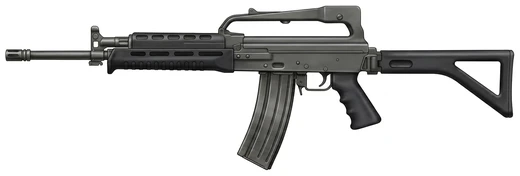
| Fire rate | 650 rounds/min. |
| Caliber | 5.56 x 45 mm NATO |
| Magazine | 35 rounds |
| Length | 980 mm (38.6 in) |
| Weight | 3.8 kg (8.4 lb) |
| Range | 450 m (1476 ft) |
Description
The APS-95 (also called Ero) was an assault rifle manufactured in Croatia by Končar-Arma d.o.o. from 1995 and offered for export until at least 2007. The manufacturer, a subsidiary of the Croatian company ARMA-GRUPA Corporation, has also produced the ERO and Mini-ERO submachine guns, copies of the Israeli UZI and Mini-UZI, since the mid-1990s. The rifle was developed at the request of the Croatian Army, which wanted to quickly replace the Yugoslav-made Zastava M70 assault rifles then in service with a weapon chambered for the standard NATO cartridge. During the Croatian War of Independence, the Croatian businessman Antun Kikaš had supplied the Croatian side with several batches of the Vektor R4, the South African copy of the Israeli IMI Galil assault rifle. Croatian fighters appreciated the weapon and asked for a locally manufactured version as the standard-issue rifle of the Croatian Army.
The APS-95 was a gas-operated, piston-driven, selective-fire assault rifle fed from a detachable magazine, on the same principle as the Israeli Galil and South African R4. It was built around a stamped sheet-metal receiver, rather than a receiver machined from solid as on the Galil and R4, which reduced manufacturing cost and time. Its fire selector relied on two separate controls placed on either side of the weapon, in the manner of the Galil and Vektor R4, but operating differently. The positions were marked P (Pojedinacno, single shot), R (Rafalno, automatic) and Z (Zakoceno, safe). The lever on the right side of the receiver, derived from the AK-47 selector, had three positions. The small switch above the grip on the left side of the receiver, accessible to the thumb, had two positions, semi-automatic and automatic fire. The folding stock was made of stamped sheet steel and folded to the right side of the receiver; its profile obstructed neither the handling of the weapon nor the operation of the bolt, so the APS-95 could be fired with the stock folded. The features that most distinguished the APS-95 from the Galil and R4 were its handguard and distinctively shaped front sight, as well as its carrying handle incorporating an optical sight and, optionally, back-up iron sights. The pistol grip also differed, with finger grooves in the style of the M16 rifle. The use of polymer magazines supplied with the weapon suggests that these came from South African sources.
The APS-95 was officially adopted by the Croatian Army around 1993, acquired and issued in very small quantities before budget constraints put an end to orders. Although it was not widely issued within the Croatian Army, some examples were used during the Yugoslav Wars. The manufacturer tried for several years to place the APS-95 on the international market, without success.
Frequently Asked Questions
What type of firearm is the APS-95?
What caliber is the APS-95?
What is the effective range of the APS-95?
What is the rate of fire of the APS-95?
What magazine does the APS-95 use?
How heavy is the APS-95?
- AUG 302026 Updated Description updated
- JUL 232026 Updated Service entry year updated in a site-wide editorial pass
- JUN 122026 Updated Caliber updated
- APR 82026 Updated Sources and cross-references refreshed