Galil / R-4
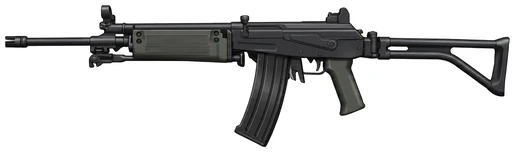
| Fire rate | 650 rounds/min. |
| Caliber | 5.56 x 45 mm NATO |
| Magazine | 25 rounds |
| Length | 1050 mm (41.3 in) |
| Weight | 4.0 kg (8.8 lb) |
| Range | 600 m (1969 ft) |
Description
The Israel Defense Forces adopted the FN FAL in the late 1950s, but the rifle proved long and bulky, and sand and dust ingress caused stoppages severe enough that some soldiers carried Uzis instead during the 1973 Yom Kippur War. Egyptian AK-47s captured during the Six-Day War demonstrated tolerance for low maintenance, and the IDF issued a requirement for a rifle combining Kalashnikov reliability with FAL and M16 accuracy. Submissions included the M16A1, the Stoner 63, the HK33, and an indigenous design by Uziel Gal that was rejected as complex and unreliable. The winning entry came from Yisrael Galili and Yakov Lior and was based on the Finnish Valmet Rk 62, itself an AK-47 derivative; the first rifles were assembled on Rk 62 receivers supplied from Finland. Trials ran from the late 1960s into the early 1970s, and issue was delayed by the outbreak of the Yom Kippur War in 1973. Production was undertaken by Israel Military Industries, later Israel Weapon Industries. Vincenzo Bernardelli built licensed copies in Italy in the 1980s, NWM De Kruithoorn N.V. briefly held a licence in the Netherlands, and manufacture continues in Colombia at Indumil.
The Galil is a selective-fire weapon using a Kalashnikov-pattern long-stroke gas piston with no gas regulator, locking by a rotary bolt with two lugs engaging recesses milled in the receiver. Gas is tapped through a port drilled at 30° in the barrel; a cam slot in the bolt carrier rotates the bolt after a period of free travel. The reciprocating cocking handle is bent upward so the rifle can be charged with the left hand. Prototypes used a stamped sheet-metal receiver, but the chamber pressure of the 5.56×45mm cartridge led the designers to a milled forging, which avoided the cracking seen in stamped AK receivers at the cost of added weight. Gas block, handguard retainers, folding-stock components, and sights are cast and finish-machined; only the magazine catch, trigger guard, dust cover, and magazines are stamped. Exterior surfaces are phosphated and enamelled. The hammer-fired trigger mechanism follows the M1 Garand pattern, and an AK-type right-side selector is supplemented by a thumb lever on the left above the pistol grip. Furniture is high-impact plastic, with a side-folding tubular aluminium skeleton stock copied in principle from the FN FAL paratrooper pattern. The muzzle takes rifle grenades, a bayonet lug, or a suppressor. Magazines are curved steel, with an adapter available for STANAG types. The L-shaped rear aperture sight offers two range settings, and tritium flip-up elements are fitted for low light. A bottle opener in the handguard and wire cutters in the bipod were included to stop soldiers damaging magazine feed lips and to speed the cutting of rural fencing.
Three configurations entered IDF service: the ARM with bipod, carrying handle and wooden handguard; the AR for support troops and military police; and the short-barrelled SAR, known as the G'lilon, for vehicle crews and staff. The Galil was never the numerically dominant Israeli rifle, as some 60,000 M16A1s arrived from 1975 under the US Military Aid Program and were cheaper than domestic production. The ARM and AR left standard issue by 2000, the SAR remaining with the Knesset Guard, Artillery Corps, and Armored Corps until around 2004–2005. The 7.62mm Galatz sniper variant appeared in 1983, later modernised as the SR-99 and produced under licence in Ukraine as the Fort-301 and in Vietnam by the Z111 Factory. The Micro Galil (MAR) was shown in Poland in 1994; the Magal, a .30 Carbine police derivative, was issued in 1999 and withdrawn in 2001 after malfunction complaints. Denel Land Systems builds a modified version in South Africa as the R4, the standard rifle of the SANDF, and Indumil produces the Galil, Galil ACE, and Galil Córdova in Colombia. Users include Estonia, Guatemala, Chile, Portugal until 2019, and the Italian National Police, which fields the Bernardelli Mod.377 and Mod.378 with the NOCS unit.
Frequently Asked Questions
What type of firearm is the Galil / R-4?
What caliber is the Galil / R-4?
What is the effective range of the Galil / R-4?
What is the rate of fire of the Galil / R-4?
What magazine does the Galil / R-4 use?
How heavy is the Galil / R-4?
- AUG 302026 Updated Description updated
- JUL 232026 Updated Service entry year updated in a site-wide editorial pass
- JUN 122026 Updated Caliber updated
- APR 82026 Updated Sources and cross-references refreshed