HK 416
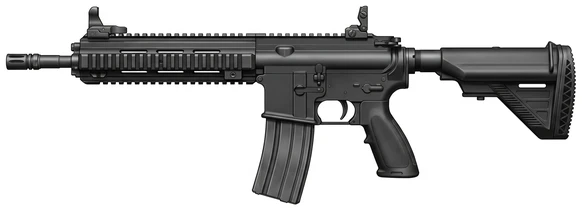
| Fire rate | 850 rounds/min rounds/min. |
| Caliber | 5.56×45mm NATO |
| Magazine | STANAG magazine rounds |
| Length | 709 mm (27.9 in) |
| Weight | 3.12 kg (6.9 lb) |
| Range | 300 m (984 ft) |
Description
The HK416 was developed by Heckler & Koch of Oberndorf am Neckar in collaboration with the United States Army's 1st Special Forces Operational Detachment-Delta, following a request from research and development NCO Larry Vickers during the 1990s. The unit sought a weapon between the MP5, whose pistol cartridge was judged insufficient, and the M4 carbine, considered too bulky when suppressed. Heckler & Koch drew on work carried out for the G36, the cancelled U.S. Army XM8 programme, and the SA80 A2 refurbishment contract for the British Armed Forces. The project was initially designated the Heckler & Koch M4 until a trademark infringement suit by Colt Defense forced a change; the name HK416 combines the M4 and M16 designations.
The rifle retains the AR-15/M16 layout and controls but replaces the direct impingement gas system with a proprietary short-stroke gas piston derived from the G36. The piston drives an operating rod that pushes the bolt carrier rearward, keeping combustion gases out of the receiver and reducing heat and fouling in the bolt carrier group. Early versions used a fixed gas port; a user-adjustable gas regulator was introduced on later variants, permitting suppressor use. The barrel is cold hammer-forged. A free-floating accessory rail forearm with MIL-STD-1913 rails on four faces can be fitted and removed without tools by using the bolt locking lug as a screwdriver. The telescoping buttstock offers six lengths of pull, with a reversible convex or concave shoulder pad and an internal storage compartment. A proprietary firing pin safety in the bolt reduces the risk of slam-fire. Over-the-beach modifications, including drainage holes in the bolt carrier and buffer system, are available for firing shortly after submersion.
Delta Force replaced its M4s with the HK416D in March 2005. In 2007 the U.S. Army tested the HK416 against the M4, FN SCAR-L and XM8 in an extreme dust environment, where it recorded fewer stoppages than the M4. An HK416D was used by SEAL Team Six during the 2011 operation against Osama bin Laden. Norway adopted the HK416N in 2008. The United States Marine Corps selected a modified version in 2009 for the Infantry Automatic Rifle programme, type-classified as the M27 IAR in 2010 and extended to the whole infantry squad from December 2017, displacing the M249, M16A4 and M4A1. France selected the HK416F in 2016 to replace the FAMAS, ordering 93,080 rifles in short and standard configurations, with the first 400 delivered on 3 May 2017. Germany's System Sturmgewehr Bundeswehr competition initially went to the Haenel MK 556 in September 2020, but the contract was cancelled and the HK416A8 selected in early 2021; the resulting G95A1 and short-barrelled G95KA1 were adopted by the Heer in 2025 to replace the G36. The HK416A5, introduced with ambidextrous controls and a tool-less gas regulator, replaced the original model in 2013 and serves with the Irish Army Ranger Wing. The G38 and G95, the latter for the KSK and KSM, are German designations of the A5 and A7 respectively. The HK417 is the 7.62 mm battle rifle derivative; civilian semi-automatic versions are marketed as the MR223/MR556 and MR308/MR762.
Frequently Asked Questions
What type of firearm is the HK 416?
What caliber is the HK 416?
What is the effective range of the HK 416?
What is the rate of fire of the HK 416?
What magazine does the HK 416 use?
How heavy is the HK 416?
- AUG 302026 Updated Description updated
- JUL 232026 Updated Service entry year updated in a site-wide editorial pass
- APR 82026 Updated Sources and cross-references refreshed
- JAN 122026 Updated Rate of fire, caliber and 4 more fields updated