K1
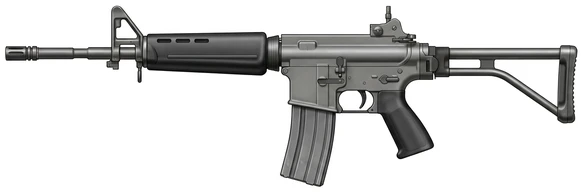
| Fire rate | 700-900 rounds/min. |
| Caliber | 5.56 x 45 mm NATO |
| Magazine | 30 rounds |
| Length | 838 mm (33.0 in) |
| Weight | 2.87 kg (6.3 lb) |
| Range | 250 m (820 ft) |
Description
In 1976, the Republic of Korea Army Special Warfare Command requested a new weapon to replace the M3 submachine gun. The Agency for Defense Development initiated a development project in 1977, deriving the design from the earlier XB rifle research project. The design requirements specified a lightweight, cost-effective weapon with increased firepower and parts commonality. First prototypes were completed in 1980, and the weapon entered service with the Republic of Korea Armed Forces in 1981. Production responsibilities transitioned through several entities, beginning with the Arsenal of National Defense and Daewoo Precision Industries, and continuing under SNT Motiv and Dasan Machineries.
The firearm utilizes a direct gas impingement operating system with a rotating bolt. Unlike designs with receiver-mounted recoil springs, this weapon positions the bolt carrier and dual recoil springs in a manner similar to the AR-18, eliminating the need for a buffer tube in the stock and enabling the installation of a sliding wire stock. The charging handle is located on the right side of the receiver. Early production models encountered issues with muzzle climb, flash, and recoil, which led to the implementation of a redesigned flash suppressor featuring three ports in the upper right quadrant to control muzzle rise. Modern configurations can be equipped with rail integration systems for mounting optical sights and accessories.
The Republic of Korea Ministry of National Defense designated the weapon as a submachine gun to align with its role in replacing the M3. The firearm has seen service in the Persian Gulf War, the War in Afghanistan, the Iraq War, and the 1992 Los Angeles Riots. Export users include Cambodia, Indonesia, Senegal, and Singapore. The primary military variants are the initial K1 and the upgraded K1A. Export semi-automatic versions were produced under designations including the K1A1, MAX-1, and AR-110C. The K1AC1 variant, introduced to replace the K1A, features a five-position stock. SNT Motiv's K13 carbine, selected under the Type II procurement program, began deployment in 2024 as a partial replacement, while a separate Type I procurement program was reinitiated to establish a full replacement.
Frequently Asked Questions
What type of firearm is the K1?
What caliber is the K1?
What is the effective range of the K1?
What is the rate of fire of the K1?
What magazine does the K1 use?
How heavy is the K1?
- JUL 232026 Updated Service entry year added; name, manufacturer and 5 more fields updated
- JUN 122026 Updated Caliber updated
- APR 82026 Updated Sources and cross-references refreshed