MSBS Grot
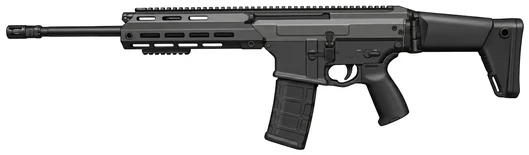
| Fire rate | 700 - 900 rounds/min. |
| Caliber | 5.56 x 45 mm NATO |
| Magazine | 30 rounds |
| Length | 980 mm (38.6 in) |
| Weight | 3.7 kg (8.2 lb) |
| Range | 800 m (2625 ft) |
Description
The Modułowy System Broni Strzeleckiej (MSBS) Grot was designed beginning in 2007 by the Military University of Technology in Warsaw in cooperation with the firearms manufacturer FB "Łucznik" Radom. The design team consisted of Adam Gawron, Bartosz Stefaniak, Grzegorz Misiołek, and Maciej Sajdak. Early prototypes developed between 2007 and 2017 were designated as the MSBS Radon. The system was designed to replace the FB Beryl as the standard-issue service rifle of the Polish Armed Forces. Serial production commenced in 2018. Following its military adoption, the moniker "Grot" was added to the system's designation in honor of General Stefan "Grot" Rowecki, the commander of the Polish Home Army.
The weapon operates via a short-stroke gas piston system with a rotating bolt. It features a modular architecture built around a universal upper receiver shared by both the conventional and bullpup configurations. This layout allows configuration conversion by swapping the lower receiver, as well as rapid barrel replacement to change weapon roles. The design incorporates fully ambidextrous controls, integrated Picatinny rails, and compatibility with standard STANAG magazines. Testing conducted by the Military University of Technology indicated lower hand-guard and barrel heating compared to the Heckler & Koch HK416, along with lower susceptibility to jamming and reduced recoil during automatic fire. The upgraded M2 generation introduced a longer upper receiver with M-LOK handguards, polymer translucent magazines, quick-detach sling mounts, and reinforced internal and external components, including the firing pin, charging handle, lock, and slide.
The rifle entered service with the Polish Territorial Defence Forces and the Polish Armed Forces. During the 2022 Russian invasion of Ukraine, ten thousand units of the classic variant were delivered to the Ukrainian military. The system was also exported to Rwanda, where it is used by special operations forces, and acquired by the United States Special Operations Command. Non-state operators, including the March 23 Movement and the Ingush Liberation Army, have also utilized the rifle. Commercial variants include semi-automatic models for the civilian market, with import approval for the United States secured in late 2025. Primary configurations include the classic variant with a folding and retractable stock, the bullpup variant, a ceremonial blank-firing variant for the Representative Honor Guard Regiment, and a designated marksman rifle variant.
Frequently Asked Questions
What type of firearm is the MSBS Grot?
What caliber is the MSBS Grot?
What is the effective range of the MSBS Grot?
What is the rate of fire of the MSBS Grot?
What magazine does the MSBS Grot use?
How heavy is the MSBS Grot?
- JUL 282026 Updated Manufacturer updated
- JUL 232026 Created Page created: MSBS Grot