SR-25
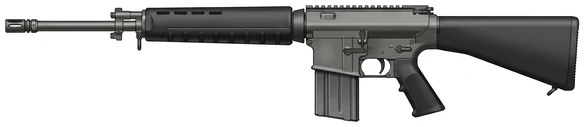
| Fire rate | 30 rounds/min. |
| Caliber | .308 Winchester |
| Magazine | 5 - 20 rounds |
| Length | 1118 mm (44.0 in) |
| Weight | 4.88 kg (10.8 lb) |
| Range | 800 m (2625 ft) |
Description
The SR-25 grew out of Eugene Stoner's work on the AR-10, designed in the late 1950s as a battle rifle for American troops. The AR-10 lost the competition to the M14, and the patent rights to both the AR-10 and the AR-15 were sold to Colt's Manufacturing Company, which concentrated its efforts on the AR-15. In the early 1990s, Stoner joined Knight's Armament Company and resumed development of the AR-10 platform. The result was the SR-25 (Stoner Rifle-25), whose designation adds together the numbers of the AR-10 and the AR-15, retaining the original architecture in 7.62 × 51 mm NATO while incorporating the developments of the M16A2 and parts commonality with it.
The SR-25 operates on a rotating bolt with a Stoner bolt-and-carrier gas system. Roughly 60 percent of its parts interchange with the AR-15 and M16, the exceptions being the upper and lower receivers, the hammer, the barrel assembly and the bolt carrier group. Barrels were originally produced by Remington Arms using 5R rifling (five grooves, right-hand twist). The heavy match-grade barrel is free-floating: the handguards attach to the front of the receiver and make no contact with the barrel. The initial version used a fibreglass handguard, a flat-top upper receiver fitted with a Mil-Std 1913 rail for optics, and a two-stage match trigger. The bolt carrier followed AR-10 practice, chrome plated with a captive firing pin retainer pin. The rifle was designed around 168-grain open-tip match ammunition. Early production used AR-10 pattern 20-round magazines, later replaced by steel 20-round magazines of M16 appearance. The SR-25 Enhanced Match rifle substitutes the URX II Picatinny-Weaver rail system for the earlier free-floating RAS, accepting various scope mounts or a carrying handle with iron sights.
United States Special Operations Command adopted the rifle as the Mk 11 MOD 0 in May 2000, drawn by its magazine capacity and shorter engagement time compared with bolt-action rifles. Modifications included a shortened Obermeyer match barrel chambered for M118 and M118LR ammunition, a quick-detachable sound suppressor mount, an aluminium free-floating RAS fore-end, flip-up front sights and adjustable back-up iron sights, and an M16A2 stock and pistol grip. The Mk 11 was fielded as a system comprising the rifle, 20-round box magazines, quick-detachable scope rings, a Leupold Mark 4 Mil-dot riflescope, a Harris swivel-base bipod on a Knight's mount, and a Knight's Armament suppressor. During the Iraq War the United States Marine Corps ordered 180 Mk 11 MOD 1 rifles, which mated the Mk 11 with the upper receiver of the M110 Semi-Automatic Sniper System, adding a URX modular rail and a flash suppressor. These saw limited use before the Marines purchased the Mk 11 MOD 2, the USSOCOM and U.S. Navy designation for the complete M110. From late 2011 USMC snipers replaced Mk 11 MOD 0 rifles with the M110 on a one-for-one basis. SOCOM began divesting the Mk 11 MOD 0 in mid-2011 in favour of the SSR Mk 20, the sniper variant of the FN SCAR, completing the replacement by 2017. Other users include the Australian Army, Royal Australian Air Force Airfield Defence Guards, Australian Police Tactical Groups, and the Philippine Light Reaction Regiment.
Frequently Asked Questions
What type of firearm is the SR-25?
What caliber is the SR-25?
What is the effective range of the SR-25?
What is the rate of fire of the SR-25?
What magazine does the SR-25 use?
How heavy is the SR-25?
- AUG 302026 Updated Description updated
- JUL 232026 Updated Service entry year added; manufacturer updated
- APR 82026 Updated Sources and cross-references refreshed