Uzi
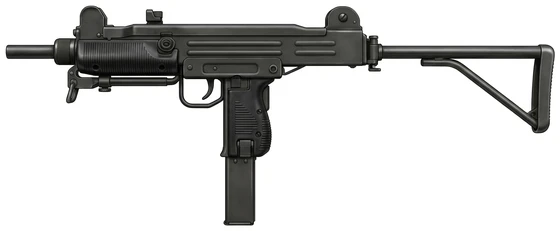
| Fire rate | 600 rounds/min. |
| Caliber | 9 x 19 mm Parabellum |
| Magazine | 32 rounds |
| Length | 650 mm (25.6 in) |
| Weight | 3.7 kg (8.2 lb) |
| Range | 200 m (656 ft) |
Description
The Uzi was designed by Captain (later Major) Uziel Gal of the Israel Defense Forces in the late 1940s, following the 1948 Arab–Israeli War. Submitted to the Israeli Army for evaluation, it was selected over more conventional designs on grounds of simplicity and economy of manufacture. Gal asked that the weapon not carry his name; the request was ignored. The prototype was completed in 1950 and the design was officially adopted in 1951. Production was undertaken by Israel Military Industries, with licensed manufacture by FN Herstal and other firms. Later variants were produced by Israel Weapon Industries Ltd., formerly the magen division of IMI.
The Uzi is an open-bolt, blowback-operated design comparable to the Czech Sa 23 series introduced in 1948. It was among the first weapons to use a telescoping bolt, in which the bolt wraps around the breech end of the barrel, permitting the barrel to sit further back in the receiver and the magazine to be housed in the pistol grip. The result is a heavier, slower-firing bolt in a shorter weapon. The receiver is built primarily from stamped sheet metal, lowering unit cost compared with machined forgings, and the low parts count simplifies stripping for maintenance. Magazine-in-grip placement supports reloading in darkness on the "hand finds hand" principle, though the protruding vertical magazine makes firing from the prone position awkward. A non-reciprocating charging handle sits on top of the receiver cover. Two external safeties are fitted: a three-position selector lever behind the trigger group and a grip safety at the rear of the grip. The magazine release is a flush paddle on the lower pistol grip. When de-cocked, the ejection port closes against dust and dirt, and the receiver carries pressed reinforcement slots to accept accumulated sand, but heavy sand ingress can still cause stoppages. A bayonet lug is fitted. Stocks included fixed wooden patterns in three IDF variations and, from 1956, a downward-folding twin-strut metal stock. Conversion kits were offered in .22 LR, .41 AE and .45 ACP.
The Uzi was issued to IDF special forces in 1954 and entered general issue two years later, first seeing combat with a fixed wooden stock during the 1956 Suez Campaign. It armed rear-echelon troops, officers, artillery crews and tankers, and served as a frontline weapon with light infantry assault units, notably in clearing Syrian bunkers and Jordanian positions in the 1967 Six-Day War. Limited range and accuracy in automatic fire led to its withdrawal from IDF front-line assault units, and it was phased out of frontline service in the 1980s. The IDF retired the type entirely in December 2003, replacing it with the Micro Tavor. Exports reached more than 90 countries. The Royal Netherlands Army was the first foreign user, issuing it in 1956 with a longer, more angular wooden stock. The Bundeswehr adopted it in 1959 as the MP2, later MP2A1, replaced by the Heckler & Koch MP7 in 2007. Belgium fielded FN-made examples between 1958 and 1971. Portugal used the Uzi during the Colonial Wars in Africa; Rhodesia produced it under licence from 1976 to 1980; Sri Lanka ordered Mini Uzi and Uzi carbines in the 1990s. The United States Secret Service carried the Uzi from the 1960s to the early 1990s, one being deployed by Special Agent Robert Wanko during the shooting of President Reagan on 30 March 1981. Military variants include the Mini Uzi (1980), the closed-bolt Micro Uzi (1986) and the polymer-framed, rail-equipped Uzi Pro (2010). Civilian versions comprise the semi-automatic Uzi carbine, Mini Uzi carbine, Uzi pistol (1984–1993) and Uzi Pro pistol. Foreign copies include the Croatian Ero and Mini-Ero, the Myanmar BA93 and BA94 (renamed MA-13 in 2018), the Norinco Model 320, the Vietnamese TK-K12 and the Serbian Zastava M97.
Frequently Asked Questions
What type of firearm is the Uzi?
What caliber is the Uzi?
What is the effective range of the Uzi?
What is the rate of fire of the Uzi?
What magazine does the Uzi use?
How heavy is the Uzi?
- AUG 302026 Updated Description updated
- JUL 232026 Updated Service entry year updated in a site-wide editorial pass
- APR 82026 Updated Sources and cross-references refreshed