LPX-class
Summary
| Origin country | 🇰🇷 South Korea |
| Category | Aircraft carrier |
| Subtype | Landing platform helicopter |
| Manufacturer | Hanjin Heavy Industries |
| Year commissioned | 2007 |
| Approx. unit cost | $285 million |
| Units | ROKS Dokdo LPH-6111, ROKS Marado LPH-6112 |
Operators
Technical specifications
| Displacement | 19500 tons |
| Crew | 330 members |
| Width | 31.0 m (101.7 ft) |
| Length | 199.0 m (652.9 ft) |
| Air Park | |
| Propulsion | 4 SEMT Pielstick 16 PC2.5 STC marine diesel engine 24 MW (32,000 shp) |
| Armament |
|
| Maximum speed | 23 knots |
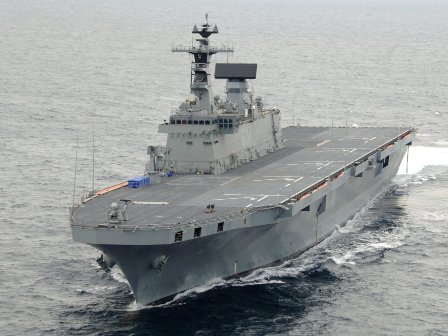
Description
The Dokdo-class, designated LPX, is a series of landing platform helicopter (LPH) amphibious assault ships operated by the Republic of Korea Navy. Developed by Hanjin Heavy Industries, the class originated from a requirement to establish blue-water naval capabilities and enhance amphibious assault and military operations other than war. The lead vessel, ROKS Dokdo, was commissioned in 2007, and the second, ROKS Marado, entered service in 2021.
The design utilizes stealth technologies and is based on an over-the-horizon assault doctrine. This concept facilitates landings using high-speed landing craft air cushion (LCAC) and helicopters from positions beyond the range of enemy detection. The ships feature a well deck to support Solgae-class LCACs and amphibious assault vehicles. The flight deck is coated with urethane to support vertical take-off and landing (VTOL) aircraft. While both ships share the same hull form, ROKS Marado features a flight deck adapted for the V-22 Osprey. ROKS Marado also utilizes different sensor and defensive suites, including EL/M-2248 and SPS-550K radars, along with Phalanx systems and K-VLS cells for K-SAAM. The lead ship, ROKS Dokdo, utilizes SMART-L and MW08 radars, Goalkeeper CIWS, and Rolling Airframe Missiles.
Operational aircraft consist primarily of UH-1H and UH-60P helicopters. Development of the KUH-Amphibious variant of the KAI Surion was initiated to provide a dedicated sea-based platform. In addition to amphibious warfare, the class is intended for disaster relief and UN peacekeeping operations. ROKS Dokdo provided search and rescue support following the sinking of ROKS Cheonan in 2010. The class conducts joint operations with the United States Navy, including LCAC integration. In November 2024, ROKS Dokdo served as a test platform for the Gray Eagle STOL unmanned aerial vehicle, which performed a takeoff and simulated landing approach. Although the operation of F-35B aircraft has been considered by the South Korean military, no official plans for such an acquisition have been confirmed.