Project 1241.1 Molnaya-class (Tarantul III)
Summary
| Origin country | 🇨🇳 Ex-USSR |
| Category | Corvette |
| Subtype | Missile corvette |
| Manufacturer | Vympel Shipyard |
| Year commissioned | 1977 |
| Approx. unit cost | $30 million |
| Units |
101 Malniya 825 Dimitrovgrad 855 Zarechnyy 870 Chuvashiya 874 Morshansk 916 R-29 921 R-20 924 R-14 937 R-18 940 R-11 946 R-24 951 R-297 953 Naberezhnye Chelny 955 R-60 971 R-298 978 R-19 991 R-261 NPR 188 Zborul NPR 189 Pescărușul NPR 190 Lăstunul |
Operators
Technical specifications
| Displacement | 549 tons |
| Range | 2400 km at 12 knots |
| Endurance | 10 |
| Crew | 50 members |
| Width | 10.5 m (34.4 ft) |
| Length | 56.0 m (183.7 ft) |
| Propulsion | 2 shaft COGAG turbines at 11,000 hp each, plus 2 cruising engines at 4,000 hp each |
| Thrust | 500 hp |
| Armament |
|
| Maximum speed | 42 knots |
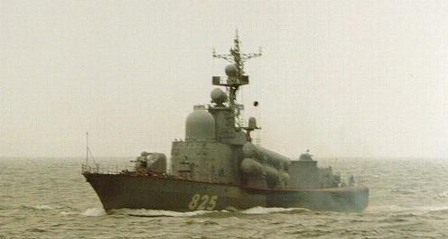
Description
Project 1241 Molniya, designated by NATO as the Tarantul class, is a series of Soviet and Russian missile corvettes. Designed in the late 1970s, the class was developed as a successor to the Project 205M Tsunami missile cutters. Development focused on providing a more seaworthy platform with higher-positioned air search radars and improved gun armament. Construction was centered at the Petrovsky, Rybinsk, and Ulis shipyards.
The initial variant, Project 1241.1, utilized a hull derived from the Pauk-class corvette and a COGOG propulsion system consisting of gas turbines for both cruising and high-speed operations. Its sensor suite included the Plank Shave radar for surveillance and target acquisition. An export version, Project 1241.RE, was distinguished by the relocation of the fire control radar to the mast and the use of the Garpun-Bal radar system.
The Project 12411 variant introduced a CODAG propulsion arrangement, combining cruise diesels with gas turbines. This version featured a redesigned superstructure and a straight lattice mast. Later developments, designated Project 1241.8 and 1242.1, integrated modern anti-ship missile systems and phased array radars. The Project 12418 variant, scheduled to enter service from 2025, utilizes CODAD propulsion and incorporates stealth-shaped turrets for its gun systems.
The class has been operated by numerous navies. The Indian Navy license-produced the design as the Veer-class, while Vietnam established a domestic production line for the Project 1241.8 variant with assistance from the Almaz Central Design Bureau. Following the dissolution of the Soviet Union, ships were distributed among successor states. In March 2014, Russian forces captured four Ukrainian vessels. During the conflict in 2024, the Russian Black Sea Fleet vessel Ivanovets was sunk by uncrewed naval drones.
Other operators have included the navies of Bulgaria, Poland, Romania, Yemen, Egypt, and Turkmenistan. The German Volksmarine operated five vessels; one was transferred to the United States Navy for evaluation and later served as a museum ship. Several decommissioned vessels are preserved as museums in Germany, India, and Russia.