Victor I-class (Project 671)
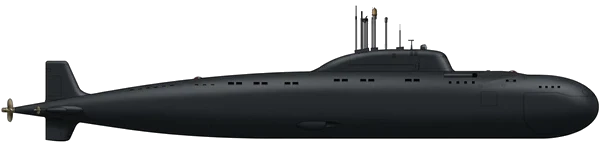
Soviet Project 671 Yorsh nuclear-powered attack submarine, first commissioned in 1967, with a teardrop hull and six 533 mm torpedo tubes; 15 were built. Key figures: displacement 3,500 tons, length 92 m, top speed 12 knots, crew 76, built 15. No longer in service; operated by 2 navies over its career.
| Subtype | Nuclear-powered attack submarine |
| Displacement | 3500 tons |
| Displacement submerged | 4700 tons |
| Crew | 76 members |
| Width | 10.6 m (34.8 ft) |
| Length | 92.5 m (303.5 ft) |
| Max. depth | 400 m (1312.3 ft) |
| Propulsion | 2 × VM-4 pressurised-water reactors (72 MW each), OK-300 plant, 31,000 shp, 1 shaft |
| Shaft power | 31,000 hp |
| Units | K-38, K-69 (K-369), K-147, K-53, K-306, K-323 (50 let SSSR), K-370, K-438, K-367, K-314, K-398, K-454, K-462, K-469, K-481 |
| Range | Unlimited, except by food supplies |
| Endurance | 60 days |
| Maximum speed | 12 knots |
| Max. speed submerged | 32 knots |
- 6 × 533 mm bow torpedo tubes
- 18 torpedoes: 53-65K, SET-65, TEST-71 (TEST-70 on Project 671M boats)
- 36 RM-2G Golets mines or 18 PMR-1, PMR-2, PMT-1 mines in place of torpedoes
- 81R Vyuga (SS-N-15) anti-submarine missiles on Project 671V boats
- 3K10 Granat (SS-N-21) cruise missiles on K-323 (Project 671K)

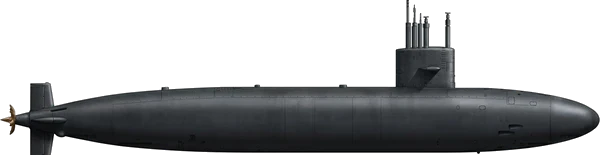
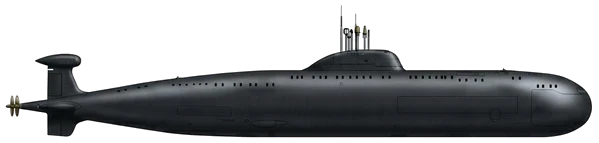
Description
The Victor I (Project 671 Yorsh) class was the first series of Soviet second-generation nuclear-powered attack submarines, designed by SKB-143, later the Malachite Marine Engineering Bureau. The design task was set on 3 November 1959 and the technical design approved on 4 March 1961. All 15 boats were built at Shipyard No. 196 Sudomekh in Leningrad, renamed the Novo-Admiralteysky Shipyard on 25 October 1966 and absorbed into the Leningrad Admiralty Association on 31 January 1972. The boats were laid down between 1963 and 1973 and commissioned between 1967 and 1974, beginning with the lead boat K-38 on 5 November 1967. The Victor I was followed in production by the Project 671RT Syomga (Victor II) and Project 671RTM/RTMK Shchuka (Victor III).
The hull is a teardrop body of revolution divided into seven compartments: torpedo room and accommodation, control room, reactor, turbines, auxiliary machinery, accommodation, and the electric motor and steering compartment. Propulsion consists of two VM-4 pressurised-water reactors of 72 MW thermal each within an OK-300 steam plant with four PG-4T steam generators, driving a single GTZA-615 geared turbine set of 31,000 shp on one shaft; K-462, K-469 and K-481 used a tandem propeller. Two PG-137 creep motors of 350 hp each turn vane-type propellers mounted on the stern planes. Electrical power comes from two 2,000 kW OK-2 turbogenerators and a 200 kW diesel generator; the Victor I was the first Soviet submarine with an alternating-current shipboard electrical network. The reactor core refuelling cycle was eight years. Operational diving depth is 320 m, with a maximum of 400 m.
Armament comprises six 533 mm bow torpedo tubes with 18 weapons — 53-65K, SET-65 and TEST-71 torpedoes — or 36 RM-2G Golets mines, or 18 PMR-1, PMR-2 or PMT-1 mines. Fire control is the Brest-671 system, with Ladoga-2 in some boats. Sensors include the MGK-300 Rubin sonar suite, the MG-509 Radian-1 mine-detection sonar, the RLK-101 Albatros radar, MRP-10 Zaliv-P ESM, the Sigma-671 navigation suite and the Molniya communications suite. Later refits fitted some boats with the MGK-400 Rubikon sonar and the MRK-50 Kaskad radar. Three boats — K-314, K-454 and K-469 — were modified to Project 671V with the Vyuga (81R, SS-N-15) anti-submarine missile and the Neva-2 fire-control system. K-323 was converted to Project 671K between 1984 and 1986 with the 3K10 Granat (SS-N-21) cruise missile system. K-398 and K-481 became Project 671M, adapted for the TEST-70 wire-guided torpedo.
All 15 boats initially served with the 3rd Submarine Division of the Soviet Northern Fleet; three were later transferred to the Pacific Fleet. On 21 March 1984 K-314 collided with the aircraft carrier USS Kitty Hawk (CV-63) in the Sea of Japan, neither vessel being seriously damaged. In September 1984 K-53 collided with the Soviet cargo ship Bratstvo in the Alboran Sea at the exit of the Strait of Gibraltar. The class was withdrawn between 1989 and 1997, and all boats were scrapped.
Frequently Asked Questions
What type of ship is the Victor I-class?
What is the displacement of the Victor I-class?
What is the maximum speed of the Victor I-class?
What is the range of the Victor I-class?
How many crew members serve on the Victor I-class?
How many Victor I-class ships have been built?
Which countries operate the Victor I-class?
- SEP 12026 Created Victor I-class submarine page created (specs, description, operators)