Victor III-class
Ex-USSR nuclear attack submarine, introduced in 1967, reached a submerged speed of 30 knots and had a 100-man crew. Key figures: displacement 6,990 tons, length 107 m, top speed 14 knots, crew 100, built 25. In service with 1 navy — Russia (2).
| Subtype | Nuclear-powered attack submarine |
| Displacement | 6990 tons |
| Displacement submerged | 7250 tons |
| Crew | 100 members |
| Width | 10.0 m (32.8 ft) |
| Length | 107.1 m (351.4 ft) |
| Max. depth | 400 m (1312.3 ft) |
| Propulsion | One VM-4P pressurized-water twin nuclear reactor (2x75 MW), 2 sets OK-300 steam turbines; 1 7-bladed or 2 4-bladed props; 31,000 shp (23,000 kW) at 290 shaft rpm |
| Range | Unlimited, except by food supplies |
| Endurance | 80 days |
| Maximum speed | 14 knots |
| Max. speed submerged | 30 knots |
- 2 bow torpedo tubes, 650 mm (6 weapons – Type 88R / SS-N-16 Stallion ASW missiles, Type 65-76 torpedoes)
- 4 bow torpedo tubes, 533 mm (18 weapons – Type 83RN / Type 53-65K / USET-80 torpedoes, Type 84RN / SS-N-15 Starfish ASW missiles, VA-111 Shkval rocket torpedoes, MG-74 Korund and Siren decoys, or up to 36 naval mines)
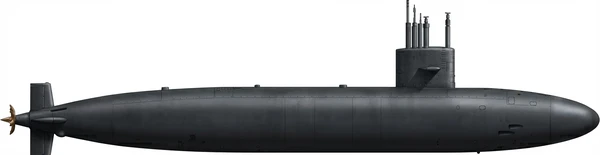
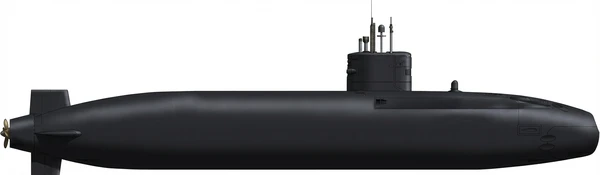
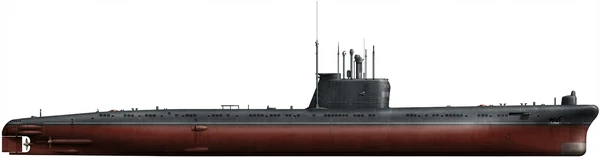
Description
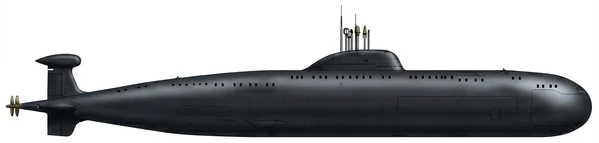
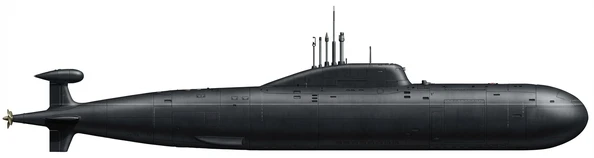
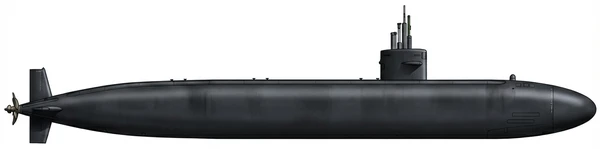
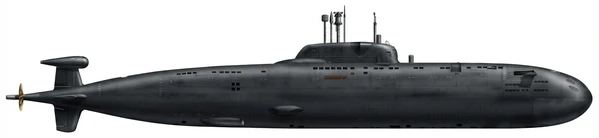
The Victor III, designated Project 671RTM/RTMK Shchuka, is a nuclear-powered attack submarine developed for the Soviet Navy. Part of the Project 671 series initiated in 1959 by SKB-143, the Victor III variant entered service in 1979. Production continued until 1991, with 25 units completed at the Sudomekh Shipyard.
The class features a teardrop hull design for speed and was designed to protect surface fleets and track ballistic missile submarines. The Victor III utilized acoustic quieting techniques, including raft mounting for machinery. A pod mounted on the vertical stern-plane serves as a hydrodynamic housing for a reelable towed passive sonar array, a system later integrated into the Sierra and Akula classes. Sensors include the MGK-503 Skat-KS sonar suite with active, passive, and flank arrays, alongside active ice avoidance sonar. Navigation and electronic warfare equipment include the MRK-50 Albatros-series radar and Zaliv-P/Buleva intercept systems. Late production models received further acoustic modifications.
Following the dissolution of the Soviet Union, the vessels transitioned to the Russian Navy. While 21 units of the Victor III class have been disposed of, two remain in service with the Northern Fleet: B-138 Obninsk and B-448 Tambov. The latter returned to active status following a refit completed between 2022 and 2023.
Operational records include several maritime encounters and technical incidents. In 1981, K-324 collided with USS Drum in Peter the Great Bay. In October 1983, K-324 became entangled with the towed array of the frigate USS McCloy west of Bermuda, which forced the submarine to surface. In March 1984, K-314 collided with the aircraft carrier USS Kitty Hawk in the Sea of Japan. In September 2006, the Daniil Moskovskiy experienced an electronics fire while operating in the Barents Sea, resulting in two crew fatalities. That vessel was formally decommissioned in October 2022.
Frequently Asked Questions
What type of ship is the Victor III-class?
What is the displacement of the Victor III-class?
What is the maximum speed of the Victor III-class?
What is the range of the Victor III-class?
How many crew members serve on the Victor III-class?
How many Victor III-class ships have been built?
Which countries operate the Victor III-class?
- SEP 12026 Updated Hulls built corrected to the Project 671RTM run rather than the whole Victor family
- SEP 12026 Updated Service-entry year corrected to the lead boat of the Project 671RTM variant rather than the first Victor
- AUG 62026 Updated Summary text updated
- JUL 242026 Updated Type updated
- APR 72026 Updated Description updated in a site-wide editorial pass
- JAN 242026 Updated Range added; max speed updated
- JAN 182026 Updated Units added; displacement, submerged displacement and 5 more fields updated