Yankee Notch-class
Russian ballistic missile submarine, introduced in 1967, displaced 7,700 tons. Key figures: displacement 7,700 tons, length 142 m, top speed 13 knots, crew 120, built 3. No longer in service; operated by 1 navy over its career.
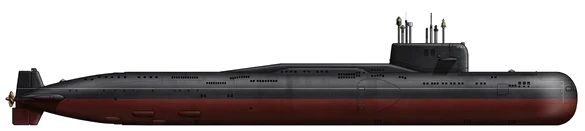
| Subtype | Nuclear-powered cruise missile submarine |
| Displacement | 7700 tons |
| Displacement submerged | 11500 tons |
| Crew | 120 members |
| Width | 11.7 m (38.4 ft) |
| Length | 141.5 m (464.2 ft) |
| Max. depth | 400 m (1312.3 ft) |
| Propulsion | two VM-4 pressurized water cooled reactors powering four steam turbines driving two shafts |
| Units | K-423, K-253, K-395 |
| Range | Unlimited, except by food supplies |
| Maximum speed | 13 knots |
| Max. speed submerged | 27 knots |
- 32–40 x RK-55 Granat (SS-N-21 Sampson) cruise missiles, tube-launched
- 4 x 533 mm and 2 x 400 mm bow torpedo tubes
- 8 x 533 mm torpedo tubes in the inserted waist section

Description
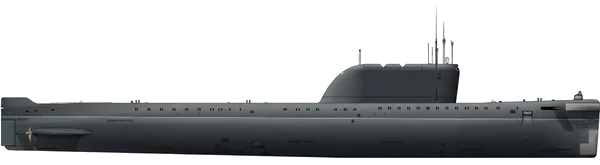
The Yankee Notch, designated Project 667AT Grusha, is a modified variant of the Soviet Project 667A nuclear-powered submarine. The conversion program began in the 1980s, with the first unit entering service in 1987. Three submarines were completed to this specification, while four additional units remained unfinished.
Design characteristics of the Yankee Notch involved structural alterations to the baseline Project 667A hull. The modification process required lengthening the vessel and installing additional torpedo tubes in the waist area. These changes shifted the submarine's classification from a ballistic missile carrier to a guided missile submarine (SSGN) or attack submarine (SSN). The primary armament for this variant was the RK-55 Granat cruise missile, identified by the NATO reporting name SS-N-21 Sampson.
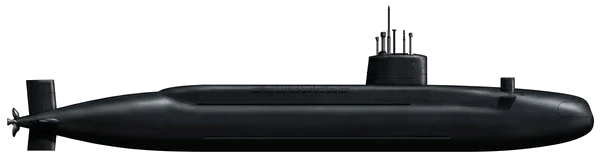
The operational history of the Yankee Notch followed the deployment patterns of the broader Yankee class, which maintained a presence in the Atlantic, Pacific, and Arctic Oceans. These vessels were part of the Soviet naval force until the implementation of international arms control agreements. Under the terms of the SALT I, START I, and START II treaties, the Yankee Notch units were disarmed and decommissioned. All completed vessels were subsequently transferred to nuclear ship scrapyards for disposal.
Frequently Asked Questions
What type of ship is the Yankee Notch-class?
What is the displacement of the Yankee Notch-class?
What is the maximum speed of the Yankee Notch-class?
What is the range of the Yankee Notch-class?
How many crew members serve on the Yankee Notch-class?
How many Yankee Notch-class ships have been built?
Which countries operate the Yankee Notch-class?
- SEP 12026 Updated Specifications rescoped to the Project 667AT conversion: hulls, length, displacement, armament and type
- SEP 12026 Updated Service-entry year corrected to the first Project 667AT conversion rather than the original Yankee I commissioning
- JUL 242026 Updated Type updated
- APR 72026 Updated Description updated in a site-wide editorial pass
- JAN 182026 Updated Type, manufacturer and 8 more fields updated