CV-90
Summary
| Origin country | 🇸🇪 Sweden |
| Category | Armored Personnel Carrier |
| Sub-type | Infantry Fighting Vehicle |
| Manufacturer | Bofors |
| Number built | None units |
| Est. avg unit price | $10 million |
Technical specifications
| Crew | 3 personnels |
| Range | 560 km |
| Mass | 26.0 tons |
| Height | 2.5 m (8.2 ft) |
| Width | 3.19 m (10.5 ft) |
| Length | 6.47 m (21.2 ft) |
| Max. speed | 70 km/h (43 mph) |
| Engine | Scania DSI 14 Diesel Engine with 550 hp |
| Weapon 1 | 1 Bofors 30mm (400 shells) gun |
| Weapon 2 | 1 Bofors 7.5mm machine gun (2100 rounds) |
Historical operators
Profile of CV-90
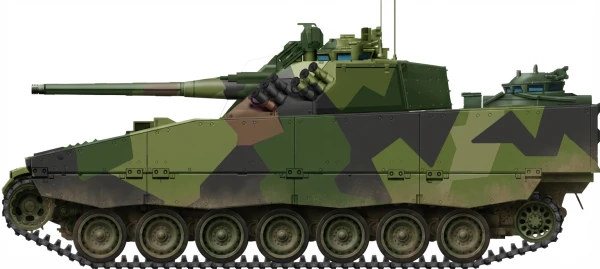
Description
The Combat Vehicle 90 (CV90) is a family of Swedish tracked armored combat vehicles developed by the Swedish Defence Materiel Administration (FMV), Hägglunds, and Bofors. Development commenced in the mid-1980s to fulfill a Swedish Army requirement for a highly mobile vehicle with anti-tank and air defense capabilities suitable for Nordic subarctic conditions. Prototypes were ordered in 1986 and underwent trials from 1988 to 1991. The CV90 entered service in 1994, and the platform has evolved through successive generations designated Mk 0 to Mk IV.
The vehicle is designed with a low profile to reduce radar and infrared signatures. Armor protection includes a frontal arc resistant to 30mm APFSDS rounds and all-round protection against 14.5mm armor-piercing rounds. Interior surfaces feature spall liners to protect occupants from shrapnel. Protection can be augmented with ceramic appliqué armor, cage armor for shaped-charge threats, and active protection systems such as Iron Fist. The CV90 incorporates nuclear, biological, and chemical (NBC) filtration alongside chemical and radiation detectors. Heat-absorbing filters are utilized to manage thermal signatures.
Armament configurations vary across variants. The Swedish strf 9040 is equipped with a 40mm Bofors L/70 autocannon. Export versions, such as the Mk I through Mk IV, typically employ 30mm or 35mm Bushmaster autocannons. Other configurations include 120mm twin mortars, 105mm or 120mm tank guns, and integrated Spike LR anti-tank guided missiles. The Mk IV version introduces the iFighting augmented reality system to assist crew decision-making. Mobility is provided by Scania diesel engines and a suspension system that utilizes either torsion bars or active damping technology to maintain chassis stability during cross-country movement.
The CV90 is operated by several nations, including Sweden, Norway, Switzerland, Finland, the Netherlands, Denmark, and Estonia. It has also been ordered for the armed forces of the Czech Republic and Slovakia. The vehicle saw its first combat deployment in 2004 with Swedish United Nations forces in Liberia. Norwegian CV90s were engaged in heavy combat in Afghanistan starting in 2007 during Operation Harekate Yolo and Operation Karez. Danish variants were also deployed to Afghanistan in 2010. During the Russo-Ukrainian war, CV9040C vehicles were transferred to Ukraine and saw action in 2023 and 2024, including engagements near Bakhmut and Vovchansk. Specialized variants in service include forward command, artillery observation, armored recovery, and anti-aircraft models.