CV-90 vs M2 Bradley
CV-90 vs M2 Bradley at a glance — weight 26,000 vs 22,940 kg, top speed 70 vs 66 km/h, range 560 vs 483 km, crew 3 vs 3.
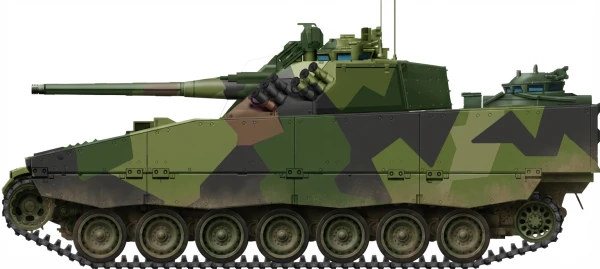
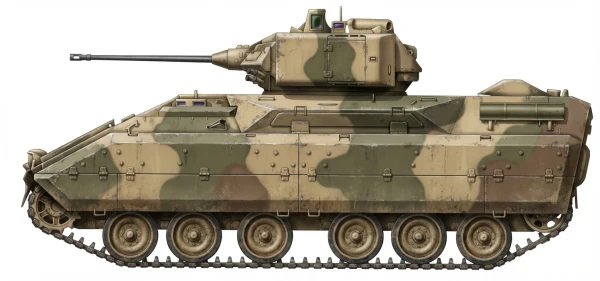
| CV-90 | M2 Bradley | |
|---|---|---|
| Origin country | 🇸🇪 Sweden | 🇺🇸 United States |
| Category | Infantry Fighting Vehicle | Infantry Fighting Vehicle |
| Type | Infantry Fighting Vehicle | Infantry Fighting Vehicle |
| Manufacturer | Bofors | FMC |
| Number produced | 1,400 units | 6,800 units |
| Estimated unit price | $10 million | $4.4 million |
| Combat weight | 26.0 tons | 22.9 tons |
| Maximum speed | 70 km/h | 66 km/h |
| Operational range | 560 km | 483 km |
| Length | 6.47 m | 6.55 m |
| Width | 3.19 m | 3.60 m |
| Height | 2.50 m | 2.57 m |
| Crew | 3 | 3 |
| CV-90 | M2 Bradley | |
|---|---|---|
| Main armament | 1 Bofors 30mm (400 shells) gun | 1 M242 Bushmaster 25mm gun |
| Secondary weapon | 1 Bofors 7.5mm machine gun (2100 rounds) | 1 TOW 2 double anti-tank launcher |
| Engine | Scania DSI 14 Diesel Engine with 550 hp | Cummins VTA-903T V8 Turbo-Diesel Engine with 500 hp |
Detailed Comparison
The Swedish CV90 and American M2/M3 Bradley function as primary Infantry Fighting Vehicles (IFVs) for their respective user nations. While both platforms provide mechanized infantry support and anti-armor capabilities, the CV90 emerged from a mid-1980s requirement for Nordic subarctic operations, whereas the Bradley entered service in 1981 specifically to counter Soviet BMP series vehicles and operate alongside the M1 Abrams main battle tank.
Development and Design
The M2 Bradley utilizes a welded aluminum monocoque chassis developed by FMC to replace the M113. Design priorities focused on maintaining formation speed with main battle tanks and survivability against overmatch threats. Over 6,800 units were produced. Conversely, the CV90 family, developed by Hägglunds and Bofors, emphasizes a low radar and infrared profile to minimize detection. Entering service in 1994, the Swedish platform incorporates nuclear, biological, and chemical (NBC) filtration and heat-absorbing filters. Later CV90 iterations (Mk I–IV) integrate digital systems like the iFighting augmented reality aid, paralleling the Bradley's M2A3 upgrades which added a Commander’s Independent Viewer for hunter-killer operations.
Protection and Firepower
The Bradley mounts an M242 25mm chain gun and a coaxial 7.62mm machine gun. Its distinct anti-armor capability comes from the integrated TOW 2 missile launcher, allowing engagement of heavy armor. Protection evolved from spaced laminate armor to steel appliqué and reactive armor brackets on the M2A2/A3. The CV90 typically fields larger caliber autocannons; while the Swedish Strf 9040 uses a 40mm Bofors L/70, the provided specifications list a Bofors 30mm gun. The CV90 frontal arc withstands 30mm APFSDS rounds, with all-round resistance to 14.5mm fire. Both vehicles support active protection systems like Iron Fist in modern variants to counter shaped-charge threats.
Mobility and Logistics
The CV90 utilizes a Scania DSI 14 diesel engine (550 hp) to drive a 26.0-ton chassis, achieving a top speed of 70.0 km/h and a range of 560 km. Its suspension options include active damping for stability in cross-country movement. The lighter 22.94-ton Bradley runs on a 500 hp Cummins VTA-903T, reaching 66.0 km/h with a 483 km range. The Bradley's torsion bar suspension and drivetrain received upgrades in the M2A4 variant to manage weight increases from armor packages. The CV90 was specifically designed for subarctic conditions, prioritizing floatation over snow and soft terrain.
Deployment and Combat Record
The Bradley saw extensive use in the Gulf War, destroying more Iraqi armored vehicles than the M1 Abrams, and later in Iraq and Ukraine. Ukrainian reports cite successful engagements against T-90M and T-72 tanks, crediting crew survival to Western armor standards. The CV90 first deployed with Swedish UN forces in Liberia (2004) and saw heavy combat with Norwegian and Danish forces in Afghanistan (2007, 2010). Both platforms operate in the Russo-Ukrainian war, with CV9040C and M2 variants utilized for maneuvers near Bakhmut and Vovchansk.
Conclusion
The M2/M3 Bradley provides an integrated anti-tank missile capability standard on the chassis, offering immediate heavy armor defeat options for mechanized infantry. The CV90 prioritizes larger caliber direct-fire support and higher mobility parameters suited for soft ground. Both designs have proven adaptable, receiving iterative updates to sensors and armor that maintain their utility in modern high-intensity conflict.