GlobalMilitary.net Open-source military intelligence Updated daily
Europe ยท Tallinn

Estonia Military Forces

Open-source order of battle for 2026: 7,100 active troops, 5 aircraft, 8 warships.

World rank #126 Military index 15.0/100
Map of Estonia Flag of Estonia
Active troops
7K
Reserve troops
41K
Defense budget
$1.5B2025
Share of GDP
3.4%
Population
1.4M2024

Armed Forces in 2026

Domain Strength Composition
Air Force 5 aircraft 1 air bases
Estonian Navy 8 warships
Personnel 7,100 active 41,200 reserve 18,000 paramilitary

ARMS Index (Aggregate Rating of Military Strength)

Full ranking โ†’
Score & Pillar Breakdown World #126
15.0/ 100
Estonia ranks #126 of 175 in the ARMS Index (Aggregate Rating of Military Strength) with a score of 15.0/100. The ARMS Index scores Estonia's overall capability on a 0โ€“100 scale from verifiable data across six pillars: manpower, ground forces, naval power, air power, nuclear deterrent and defense budget, with a readiness modifier derived from budget per soldier.
Pillar Weight Score Basis
Manpower 15% 56.1 Active, reserve & paramilitary personnel
Ground forces 20% 0.0 Tanks, armor & artillery weighted by type
Naval power 20% 10.3 Weighted by hull type: carrier tiers, nuclear vs conventional submarines
Air power 25% 6.4 Weighted by aircraft type and fleet age
Nuclear deterrent 10% 0.0 No declared nuclear capability
Defense budget 10% 36.3 Annual spending, purchasing-power adjusted
Readiness modifier ×1.12 Budget per soldier: proxy for training, maintenance & technology

Country File

Defense Statistics & Key Metrics
Population1.4M (2024)
GDP$43.1 billion (2024)
GDP per capita$31,428
Military budget$1.5B (2025)
Share of GDP3.4% (2025)
Military spending per capita$1,069 (2025)
Inflation rate3.52% (2024)
Military Budget History CIA World Factbook
2021 โ€” $0.7B, 2.00% of GDP $0.7B 2021 2022 โ€” $0.8B, 2.20% of GDP $0.8B 2022 2023 โ€” $1.2B, 3.00% of GDP $1.2B 2023 2024 โ€” $1.5B, 3.40% of GDP $1.5B 2024 2025 โ€” $1.5B, 3.40% of GDP $1.5B 2025
Budget (US$) Share of GDP (0-5%)
Geography
CapitalTallinn
RegionEurope
Land area42,388 kmยฒ
Coastline3,794 km
Land borders633 km
Bordering countries2
CurrencyEUR
National Flag Adopted 1990
Flag of Estonia
Aspect ratio7:11
ColorsBlue, white, black
Compare this Country
๐Ÿ‡ช๐Ÿ‡ช Estonia vs

Strategic Overview in 2026

Strategic Position

Estoniaโ€™s defense posture is defined by its location on the eastern flank of NATO, sharing a 294-kilometer land border with the Russian Federation. The state operates under a "Total Defense" doctrine, which integrates military response with civilian readiness and psychological endurance to deter external aggression.

Estonia has been a member of NATO and the European Union since 2004. It participates in the UK-led Joint Expeditionary Force (JEF) and maintains a defense cooperation agreement with the United States. Regional security is coordinated through the Baltic Defense College and joint procurement initiatives with Latvia and Lithuania. The presence of the NATO Enhanced Forward Presence (eFP) Battlegroup, led by the United Kingdom and supported by France, provides a permanent rotational allied presence. In 2025, defense planning emphasizes the transition from a tripwire force to a forward defense model, intended to contest territory from the onset of hostilities.

Military Forces

The Estonian Defence Forces (EDF) consist of the Land Forces, Navy, and Air Force, supported by the Estonian Defence League, a voluntary paramilitary organization. The command structure is centralized under the Headquarters of the Estonian Defence Forces.

Personnel The EDF maintains approximately 7,500 active-duty personnel. The force structure relies on a conscription model, generating a wartime reserve of approximately 44,000 personnel. The Estonian Defence League provides an additional 20,000 volunteers trained for territorial defense and asymmetric warfare.

Land Forces The Land Forces are organized into the 1st and 2nd Infantry Brigades, plus a recently established national division structure designed to integrate domestic and allied units. Primary maneuver elements operate CV9035 infantry fighting vehicles and K9 Thunder self-propelled howitzers. Armored transport is provided by Sisu XA-188 and XA-180 wheeled personnel carriers. Anti-armor capabilities are centered on Javelin and Spike missile systems. Long-range strike capabilities are provided by HIMARS rocket artillery.

Navy The Estonian Navy focuses on mine countermeasures and maritime situational awareness. It operates Sandown-class minehunters and various patrol craft. The service is integrating the Blue Spear land-to-sea missile system to establish coastal defense and sea-denial capabilities in the Baltic Sea.

Air Force The Air Force manages national airspace surveillance and the ร„mari Air Base, which hosts NATO Baltic Air Policing detachments. It operates L-39 Albatros jet trainers and M-28 Skytruck transport aircraft. Estonia does not operate supersonic fighter aircraft, relying on NATO allies for air superiority missions.

Specialized Capabilities The Cyber Command conducts operations in the digital domain and supports the EDF's communication infrastructure. Estonia also hosts the NATO Cooperative Cyber Defence Centre of Excellence (CCDCOE) in Tallinn. The Special Operations Forces (EOG) focus on unconventional warfare and reconnaissance.

Defense Industry

The domestic defense industry focuses on autonomous systems, surveillance, and cyber security. Milrem Robotics is the primary manufacturer, producing the THeMIS unmanned ground vehicle (UGV), which is exported to multiple NATO members. Threod Systems develops and manufactures tactical unmanned aerial vehicles (UAVs) for ISR (Intelligence, Surveillance, and Reconnaissance) missions.

Estonia remains dependent on foreign imports for heavy equipment, including armored vehicles, artillery, and air defense systems. Procurement is frequently conducted through joint tenders with other Baltic or Nordic states to achieve economies of scale.

Strategic Trends

Defense spending in Estonia reached approximately 3.4% of GDP in 2025, driven by regional security shifts. Procurement priorities focus on three areas: medium-range air defense, long-range indirect fire, and maritime sea denial. The acquisition of the IRIS-T SLM air defense system from Germany represents a shift toward addressing high-altitude and cruise missile threats.

The EDF is undergoing a structural transition to a division-level command, allowing for better synchronization of artillery, intelligence, and logistics with NATOโ€™s regional defense plans. Infrastructure expansion includes the enlargement of the Nursipalu training area to accommodate increased live-fire exercises and allied deployments. A persistent challenge is the demographic constraint on personnel numbers, which the state addresses through increased investment in automated systems and high-technology force multipliers.

In the News

All news โ†’
Illustration
AUG 15, 2026

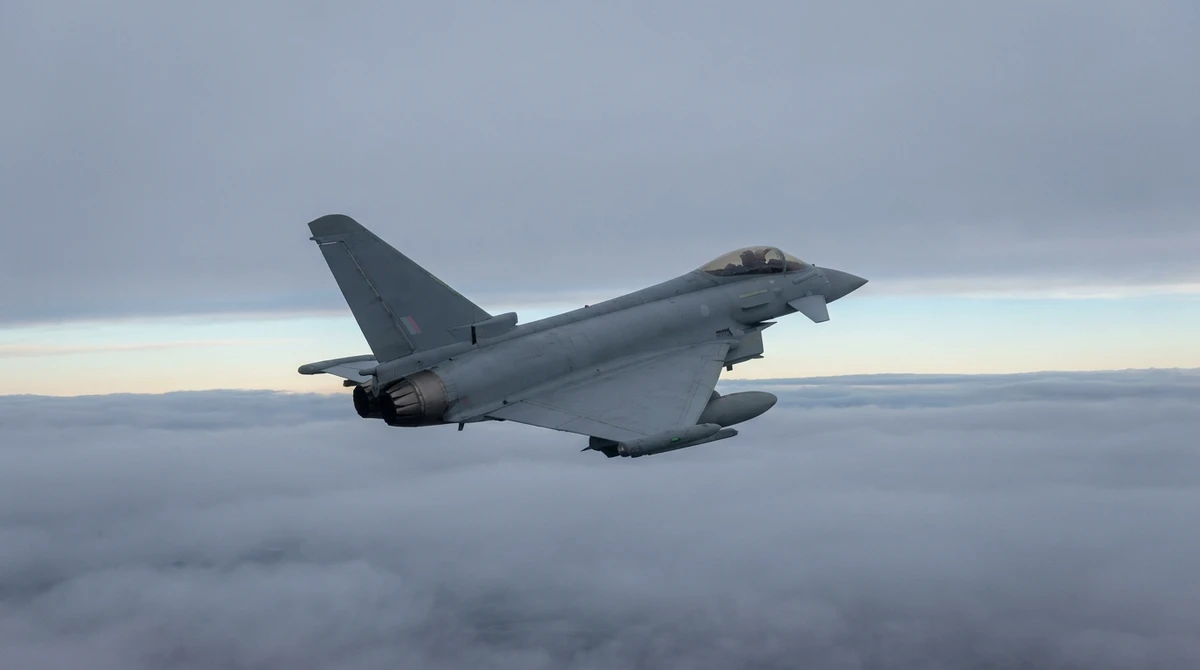
NATO Jets Down a Drone Over Latvia in the Baltic Mission's Second Shootdown of 2026

An Italian Eurofighter on NATO Baltic Air Policing duty destroyed an unidentified drone over eastern Latvia before dawn on 14 August, the second time the alliance's quick-reaction force has shot one down over the country this year.

๐Ÿ‡ช๐Ÿ‡ช ๐Ÿ‡ฎ๐Ÿ‡น ๐Ÿ‡ฑ๐Ÿ‡น ๐Ÿ‡ฑ๐Ÿ‡ป ๐Ÿ‡ท๐Ÿ‡ด

Frequently Asked Questions

How large is Estonia's military?
Estonia has 7,100 active military personnel with an additional 41,200 in reserve. This includes army, navy, and air force service members.
What is Estonia's defense budget?
Estonia's annual defense budget is approximately $1.5 billion. This covers personnel costs, equipment procurement, operations, and maintenance of military forces.
How does Estonia rank militarily in the world?
Estonia ranks #126 globally on the ARMS Index with a score of 15.0 out of 100. This composite index measures military capability across manpower, ground forces, naval power, air power, nuclear deterrent, and defense budget, adjusted for equipment quality and readiness.
Does Estonia have nuclear weapons?
No, Estonia does not possess nuclear weapons and is a non-nuclear weapon state.
How many aircraft does Estonia's air force have?
Estonia operates 5 military aircraft. The fleet includes fighters, transport planes, helicopters, and training aircraft.
How large is Estonia's navy?
Estonia's navy operates 8 vessels. The fleet includes surface combatants, support ships, and coastal patrol craft.
What percentage of GDP does Estonia spend on defense?
Estonia spends approximately 3.4% of its GDP on defense. This meets the NATO target of 2% of GDP.
What is Estonia's military personnel per capita?
Estonia has approximately 5.2 active military personnel per 1,000 citizens. This ratio reflects the country's military manpower relative to its population of 1,372,341.
Does Estonia have paramilitary forces?
Yes, Estonia maintains 18,000 paramilitary personnel. These forces typically include gendarmerie, border guards, coast guard, and internal security troops that supplement regular military capabilities.
Population, GDP, Inflation and Personnel: World Bank.
Military Expenditure: CIA World Factbook. Last updated on 4 August 2026. Suggest a change
Latest Data Updates
  1. AUG 42026 Updated Global Military Index updated in a site-wide editorial pass
  2. AUG 32026 Updated Global Military Index updated
  3. JUL 162026 Updated Global Military Index updated in a site-wide editorial pass
  4. JUN 162026 Updated Yearly statistics, military spending and 2 more fields updated
  5. APR 82026 Updated Paramilitary personnel updated
  6. MAR 172026 Updated Paramilitary personnel added
  7. MAR 162026 Updated Reserve personnel updated