Gulfport Combat Readiness Training Center
Gulfport Combat Readiness Training Center (ICAO KGPT) is an active joint civil-military airfield in Mississippi, United States, operated by the US Air National Guard. It has 2 runways (longest 2,744 m). Home to the 255th Air Control Squadron, the 209th Civil Engineer Squadron, the 1108 Theater Aviation Sustainment Maintenance Group.
Facility Details
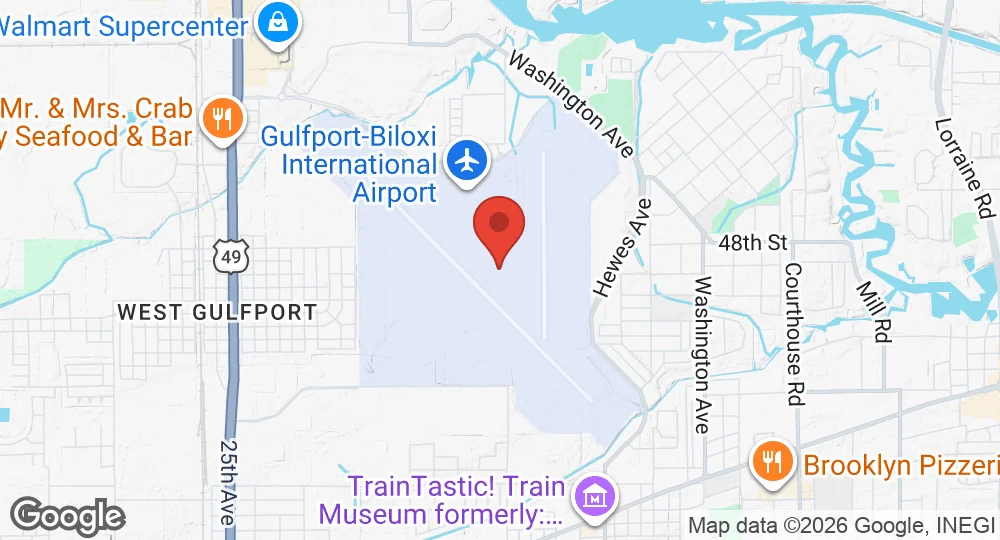
30.4072°N, 89.0700°W · 9 m elevation
| Operating Country | 🇺🇸 United States |
| Location | 🇺🇸 United States |
| Status | Active |
| Usage | Dual |
| Year built | 1942 |
| Operating Organization | US Air National Guard |
| Units |
255th Air Control Squadron209th Civil Engineer Squadron1108 Theater Aviation Sustainment Maintenance Group
|
| Elevation | 9 m (30 ft) |
| IATA code | GPT |
| ICAO code | KGPT |
| Runways |
14/32 · 2,744 m (9,003 ft) · Asphalt/Concrete18/36 · 1,504 m (4,934 ft) · Asphalt
|
| Website | www.gulfportcrtc.ang.af.mil// |
- 14 km Keesler Air Force Base 81st Training Wing
- 113 km Naval Air Station Joint Reserve Base New Orleans Fighter Squadron Composite 204 (VFC-204)
- 168 km Naval Air Station Pensacola Training Air Wing Six
- 199 km Naval Air Station Whiting Field Training Air Wing Five
- 216 km Key Field Air National Guard Base 186th Air Refueling Wing
- 228 km Hurlburt Field Headquarters Air Force Special Operations Command
 255th Air Control Squadron
 209th Civil Engineer Squadron
Description
Gulfport Combat Readiness Training Center is situated five miles north-northeast of Gulfport, Mississippi, and shares facilities with the Gulfport-Biloxi International Airport. Established in 1942 as Gulfport Army Airfield, the site originally served as a training base for the Air Corps Flying Training Command. During World War II, the facility conducted technical training and functioned as a replacement training site for B-17 Flying Fortress and B-24 Liberator units, as well as B-29 Superfortress aircrew transition training. Following a period in reserve status starting in 1946 and conveyance to the City of Gulfport in 1949, the site was reactivated in 1951 as Gulfport Air Force Base. It served as the headquarters for the Technical Training Air Force until 1958, when the installation was transferred to the Mississippi Air National Guard.
The U.S. Air Force operates the center under the control of the Mississippi Air National Guard. The installation hosts deployments for Air National Guard and Air Force Reserve Command units. Stationed tenant units include the 255th Air Control Squadron, which provides Ground Control Intercept and air control capabilities, and the 209th Civil Engineer Squadron. The 209th is a geographically separated unit of the 172nd Airlift Wing and falls under Air Force Special Operations Command when activated. It maintains a Rapid Runway Repair site and a fire training facility. The 1108th Theater Aviation Sustainment Maintenance Group of the Mississippi Army National Guard is co-located at the facility and operates an aviation maintenance depot for combat and transport helicopters.
The center utilizes instrumented offshore airspace for air-to-air engagement recording and integrates with an air-to-ground range at nearby Camp Shelby for ground attack training. All ranges and drop zones are managed via the Air Combat Training System, which provides electronic threat and scoring capabilities. Infrastructure includes housing for approximately 1,000 personnel. The flight line ramp space is configured to support various aircraft types, including heavy transport aircraft, tankers, and squadrons of fighter aircraft.
- AUG 132026 Updated Runway designations, surfaces and lengths recorded
- APR 112026 Updated Description updated in a site-wide editorial pass
- JAN 122026 Updated Sources and cross-references refreshed
- JUL 12025 Updated Airbase data reviewed and updated